J-2 status - dependents of a J-1 exchange visitor
8 mins read | Nov 9, 2026
TWO ROUTES, TWO TIMELINES
Contributor
Tukki
Reading time
8 mins read
Date published
Sep 30, 2026
Two candidates are equally qualified. One is in the United States on F-1 OPT that runs to July, the other is in Bangalore and has never held a U.S. visa. Your hiring manager wants a start date for both by the end of the month.
Consular processing vs change of status is the question underneath that request. Both routes share one petition, then split: one finishes inside the country with USCIS, the other at a consulate and a port of entry where the company holds no lever.
Talk to an immigration attorney about the route your next hire should take
The route follows the person: a candidate already inside the country in valid nonimmigrant status changes status without leaving. A candidate abroad, or one who plans to travel first, applies for a visa at a consulate and then enters.
For the petition-based categories most employers use, the H-1B and the L-1 among them, hiring foreign workers in the U.S. begins with the same Form I-129 either way. The employer elects the outcome on the form.
A few categories skip the petition when the candidate applies from abroad, among them the H-1B1 for Chileans and Singaporeans and the TN for Canadians and Mexicans. Our types of U.S. work visas overview sets out which is which.
| Change of status | Consular processing | |
|---|---|---|
| Who it fits | Candidate is in the United States in valid status and stays here | Candidate is abroad, or will travel before starting |
| What the employer files | Form I-129 with the change of status election | Form I-129 with consular notification |
| Steps after approval | None. Status changes on the requested date | Form DS-160, visa fee, biometrics, interview, issuance, travel, CBP inspection |
| Legs the employer controls | Labor Condition Application, petition preparation, filing, premium processing | Labor Condition Application, petition preparation, filing, premium processing. Nothing after approval |
| Legs the employer does not control | USCIS adjudication speed, unless premium processing is added | Appointment availability, 221(g) administrative processing, visa issuance, admission at the port of entry |
| Added cost beyond the petition | Optional premium processing on Form I-907 | Visa application fee, any issuance fee under the reciprocity schedule, travel, plus optional premium processing |
| Earliest realistic start | The requested start date on the petition, if approval lands by then | After the visa is issued, the candidate travels, and CBP admits them |
| Does the candidate end up with a visa | No. A future entry still needs one | Yes. The visa is in the passport on arrival |
Companies hiring foreign workers in the U.S. for the first time should start with visa sponsorship and how to sponsor a foreign worker.
A change of status moves someone already in the country from one nonimmigrant classification to another without leaving. USCIS decides it on the same Form I-129 the employer files for the job.
Under 8 CFR 248.1, USCIS will not approve a change for someone who failed to maintain the previously accorded status, or whose status expired before the application was filed. A narrow exception covers extraordinary circumstances beyond the applicant's control.
For most categories the candidate cannot start before approval, because the new status begins on the day USCIS grants it.
H-1B portability is the exception employers meet most often. USCIS states that a worker already in H-1B status may begin with a new employer as soon as that employer properly files a non-frivolous Form I-129. The authorization then runs until the petition is decided.
Our attorneys recommend setting the start date after the approval notice even where portability allows an earlier one. A denial once the person has started leaves payroll to unwind and the employee out of status. Where the business genuinely cannot wait, premium processing narrows that gap. Our H-1B transfer walkthrough covers what a portability filing carries.
How recently the candidate entered the country matters as well. A change of status filed days after admission, particularly from a visitor category, raises a question about what the person intended at the border.
The USCIS Policy Manual states that conduct inconsistent with a nonimmigrant status does not automatically mean there was a misrepresentation. It adds that such evidence weighs more heavily where the conduct came shortly after the visa interview or the admission.
A candidate on F-1 OPT keeps working on that authorization until the H-1B start date.
Consular processing is the route for a candidate outside the country: USCIS approves the petition, notifies the post, and the candidate applies there for the visa. The employer's direct involvement ends with the approval notice.
Send the candidate our Form DS-160 walkthrough, visa interview tips and interview risk factors before step 2.

Change of status vs consular processing is where a shared timeline splits. The first three legs are identical: the Labor Condition Application certified by DOL, the petition prepared by the employer and counsel, then USCIS adjudication of the Form I-129. The employer controls the first two, and premium processing is the only lever on the third.
Everything after approval separates the routes and shifts the control. Read every figure below as covering only its own leg, since an adjudication window is not the time to a start date.
| Leg after approval | Change of status | Consular processing | Who controls it |
|---|---|---|---|
| What happens on approval | Status changes on the requested date, with nothing further to do | Consular notification issues and the candidate's own steps begin | Split |
| Form DS-160 and the visa fee | Nothing to file | Candidate, usually days | Candidate |
| Interview appointment | No interview to book | Depends entirely on the post, so look it up | Consulate |
| Interview and issuance | Not applicable | A decision at the window, or 221(g) administrative processing with no committed timeline | Consular officer |
| Travel and admission | Not required before work begins | Passport return, flights, then a decision on arrival | Candidate, then CBP |
Visa interview appointment wait times move and they differ sharply by post, so look them up rather than assuming. The Department of State publishes a visa appointment wait times tool: select the post the candidate will use, read the nonimmigrant category, and note the figure. Refreshed monthly, in half-month or full-month increments.
The two routes cost close to the same, because the petition is the same filing with the same fees either way. The consular route adds the visa application fee and the travel, and that is the whole difference.
Current as of October 2026:
| Cost item | Amount | Applies to |
|---|---|---|
| Form I-129 filing fee, H classification | $780, or $460 for a petitioner with 25 or fewer full-time employees | Both routes |
| Asylum Program Fee | $600, $300 at that employer size, $0 for nonprofits | Both routes |
| ACWIA fee, Fraud Prevention and Detection Fee, 9-11 Response and Biometric Entry-Exit Fee | Set by classification and employer size, as our guide to Form I-129 sets out | H-1B and L-1 petitions |
| Premium processing on Form I-907 | $2,965 on the current schedule | Optional, on either route |
| Visa application fee | $205 for petition-based categories including H, L, O, P, Q and R | Consular route only |
| Visa issuance fee | Set by the reciprocity schedule for the candidate's nationality, so two hires in the same role can face different totals | Consular route only |
| Form DS-160, travel to the post, flights to the United States | Varies | Consular route only |
The figures above hold until October 16, 2026. On that date an inflation adjustment to several immigration fees takes effect, and USCIS rejects a filing postmarked on or after it that still carries the old amount. Read the fee schedule on the day you file rather than the day you budget.
Premium processing buys a date rather than an outcome, and it attaches to the Form I-129 on either election. USCIS commits to adjudicative action within 15 business days for most I-129 classifications. The clock starts when a properly completed Form I-907 reaches the correct filing address, and USCIS refunds the fee if it misses the window.
It earns that fee in specific situations: a cap-exempt hire with a fixed project start, an incumbent whose status expires soon, or a consular interview booked around the approval notice. Where the start date is months out and nothing expires, the same approval arrives without it.
Our premium processing and Form I-907 posts cover the mechanics.
Change of status vs consular processing carries a different rule on each side.
Travel while the case is pending. Departure abandons a pending change of status, and the case converts to a consular one. Our post on travel while a petition is pending covers the trip that cannot be moved.
A denied change of status. The candidate falls back to the status they held before, if it is still valid. The petition can still be approved for consular processing, so the person leaves, applies at a post and enters on the new visa.
221(g) administrative processing. The officer holds the case open for further review after the interview. No committed timeline attaches to it, so a consular start date should never rest on a same-day issuance.
A refusal at the port of entry. A visa is permission to travel to a port of entry and request admission. A CBP officer decides admissibility and the period of admission on arrival, as our port of entry guide sets out.
The admission period comes from CBP rather than from the visa, and the Admit Until Date on the I-94 controls the stay. Have the employee pull the record from the CBP I-94 website in the first week, as our I-94 explainer describes.
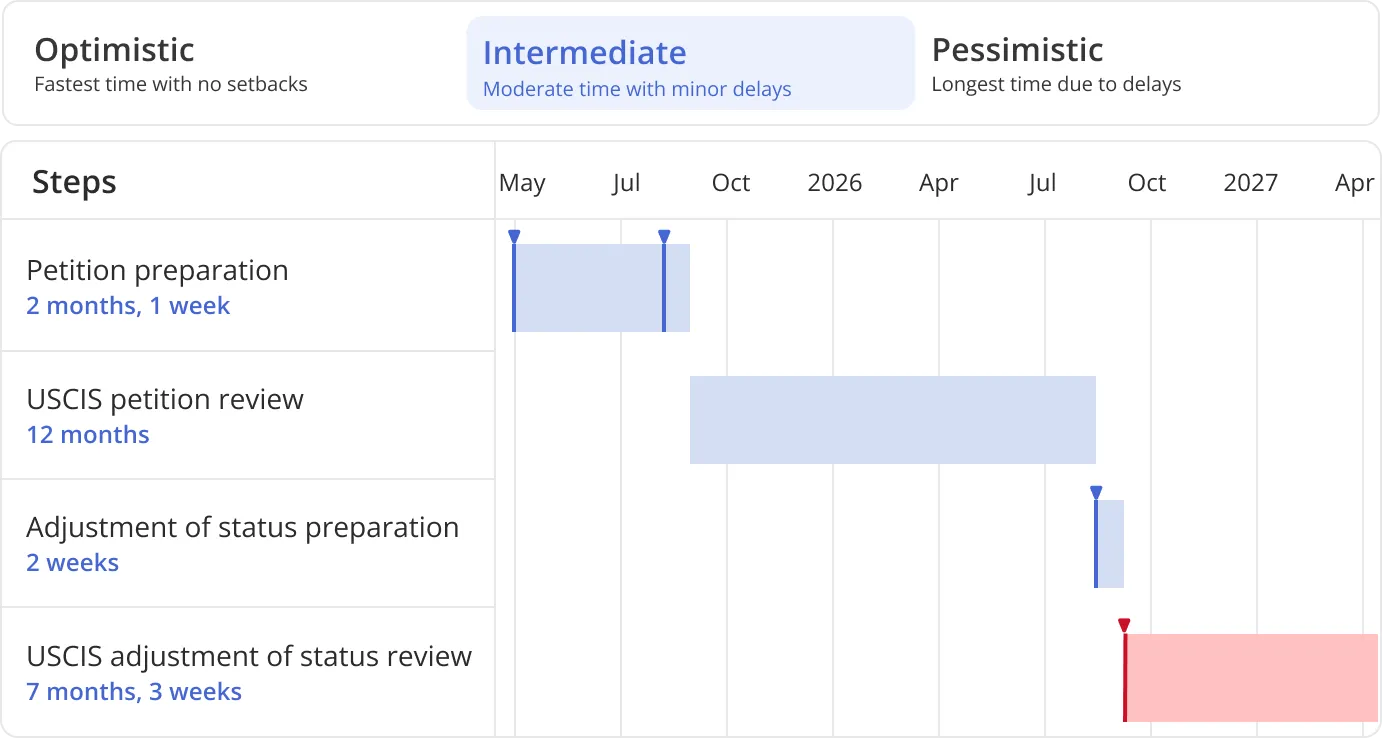
A start date a visa candidate can hold is built from the slower of the two paths and made contingent in writing. Naming a fixed day for a consular hire promises what the company cannot deliver, since the closing legs belong to a consulate and to CBP.
Tell the hiring manager which legs the company holds before the offer goes out. Our onboarding guide covers the first weeks, and a written company immigration policy settles reimbursement and travel rules in advance.
Four questions settle it, and the consular processing vs change of status decision follows from the answers.
An approved change of status produces status, not a visa. The person can stay and work, and the moment they leave they need a visa in the new category to return.
Where the number does not come, the options for an unselected employee cover the year ahead. Where the hire holds an approved immigrant petition, consular processing vs adjustment of status answers the immigrant-side version.
Consular processing vs change of status is a question about control. On the change of status route the company and USCIS hold almost every lever, and premium processing converts the longest one into a known date. On the consular route the closing legs belong to a consulate and to CBP, and no fee moves them.
Neither route is the right one in the abstract. A candidate in valid status who is not travelling gives you a cleaner timeline. A candidate abroad gives you a longer one, with a visa at the end of it.
At Tukki, immigration attorneys read the candidate's status and travel plans, decide the election before the petition is filed, and carry the case to the start date.
Book a demo and see how Tukki runs a sponsored hire end to end
WE CAN HELP
Need more clarity?
Find quick answers to frequent visa questions from our legal experts
How does the H-1B lottery system work?
Each year, USCIS receives more H-1B registrations than the 85,000 available visas (65,000 regular cap plus 20,000 masters cap). Employers submit electronic registrations during a window in March, and USCIS conducts a random selection.
Selected registrants can then file the full petition. For a detailed walkthrough, see our H-1B lottery guide.
How long does the L-1 route really take?
At least a year, plus the petition. The employee has to complete one continuous year of qualifying employment abroad within the three years before admission, and that year cannot be compressed.
Treat it as a plan for next year rather than a fix for this quarter.
Can I represent myself instead of using Form G-28?
Yes. You are always allowed to represent yourself before USCIS.
Form G-28 is only necessary when you want a licensed attorney or accredited representative to act on your behalf.
If you choose to handle your own visa process, USCIS will communicate directly with you.
However, for complex petitions or cases involving RFEs, many foreign nationals find that working with an immigration attorney leads to better outcomes.
Does the H-1B lead to a green card?
Yes. The H-1B is one of the strongest pathways to permanent residence because it allows dual intent. Many H-1B holders pursue a green card through employer sponsorship via the PERM labor certification process under the EB-2 or EB-3 categories.
Those with stronger profiles may also qualify for the EB-1A extraordinary ability green card, which allows self-petitioning and doesn't require PERM.
Does each employer pay separate filing fees?
Yes. Each employer must pay the filing fees for their own H-1B petition, including the base fee and any applicable fraud prevention or American Competitiveness and Workforce Improvement Act (ACWIA) fees.
If the employer wants expedited processing, they also pay the premium processing fee.
Other blogs for every step of your visa journey