You have a valid visa and an EAD at the same time - which one you work on and why it matters
8 mins read | Oct 6, 2026
REQUEST FOR PREMIUM PROCESSING SERVICE
Contributor
Tukki
Reading time
9 mins read
Date published
May 18, 2026
Form I-907 is what you file when you want USCIS to put a deadline on its own desk. Pay the additional fee, attach it to an eligible petition, and the agency commits to acting within a short window: 15 business days for most cases, 30 business days for some, and 45 calendar days for the trickier I-140 categories. If USCIS misses that window, the I-907 fee comes back. This guide walks through how to actually file the form in 2026, picking up where our conceptual overview of USCIS premium processing leaves off.
Estimate your visa timeline and fees
Form I-907 is the Request for Premium Processing Service, and it doesn't replace your underlying petition. It rides alongside an existing or concurrently filed petition (Form I-129, Form I-140, Form I-539, or Form I-765 in eligible categories) and buys you a guaranteed adjudication window from USCIS on that petition.
The key thing to understand is that premium processing guarantees adjudicative action, not approval. USCIS may approve, deny, issue an RFE (Request for Evidence), issue a NOID (Notice of Intent to Deny), or open an investigation, and any of those counts as action that stops the clock. The guarantee is about speed of response, not about the outcome itself.
For the full conceptual overview of premium processing, including which categories are eligible, the history of the program, and why USCIS expanded it, see our USCIS premium processing guide. This article focuses on the filing mechanics: who can file the I-907 form, how much it costs, and what to expect once USCIS receives it.
Premium processing has been rolled out category by category over several years, so eligibility depends entirely on the underlying petition. Most nonimmigrant petitions on Form I-129 and most immigrant petitions on Form I-140 are now eligible, while some I-539 and I-765 categories are still phasing in. Before you file Form I-907, confirm your underlying petition's category is currently eligible by checking the official USCIS premium processing page.
The categories eligible in 2026 are:
| Underlying petition | Eligible categories |
|---|---|
| I-129 (nonimmigrant worker) | H-1B, H-2B, H-3, L-1, O-1, O-2, P-1, P-2, P-3, Q-1, R-1, TN, E-1, E-2, E-3 |
| I-140 (immigrant petition) | EB-1A, EB-1B, EB-1C, EB-2, EB-2 NIW, EB-3 |
| I-539 (change/extension of status) | E-1, E-2, E-3, H-4, L-2, O-3, P-4, R-2 |
| I-765 (work authorization) | F-1 students in c(3)(A), c(3)(B), c(3)(C) only |
If your category isn't on the list, you can't yet file Form I-907 for that petition, and paying the fee won't unlock the guarantee. The closest reference points by visa type are our guides for Form I-129 and Form I-140, which list the underlying eligibility rules for each category.
The premium processing fee and adjudication window both depend on the underlying petition, since some I-140 categories take longer to review than an H-1B amendment. The fee is paid in addition to the regular petition fee, and the window doesn't start when you mail the form: it starts on the receipt date USCIS prints on the Form I-797C notice for your I-907.
USCIS raised the I-129 and I-140 premium processing fee to $2,965 effective March 1, 2026. The I-539 and I-765 fees stayed at $1,965. Always confirm against the USCIS Form I-907 page before filing, since the agency adjusts these on its own schedule.
| Underlying petition | Premium processing fee | Adjudication window |
|---|---|---|
| I-129 (all eligible categories) | $2,965 | 15 business days |
| I-140 EB-1A, EB-1B, EB-2, EB-3 | $2,965 | 15 business days |
| I-140 EB-1C, EB-2 NIW | $2,965 | 45 calendar days |
| I-539 (eligible categories) | $2,075 | 30 business days |
| I-765 (F-1 c(3) categories) | $1,780 | 30 business days |
For a category-by-category I-140 breakdown, see I-140 premium processing time. For an H-1B-specific cost view, see H-1B premium processing fee, and for transfers in particular, H-1B transfer premium processing covers the timing nuances.
Filing Form I-907 is more procedural than strategic, but the order matters: a wrong fee or a wrong service center routinely gets the I-907 form rejected and the underlying petition delayed. The steps below break the process into the four moments that actually drive timing: eligibility confirmation, filing strategy, submission, and what happens after USCIS receives the I-907.
The first job is confirming the underlying petition is in an eligible category for the current quarter, since USCIS phases categories in over time. Pull the most current eligibility list directly from the USCIS premium processing page rather than from a third-party source, because the rules change.
The second job is making sure you're using the current edition of Form I-907. USCIS rejects older editions outright, and the edition date is printed in the footer of the PDF. Always pull the form from the official USCIS forms page.
Once eligibility is confirmed, the next decision is whether to file Form I-907 concurrently with the underlying petition or as an upgrade to a petition that's already pending. The two routes have the same end result, but the premium processing clock starts on different dates, which can make a real difference if you're racing a status expiration. We unpack the trade-off in detail in the "Concurrent filing vs upgrade" section below.
For most cap-season H-1B filings, concurrent is the default. For I-140 cases where you're not sure at first whether premium processing is needed, an upgrade later is common. Pick the route that matches your actual timing, since switching mid-way means a second filing.
When you complete Form I-907, you'll need the underlying petition's receipt number from Form I-797C if you're upgrading. If you're filing concurrently, leave the receipt-number field blank and follow the form instructions for paired filings. Pay the right premium processing fee for your category ($2,965 for I-129 and I-140 categories since the March 1, 2026 increase, $2,075 for eligible I-539 and $1,780 for eligible I-765 filings), since the wrong amount triggers an outright rejection.
Then choose a filing method: online through myUSCIS if the underlying petition is also eligible for online filing, or paper to the service center handling the underlying petition. The paper address varies by petition type, so don't reuse an old address from a previous filing.
The premium processing clock officially starts on the date USCIS receives the I-907, not the date you mailed it. Online filers see a receipt number immediately and can track status in myUSCIS. Paper filers wait for the I-797C receipt notice, which confirms the start date and locks in the deadline.
Within the window, USCIS will issue one of five outcomes: an approval, a denial, an RFE, a NOID, or a notice of investigation. Any of these counts as action and closes the premium processing window. If an RFE arrives, the clock pauses on the day USCIS issues it and resumes when USCIS receives your response, with the remaining time from the original window. Our guides on USCIS Requests for Evidence and how long USCIS takes to respond to an RFE cover the follow-up procedure.
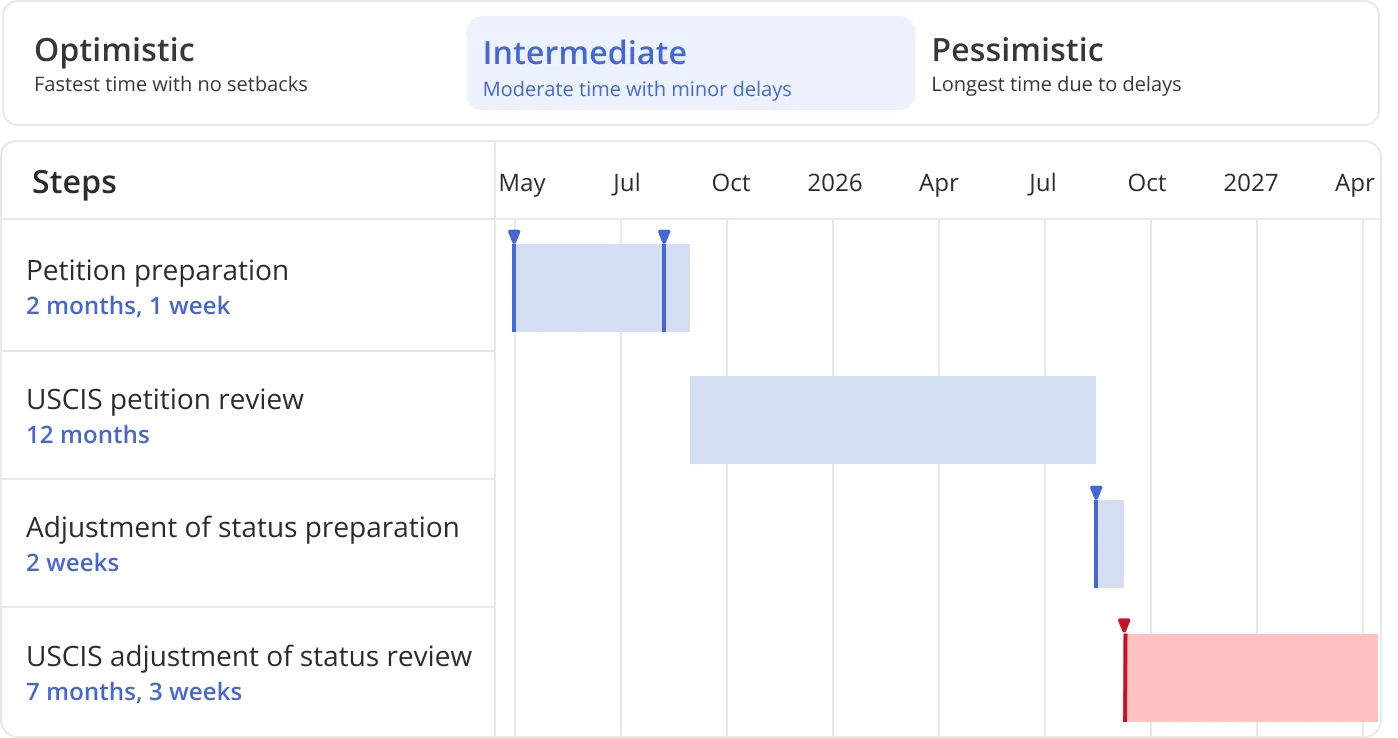
Choosing between concurrent filing and an upgrade is the most common timing decision for a premium processing request, and it comes down to when you knew you needed the speed. Concurrent filing means you submit Form I-907 in the same envelope or online submission as the underlying petition, so the clock starts when USCIS receives the whole package and the guarantee covers the petition from day one. This is the right choice when you know in advance that a fast decision matters, such as a cap-season H-1B with a hard October start date.
An upgrade means you file the underlying petition first without I-907, then submit I-907 later if your circumstances change. The premium processing clock starts when USCIS receives the I-907, not when the original petition was filed, so you lose the time the petition already spent pending. This route makes sense when you weren't sure you'd need premium processing initially, or when the category wasn't eligible at the time of the original filing and only became eligible later.
For an H-1B transfer specifically, where the timing trade-off interacts with portability and the 60-day grace period, see H-1B transfer premium processing. For I-140 strategy, particularly around timing an upgrade alongside an I-485, see I-140 premium processing time.
If USCIS does not act within the premium processing window, the I-907 fee is refunded automatically in most cases, and you don't need to file a separate request. The underlying petition continues to be adjudicated under regular processing, so a missed deadline doesn't reset or restart the case: it just means you didn't get the speed you paid for.
In practice, missed deadlines are rare for I-129 cases, since USCIS hits the 15-business-day target on the vast majority of H-1B and O-1 filings. Missed deadlines are more common for I-140 cases in the 45-calendar-day window, particularly for EB-1C and EB-2 NIW, where the underlying review is more involved. If you believe the deadline was missed and the refund hasn't appeared, the USCIS Contact Center can track it down using the I-907 receipt number.
Premium processing is narrow by design, and a lot of timing pain in immigration sits outside what Form I-907 can touch. Knowing what the additional fee doesn't buy is just as important as knowing what it does.
For broader context on what does and doesn't compress overall timelines, see I-140 premium processing time and O-1A visa processing time.
Most rejected I-907 filings come down to a small set of recurring errors, and almost all of them are avoidable with a careful checklist. The same mistakes show up in I-129 and I-140 filings alike, since the I-907 form itself follows the same rules regardless of the underlying petition type.
Tukki is a U.S. immigration provider that helps skilled professionals and their employers with work visas and green cards, from H-1B and O-1A to EB-1A and EB-2 NIW. Most premium processing filings are straightforward when the underlying petition is already in motion, but the cases that benefit most from attorney support are the ones where the I-907 form is bundled with strategy decisions, like timing an I-140 upgrade alongside an I-485, or choosing between concurrent filing and upgrade for a complex H-1B transfer. With dedicated attorney support and full case visibility at every step, we help you decide where the additional fee actually buys you time and where it doesn't.
WE CAN HELP
Need more clarity?
Find quick answers to frequent visa questions from our legal experts
Can a timely filed renewal keep our employee working while USCIS decides?
Not for renewals filed on or after 30 October 2025. DHS ended the automatic extension of EADs on a timely filed Form I-765 as of that date, with limited exceptions provided by law or Federal Register notice.
Renewals filed before 30 October 2025 keep the automatic extension of up to 540 days they already had.
Is FIFA PASS the same as the Fan ID from the 2018 World Cup in Russia?
No. The 2018 Fan ID was a visa-free entry document that let ticket holders enter Russia without a separate visa. FIFA PASS 2026 doesn't grant entry to any country.
It's a scheduling tool that gives eligible ticket holders faster access to U.S. visa interview appointments. You still need a valid visa or ESTA to enter the United States.
Can I switch from filing alone to hiring a lawyer mid-case?
Yes. If you've already filed Form I-90 on your own and USCIS issues a Request for Evidence or otherwise pushes back, you can hire an attorney at that point. The attorney files Form G-28 (Notice of Entry of Appearance) so USCIS knows they represent you, then drafts and submits the RFE response.
Many immigration firms accept RFE-only engagements for cases that started DIY.
Is a green card a visa?
No, a green card is not a visa, though the two are related. A visa is permission to travel to the U.S. and seek entry for a purpose, while a green card is evidence that you are already a lawful permanent resident.
Some people reach a green card through an immigrant visa issued abroad, but the green card itself represents permanent residence, not temporary permission to enter.
What visa can I get if I do not win the H-1B lottery?
It depends on your profile. Australians can use the E-3, Canadians and Mexicans in listed professions can use the TN, transferees from a related company abroad can use the L-1, treaty-country investors can use the E-2, and people with a strong record can pursue the O-1.
If you qualify for permanent residence, EB-1A or EB-2 NIW let you self-petition. Our post on what to do after a non-selection walks through the immediate next steps.
Other blogs for every step of your visa journey
You have a valid visa and an EAD at the same time - which one you work on and why it matters
8 mins read | Oct 6, 2026
J-1 Research Scholar, Specialist and Trainee - the three categories employers use
8 mins read | Oct 5, 2026
RFE or NOID - what a notice of intent to deny means for your case
9 mins read | Oct 2, 2026