Form I-290B after a denial: motion to reopen, motion to reconsider, or appeal
9 mins read | Oct 16, 2026
HOW WORK VISA SPONSORSHIP WORKS
Contributor
Tukki
Reading time
11 mins read
Date published
Jun 9, 2026
So what is a visa sponsorship? It's the process where a U.S. employer files a petition with the government to hire or keep a foreign worker on a work visa or an employment-based green card. The employer takes on a defined legal role: it confirms the job is real, that the pay meets federal standards, and that the worker qualifies. If you're an HR or global mobility lead, the short version is that sponsorship is a structured sequence with clear owners at each step. This guide covers what employment-based visa sponsorship means, how the process moves from job to approval, which visas need an employer sponsor, who pays, and how a team keeps several cases visible at once.
We'll stay strictly on employment-based sponsorship. Family-based sponsorship, where a relative petitions for a family member, runs through a different set of forms and rules and falls outside what we cover.
Employment-based visa sponsorship is a U.S. employer formally asking the government to authorize a foreign worker for a specific job, either on a temporary work visa or a permanent green card. The employer files a petition, attests to certain facts about the role and the pay, and accepts ongoing obligations, while the worker provides the documents that prove they qualify. Both sides have a part to play, which is why the process has more moving parts than a standard hire.
Immigration sponsorship exists because a foreign national usually can't authorize their own U.S. employment. Most work-based categories require a U.S. entity to stand behind the job and confirm it's genuine, and that confirmation is what unlocks the worker's ability to receive a visa or adjust to permanent residence. For an HR team, the takeaway is that you're taking on attestations the government can later check, so accuracy at the start saves you from audits and delays down the line.
The petitioner is the U.S. employer that files the petition, and the beneficiary is the foreign worker who receives the immigration benefit. Keeping these two roles straight matters because they carry different responsibilities and sign different things. The petitioner owns the filing, makes the legal attestations, and in most categories pays the mandatory fees, essentially answering the government's main question: is this a real job at a fair wage? The beneficiary supplies evidence of their qualifications, such as degrees, experience letters, and a passport, answering a related question: am I actually qualified for this role?
This split also shapes how a good sponsorship setup should run, a point we return to at the end: HR needs portfolio-level visibility into the filings and deadlines, while each beneficiary needs a direct line to the attorneys handling their personal documents.
Employment-based sponsorship is tied to a job and a U.S. employer, while family-based sponsorship is tied to a qualifying family relationship and a U.S. citizen or lawful permanent resident relative. They use different petitions, different eligibility rules, and different parts of the immigration system. If a candidate mentions that a spouse or parent is also helping with their case, that's a separate family track and doesn't change anything about the employment petition your company files. For employers, the only sponsorship that matters is the employment-based kind, which is what every section here refers to.
Visa sponsorship works as a sequence: the employer defines and tests the role, files the right petition with the government, and the worker then either changes status inside the U.S. or completes the process at a consulate abroad. The exact steps vary by visa type, but the backbone is consistent across employment-based categories, and knowing the order helps you plan start dates and budget instead of reacting to surprises. Here's the general flow most employer-sponsored cases follow.
| Stage | Who leads | What happens |
|---|---|---|
| Define the role and wage | Employer | Confirm job duties and the required wage level |
| Labor steps (when required) | Employer + DOL | File the LCA for H-1B, or run PERM for most EB-2 and EB-3 green cards |
| File the petition | Employer | Submit Form I-129 (temporary visa) or Form I-140 (green card) to USCIS |
| Final step for the worker | Beneficiary | Change of status in the U.S., or consular processing abroad |
The first three stages sit with the employer, which is why HR carries most of the early load, while the last stage shifts toward the worker once the petition is approved.
Sponsorship starts with the job itself: the employer confirms the role's duties and sets the wage at or above the prevailing wage, which is the typical pay for similar work in the same area, based on data the U.S. Department of Labor publishes. This step matters because the wage you commit to is something the government can review later, and a wage set too low is one of the most common triggers for added scrutiny.
For an H-1B specifically, the employer files a Labor Condition Application (LCA), a form certified by the Department of Labor before the petition can go to USCIS, in which the employer attests that it will pay at least the required wage and that hiring the worker won't harm conditions for similar U.S. workers. Not every visa needs a labor step, though. PERM labor certification, the recruitment-based process that tests the U.S. job market, is required for most EB-2 and EB-3 green cards but not for O-1A, L-1A, EB-1A, or EB-2 NIW, and knowing which bucket your role falls into early can change your timeline by many months. You can read how the four wage tiers work in our Department of Labor foreign labor guidance.
After the role and any labor steps are set, the employer files the petition that matches the visa type: Form I-129, the Petition for a Nonimmigrant Worker, for temporary work visas like H-1B, L-1A, and O-1A, or Form I-140, the Immigrant Petition for Alien Worker, for employment-based green cards. The petition is where the employer's attestations and the worker's evidence come together in one package, and USCIS reviews it to decide whether the job and the worker meet the legal standard for that category. Premium processing is available on both petitions and guarantees that USCIS acts within 15 business days, with the cost covered below. For a deeper look at each form, see our Form I-129 guide and our Form I-140 guide.
Once the petition is approved, the worker reaches the final step in one of two ways: change of status if they're already inside the U.S., or consular processing if they're abroad. Change of status converts the worker's current status to the new one without leaving the country, while consular processing means the worker applies at a U.S. embassy or consulate, completes the DS-160 form, attends an interview, and enters on the new visa.
Which path applies depends mostly on where the worker is when the petition is approved, not on a choice the employer makes freely. A candidate already in the U.S. on another status can often change status, while a new hire coming from abroad typically goes through a consulate. The route affects timing, so confirm it early when you're planning a start date.
Most U.S. work visas require an employer to act as the sponsor, but a few green card categories let qualified individuals petition for themselves. The dividing line matters for hiring: if a role needs employer sponsorship, your company carries the filing, while a candidate who qualifies to self-petition can move forward without your company on the petition. Knowing which is which helps you scope your involvement before you commit.
The H-1B, L-1A, and O-1A all require a U.S. employer or sponsoring entity to file the petition. The H-1B is for specialty occupation roles, jobs that need at least a bachelor's degree in a specific field, and it requires an approved LCA. It's also cap-subject, meaning most new H-1B petitions go through an annual lottery before they can even be filed. Our H-1B visa guide covers the lottery, wage levels, and eligibility in full.
The L-1A is for managers and executives transferring within a multinational company, and it requires a qualifying corporate relationship between the foreign and U.S. entities. The O-1A is for individuals with extraordinary ability in fields like science, business, education, or athletics, and it can be sponsored through a U.S. agent rather than a single payroll employer, which gives more flexibility for consultants and founders. Each names a real job and a genuine employer-employee or agent relationship as the basis for the petition. Our O-1A visa guide explains the eight criteria in full.
Two employment-based green cards let a qualified individual file without an employer: EB-1A, for extraordinary ability, and EB-2 NIW, the National Interest Waiver. In both, the worker is their own petitioner, which means no company sponsorship, no job offer requirement, and no PERM labor certification. These routes exist for people whose work clears a high bar on its own merits.
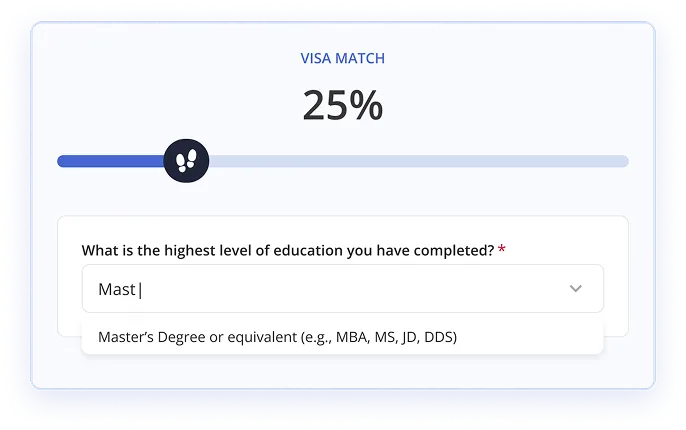
For an employer, this is useful context rather than a task: if a candidate already qualifies for EB-1A or EB-2 NIW, they may not need your company on a green card petition at all. When a candidate isn't sure where they fit, our visa match tool can give a profile-based starting point before anyone files.
When people ask what is a visa sponsorship going to cost, the answer is that the employer pays for most of it, and for some fees the law requires it. The total depends on the visa type, whether you use premium processing, and your attorney arrangement, so there's no single sticker price. What's predictable is the structure: government filing fees, certain mandatory employer-only charges, and optional add-ons. For a full breakdown across visa types, our guide to U.S. work visa costs lays out every fee category, and our employer guide to H-1B sponsorship cost drills into the H-1B specifically.
Certain H-1B fees must legally be paid by the employer and can't be passed to the worker. These employer-only charges exist so the cost of sponsorship doesn't quietly shift onto the person it benefits, and trying to recover them from the employee through payroll deductions or side agreements can put the company out of compliance.
Beyond the H-1B-specific rules, the norm across most categories is that the employer covers the petition because the visa supports the business need. The base filing fee for Form I-140, the green card petition, is $715. For how employer budgets break down across the full sponsorship arc, see our work visa sponsorship cost guide.
Premium processing and attorney fees are the two main optional costs, and each makes sense in specific situations. Premium processing costs $2,965 and guarantees that USCIS acts within 15 business days, a fee that took effect March 1, 2026 and applies to both Form I-129 and Form I-140. It's the right call when a start date is at risk, a work authorization gap is approaching, or business planning depends on a firm answer soon. When timing is comfortable and regular processing fits the calendar, many employers skip it and put the money elsewhere.
Attorney support is the other variable. Experienced immigration counsel is often the right call for first-time sponsors, complex roles, candidates with thin or unusual records, or any case where a wrong attestation could trigger an RFE (a Request for Evidence, where USCIS asks for more documentation before deciding). For a straightforward, repeat filing, some employers handle more in-house. The decision depends on your risk tolerance and how much in-house immigration knowledge you already have, and it's yours to make. You can read the official fee schedule on the USCIS filing fees page.
Visa sponsorship timelines range from a few weeks to several years, depending on the visa type, whether a labor step is required, and the worker's country of birth for green cards. A temporary visa petition like an H-1B, L-1A, or O-1A can be decided in a couple of weeks with premium processing or a few months under regular processing, on top of any required labor step, with the H-1B also tied to annual lottery timing since most new petitions can only be filed after selection.
For green cards, the picture stretches: PERM labor certification alone often runs close to two years, the I-140 takes a few months (or 15 business days with premium processing), and then the priority date wait can add years for nationals of high-demand countries because of per-country limits in the Visa Bulletin. A self-petition green card or a category without PERM avoids the longest delays, while an employer-sponsored EB-2 or EB-3 for a high-backlog country sits at the long end. Planning start dates against the realistic range, not the best case, keeps a workforce plan from slipping.
HR and global mobility teams manage sponsorship at scale by keeping every case visible in one place and giving each worker a clear channel for their own questions. When a company sponsors more than one or two people, the challenge stops being any single petition and becomes the portfolio: new filings, pending green cards, upcoming extensions, and transfers all moving at once. Most sponsorship stress comes down to a missing process: no shared view of where each case stands, no early warning before a deadline, and no clear owner for each step. Putting that structure in place turns sponsorship from a source of anxiety into something predictable.
The HR or immigration specialist needs a single, current view of every case, because that visibility is what prevents missed deadlines and last-minute fire drills. With several beneficiaries at different stages, the questions that matter are practical: which extension is due next, which petition is waiting on the worker's documents, and which case just got an RFE. When you can see the whole portfolio, you can also forecast costs, time premium processing where it counts, and brief leadership on when each hire will have firm work authorization, which turns immigration into part of talent planning rather than a recurring emergency.
Beneficiaries need a direct line to the attorneys handling their case, separate from the HR dashboard. The worker's questions are personal and specific: what documents to gather, what a notice means, how a job change affects their status. Routing all of that through HR slows everyone down and puts the HR lead in the position of relaying legal answers they're not equipped to give.
This is the audience split a good sponsorship setup respects. HR gets the platform and portfolio-level visibility to run the program, while each beneficiary gets attorney access for their own case. Keeping those two channels distinct, rather than funneling everything through a single contact, keeps both the company and the worker confident that nothing is slipping.
Tukki is a U.S. immigration provider that helps employers and their employees with work visas and green cards, from H-1B and O-1A to EB-1A and EB-2 NIW. HR and mobility teams get full case visibility across every sponsored worker, while each beneficiary gets dedicated attorney support for their own filing.
WE CAN HELP
Need more clarity?
Find quick answers to frequent visa questions from our legal experts
How long does the I-526E take right now?
As of August 2026, I-526E processing time runs roughly 11.5 to 36.5 months for rural reserved petitions, 17 to 52 months for high-unemployment reserved, and 30.5 to 61 months unreserved.
Those ranges cover petition adjudication only, not the green card or removal of conditions. Check the USCIS processing times tool and the official I-526E page for current figures.
Can PERM be skipped for any green card?
Yes. The EB-2 National Interest Waiver skips PERM entirely because the applicant self-petitions and no employer or job offer is required. EB-2 Exceptional Ability and the EB-1 categories, including EB-1A extraordinary ability and EB-1C multinational managers, also bypass PERM.
These all rely on the applicant's own qualifications rather than a labor market test.
Which O-1 is better for a green card?
The O-1A aligns most cleanly with the EB-1A green card, because the two share a similar extraordinary ability framework, so evidence often carries over. The O-1B can also lead to an EB-1A, particularly from the arts side, though the EB-1A applies a higher standard of proof than either O-1 category.
If permanent residence is the goal, it helps to plan the O-1 category and the green card path together from the start.
How does USCIS evaluate the EB-1A eligibility criteria?
USCIS evaluates EB-1A petitions using a two-step process.
First, you must either demonstrate a major internationally recognized award or meet at least three of the ten regulatory criteria. While three is the minimum, satisfying more criteria generally strengthens your case.
Second, USCIS conducts a final merits review, assessing the overall quality, significance, and impact of the evidence compared to others in your field.
Other blogs for every step of your visa journey
Form I-290B after a denial: motion to reopen, motion to reconsider, or appeal
9 mins read | Oct 16, 2026
EB-2 NIW approval rate: what the published numbers show and where cases fail
8 mins read | Oct 15, 2026
Form I-539: how to extend or change your status without leaving the U.S.
8 mins read | Oct 14, 2026