Your immigration forms - what each one is for and what to check before you sign
9 mins read | Oct 13, 2026
SPONSORING A WORK VISA
Contributor
Tukki
Reading time
10 mins read
Date published
Apr 16, 2026
How much does it cost to sponsor a work visa? If you're an employer bringing on a foreign worker, the answer depends on two things: which visa you're filing and whether you plan to sponsor a green card down the line. A single H-1B petition can run anywhere from $6,000 to over $13,500 in government and legal fees combined. Add green card sponsorship on top, and the total investment can reach $20,000 to $40,000 or more over several years.
Those numbers surprise a lot of employers, especially first-time sponsors. But the cost of sponsoring an employee isn't just about filing fees. It includes mandatory training fees, fraud prevention charges, recruitment advertising for the PERM process, attorney fees at every stage, and in some cases a $100,000 proclamation surcharge that's currently being challenged in court. This article breaks down every fee employers face, from the initial work visa through permanent residence, so you can budget accurately and avoid surprises.
Most employers who commit to a long-term foreign hire will go through two distinct cost phases. The first is the temporary work visa, such as the H-1B, L-1A, or O-1A. The second is permanent residence through an employer-sponsored green card, which involves PERM labor certification, an I-140 immigrant petition, and either adjustment of status or consular processing.
Not every employer does both. Some bring a worker in on an H-1B and the employee eventually self-petitions for an EB-1A or EB-2 NIW. Others skip the temporary visa entirely and go straight to green card sponsorship if the employee already has work authorization. But for the most common scenario, an H-1B followed by an EB-2 or EB-3 green card, you should plan for both phases when setting your budget.
The government fees vary quite a bit depending on the visa type. H-1B petitions carry the most fees because of add-ons like the ACWIA training fee and the Fraud Prevention and Detection Fee. L-1 and O-1A petitions are generally cheaper on the government side, though attorney fees tend to be comparable.
Here's what the fees look like side by side for a large employer (25+ full-time employees):
| Fee component | H-1B | L-1A/L-1B | O-1A |
|---|---|---|---|
| Registration fee | $215 | N/A | N/A |
| I-129 base filing fee | $780 | $1,385 | $1,055 |
| Fraud Prevention and Detection Fee | $500 | $500 | N/A |
| ACWIA Training Fee | $1,500 | N/A | N/A |
| Asylum Program Fee | $600 | $600 | $600 |
| Premium processing (I-907) | $2,965 | $2,965 | $2,965 |
| Public Law 114-113 fee (if H-1B/L-1 dependent) | $4,000 | $4,500 | N/A |
Small employers (fewer than 25 employees) pay reduced rates on several of these: approximately half of the I-129 base fee, $750 for the ACWIA Training Fee, and $300 for the Asylum Program Fee. Nonprofits are exempt from the Asylum Program Fee entirely.
One fee that deserves its own callout: new H-1B petitions filed through consular processing may be subject to a $100,000 surcharge under a recent presidential proclamation. This fee is currently under legal challenge, and its status may change. If you're planning an H-1B petition for a worker abroad, talk to your attorney about whether this applies to your case and what workarounds might exist.
On top of government fees, expect to pay $2,500 to $6,000 in attorney fees for a straightforward H-1B petition. L-1A and L-1B petitions tend to cost more, typically $4,500 to $10,000, because of the added documentation around the qualifying relationship between the U.S. and foreign entities. O-1A cases generally run $6,000 to $12,000, because they require building an evidentiary record that proves extraordinary ability. For a deeper look at what attorneys charge across visa types, see our immigration lawyer cost breakdown.
| Scenario | Estimated total (government + attorney) |
|---|---|
| H-1B (large employer, no premium processing) | $6,000 to $13,500 |
| L-1A (large employer, no premium processing) | $6,500 to $12,500 |
| O-1A (large employer, no premium processing) | $7,500 to $14,000 |
For a detailed breakdown of H-1B fees specifically, including how each fee is calculated and who qualifies for reduced rates, see our H-1B sponsorship cost guide. For L-1A processing fees and timelines, we have a dedicated breakdown as well.
Green card sponsorship through the employer-sponsored route (EB-2 or EB-3) involves three stages, each with its own costs. This is where the total investment starts to add up.
The PERM labor certification is filed with the U.S. Department of Labor and has no government filing fee. That sounds cheap, but it's not.
The employer must conduct a full recruitment process to demonstrate that no qualified U.S. worker is available for the position. That means placing newspaper ads, posting on job boards, and running internal job postings, all following strict DOL guidelines. Recruitment and advertising costs typically run $1,000 to $3,000. Attorney fees for handling the PERM process add another $6,000 to $12,000, making this the most expensive stage in terms of professional fees.
PERM is also the most time-consuming step. Between getting a prevailing wage determination (which can take 6 to 9 months on its own), conducting recruitment, and waiting for DOL processing, this stage alone can stretch over a year.
Once the PERM is certified, the employer files Form I-140 (Immigrant Petition for Alien Workers) with USCIS. The I-140 filing fee is $715, plus the Asylum Program Fee of $600 for large employers or $300 for small employers.
If you want a decision within 15 business days, premium processing is available for $2,965. Many employers opt for premium processing here because a denied I-140 means restarting the PERM process from scratch, and faster certainty is worth the cost.
The final stage depends on where the employee is located. If they're already in the U.S., they file Form I-485 (Adjustment of Status) with a filing fee of $1,440 for paper filing. This fee includes the EAD (Employment Authorization Document) and advance parole, which lets the employee work and travel while the green card is pending.
If the employee is abroad, they go through consular processing instead. There's no I-485 fee, but the DS-260 immigrant visa application and consular interview fees apply.
Here's the key distinction: the employer is not legally required to pay the I-485 fee. The employee typically files and pays for adjustment of status themselves. That said, many employers cover it as a retention benefit, especially in competitive fields like tech and healthcare.
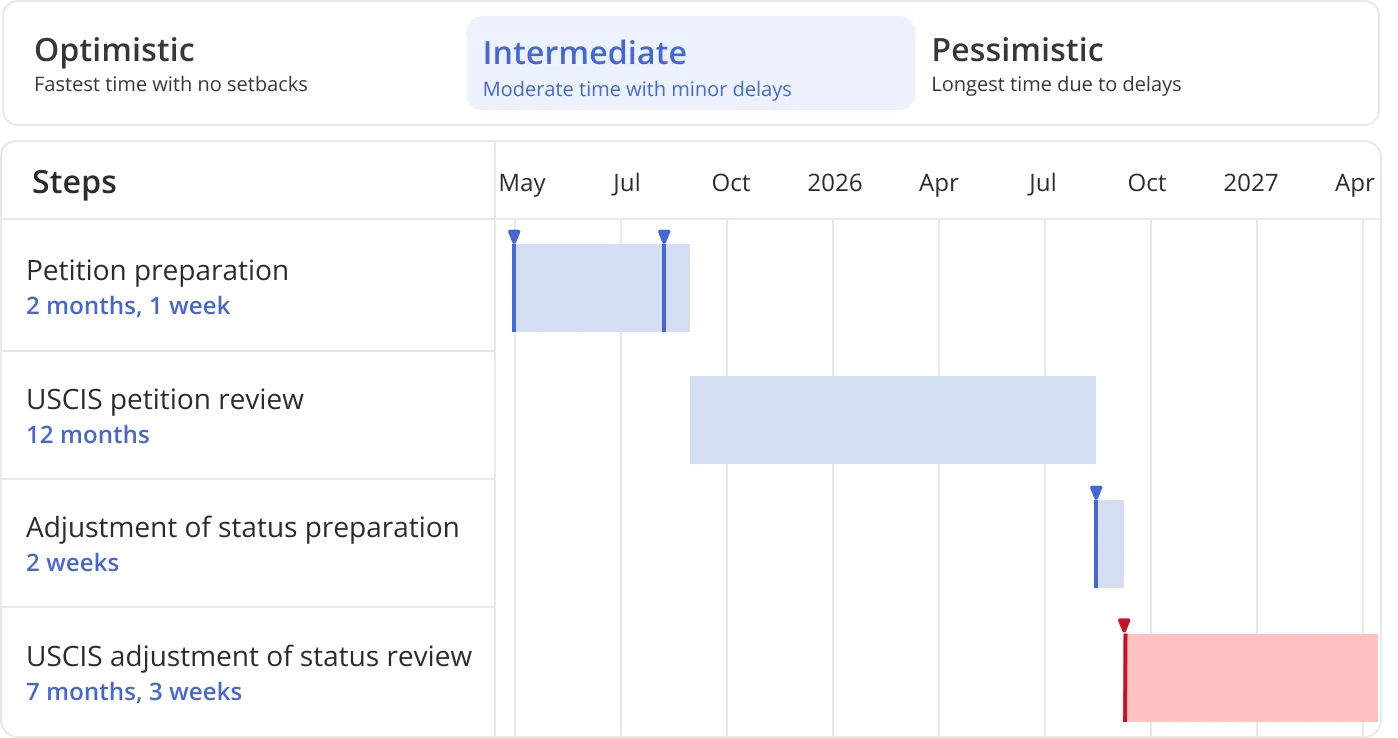
When you add both phases together, the full cost of sponsoring an employee becomes clear. These ranges include government fees, recruitment costs, and typical attorney fees.
| Scenario | Estimated total |
|---|---|
| H-1B only (large employer, no premium processing) | $6,000 to $13,500 |
| H-1B + green card (PERM, I-140, I-485) | $20,000 to $40,000+ |
| L-1A only (large employer, no premium processing) | $6,500 to $12,500 |
| O-1A only (large employer, no premium processing) | $7,500 to $14,000 |
| Green card only (PERM, I-140, I-485, no temp visa) | $14,000 to $30,000 |
The "$40,000+" on the H-1B to green card line isn't a scare number. Once you factor in premium processing for both the H-1B and I-140, higher attorney fees for complex cases, and the employer covering the I-485, costs can climb past that threshold. Companies sponsoring workers in high-cost metro areas also face higher prevailing wage obligations, which affects overall compensation budgets even if it's not a direct filing fee.
Estimate your full sponsorship cost with Tukki's pricing tool
This trips up a lot of first-time sponsors. Some fees must be paid by the employer by law, and the employee can't reimburse them. Others are optional or traditionally split.
The employer must pay:
The employee can pay:
What most employers actually do: In practice, competitive employers cover everything. Paying the full cost of sponsorship, including I-485 and premium processing, has become a standard retention tool, especially for roles that are hard to fill. If you're trying to attract top talent who has offers from multiple sponsors, covering the full cost signals commitment.
Government filing fees and attorney rates are the numbers everyone focuses on. But several less obvious costs can catch employers off guard.
When you sponsor an H-1B or go through PERM, you must pay the employee at least the prevailing wage for that occupation in that geographic area. This isn't a filing fee, but it directly affects your compensation budget. If your standard salary for a role is $85,000 but the prevailing wage is $105,000, you're committing to the higher number for as long as the employee is on that visa. The DOL publishes prevailing wage data through its Foreign Labor Certification Data Center, and checking this before starting the process can prevent sticker shock.
If USCIS issues a Request for Evidence (RFE) on your petition, your attorney will charge additional fees to prepare the response, typically $1,500 to $3,000 depending on complexity. You can't fully prevent RFEs, but a well-prepared initial petition reduces the odds.
Employees change roles, offices relocate, projects shift. Each of these can trigger an H-1B amendment filing, with its own set of I-129 fees and attorney costs. Extensions (every three years for H-1B) also require new filings. Over a six-year H-1B period, you might file the original petition plus one extension and one or two amendments, effectively doubling your visa costs.
This isn't a dollar cost, but it's a cost of time that affects retention planning. Employees born in India or China face multi-year (sometimes decade-long) backlogs for EB-2 and EB-3 green cards due to per-country limits. That means your sponsored employee might be on H-1B extensions for 10 to 15 years while waiting for their priority date to become current. Each extension costs money, and the uncertainty affects employee morale and retention. For some employers, exploring alternative green card paths like the EB-1A (which has no backlog for most countries) is worth the additional upfront investment.
You can't avoid government filing fees, but you can be strategic about when and how you spend.
Skip premium processing when timing allows. The $2,965 premium processing fee is worth it when you need a quick answer, but if you have a comfortable timeline, regular processing saves nearly $3,000 per filing.
Start PERM early. The PERM process has the longest lead time. Beginning it in the employee's first year on H-1B, rather than waiting until year three, gives you more runway and reduces the risk of needing expensive H-1B extensions while waiting for the green card process to move forward.
Consider the employee's full visa history. If the employee was previously counted against the H-1B cap, they may not need to go through the lottery again, which saves time and registration fees. If they qualify for an O-1A or EB-1A, those paths skip the PERM process entirely, saving $5,000 to $10,000 in recruitment and labor certification costs.
Bundle cases when possible. If you're sponsoring multiple employees, many law firms offer volume discounts on attorney fees. This won't reduce government filing fees, but it can meaningfully lower your per-employee legal spend.
Tukki is a U.S. immigration provider that helps employers sponsor work visas and green cards, from H-1B and L-1 to PERM labor certification and I-140 petitions, with dedicated attorney support and full case visibility from day one.
WE CAN HELP
Need more clarity?
Find quick answers to frequent visa questions from our legal experts
What happens to our employee if their spouse is laid off?
Under 8 CFR 214.1(l)(2), the principal and their dependents get up to 60 consecutive days of authorized stay once per validity period. The window ends sooner if the authorized validity period runs out first.
DHS has proposed eliminating that grace period, with comments open until 10 November 2026, so it's worth watching.
Which option is fastest if the OPT end date is close?
Usually TN for a Canadian at a port of entry, or an E-3 or H-1B1 interview at a consulate, since none of them needs a USCIS petition first.
A cap-exempt filing with premium processing is the fastest route that keeps the person in the United States.
Which visa is better for a green card, H-1B or O-1?
If you qualify for O-1A, the EB-1A path is usually faster and cleaner, since the evidentiary framework overlaps and EB-1A is current for most countries on the visa bulletin.
If you only qualify for H-1B, you'll go through PERM and EB-2 or EB-3, which works but takes much longer for India-born and China-born applicants because of priority date backlogs.
Can I start a new job before my H-1B transfer is approved?
Yes. Under H-1B portability, you can begin working for a new employer once they properly file a nonfrivolous H-1B change-of-employer petition on your behalf, while it is still pending. You do not have to wait for the approval notice, which is what lets the new job and the paperwork move at the same time inside your grace-period window.
Is an H-1B required before a green card?
No, an H-1B is not required before a green card, but it is one of the most common routes. Many people reach an employment-based green card through other statuses, such as O-1A or L-1, or through self-petition categories like EB-1A and EB-2 NIW that need no employer at all.
The H-1B is popular as a starting point because it allows dual intent and is widely sponsored.
Other blogs for every step of your visa journey
Your immigration forms - what each one is for and what to check before you sign
9 mins read | Oct 13, 2026
How to write an RFE response letter and organize the evidence behind it
9 mins read | Oct 12, 2026
Laying off a sponsored employee on H-1B: what the company owes and what the employee has left
8 mins read | Oct 9, 2026