Your immigration forms - what each one is for and what to check before you sign
9 mins read | Oct 13, 2026
FILING FEES, PREMIUM PROCESSING COSTS, AND CURRENT WAIT TIMES EXPLAINED
Contributor
Tukki
Reading time
8 mins read
Date published
Mar 1, 2026
When filing an L-1A visa petition, understanding the full visa processing time and government fees is essential before deciding to move a manager or executive to the United States. Especially if you are on the HR or finance team, these timelines and figures will shape when your employee can realistically start working.
This guide breaks down every fee tied to the L-1A petition in 2026, walks through current processing timelines and explains what the upcoming premium processing fee increase means for employers filing this spring. If you need a refresher on who qualifies for the L-1A, start with our L-1A visa requirements guide.
Every L-1A visa petition begins with Form I-129, the Petition for a Nonimmigrant Worker. USCIS (United States Citizenship and Immigration Services) uses this form to process employer-sponsored work visa requests, including all L-1 intracompany transfers. The fees attached to this form depend on the employer's size, whether the petitioner is a nonprofit and whether the filing is an initial petition or an extension.
Here's what each fee covers and who owes it.
The I-129 base filing fee is the core government charge for every L-1A petition. Most employers pay $1,385. Small employers with 25 or fewer full-time equivalent employees along with nonprofit organizations pay a reduced rate of $695.
This fee applies to both initial petitions and extensions. You'll pay it each time you file or renew an L-1A visa petition, regardless of your company's size.
The Asylum Program Fee is a separate charge that USCIS collects from employers filing certain employment-based visa petitions, including the L-1A. Standard employers pay $600. Companies with 25 or fewer employees pay $300. Nonprofit organizations don't owe this fee at all.
Like the base filing fee, the Asylum Program Fee applies to both new petitions and extensions.
USCIS charges a $500 Fraud Prevention and Detection Fee on initial L-1A petitions only. If you're filing an L-1A visa extension, you won't owe this fee again. The agency uses it to fund programs that detect and prevent fraud across employer sponsorship categories.
This is an important distinction for HR teams budgeting for renewals. Your extension filing will cost $500 less than the original petition.
L petitioners must submit a Fraud Prevention and Detection fee if they are:
This fee catches many employers off guard. If your company has 50 or more employees in the United States and more than 50% of those employees hold H-1B or L-1 status, USCIS requires an additional $4,500 per petition. Congress enacted this fee under Public Law 114-113.
Most companies don't trigger this threshold. But if yours does, it adds substantially to the total L-1A visa cost. Check your workforce composition before you finalize your immigration budget and if they are required to submit the Fraud Prevention and Detection fee too.
The table below shows total government filing fees for an initial L-1A petition by employer category. These figures don't include premium processing, attorney fees, or relocation costs.
| Fee component | Standard employer | Small employer (25 or fewer) | Nonprofit |
|---|---|---|---|
| I-129 base filing fee | $1,385 | $695 | $695 |
| Asylum Program Fee | $600 | $300 | $0 |
| Fraud Prevention and Detection Fee | $500 | $500 | $500 |
| Pub. L. 114-113 fee (if applicable) | $4,500 | N/A | N/A |
| Total (without Pub. L. 114-113) | $2,485 | $1,495 | $1,195 |
| Total (with Pub. L. 114-113) | $6,985 | N/A | N/A |
For extension petitions, subtract the $500 Fraud Prevention and Detection Fee AND the Pub. L. 114-113 fee from the totals above. A standard employer filing an extension pays roughly $1,985, while a small employer pays around $995.
USCIS no longer accepts personal or business checks for paper filings. You'll need to pay by credit card, debit card, or prepaid card using Form G-1450, or through a direct bank payment using Form G-1650. The full fee schedule is published on USCIS Form G-1055.
The current wait times for L-1A visa processing time for regular petitions is approximately 3 to 8 months. The exact timeline depends on which USCIS service center handles your case and the overall petition volume at that time, because both the California Service Center and the Vermont Service Center adjudicate L-1A petitions, but their processing speeds don't always match.
Of course, this range creates real challenges for HR immigration planning. If you're coordinating a foreign national's start date, relocation, and project timelines, a five-month window of uncertainty it's not the best plan.
USCIS publishes estimated processing times by form type and service center on its processing times tool. It's worth checking this tool regularly because wait times shift from month to month. If your transfer has a firm deadline, regular processing may not give you enough predictability.
It's in this scenario where premium processing becomes essential.
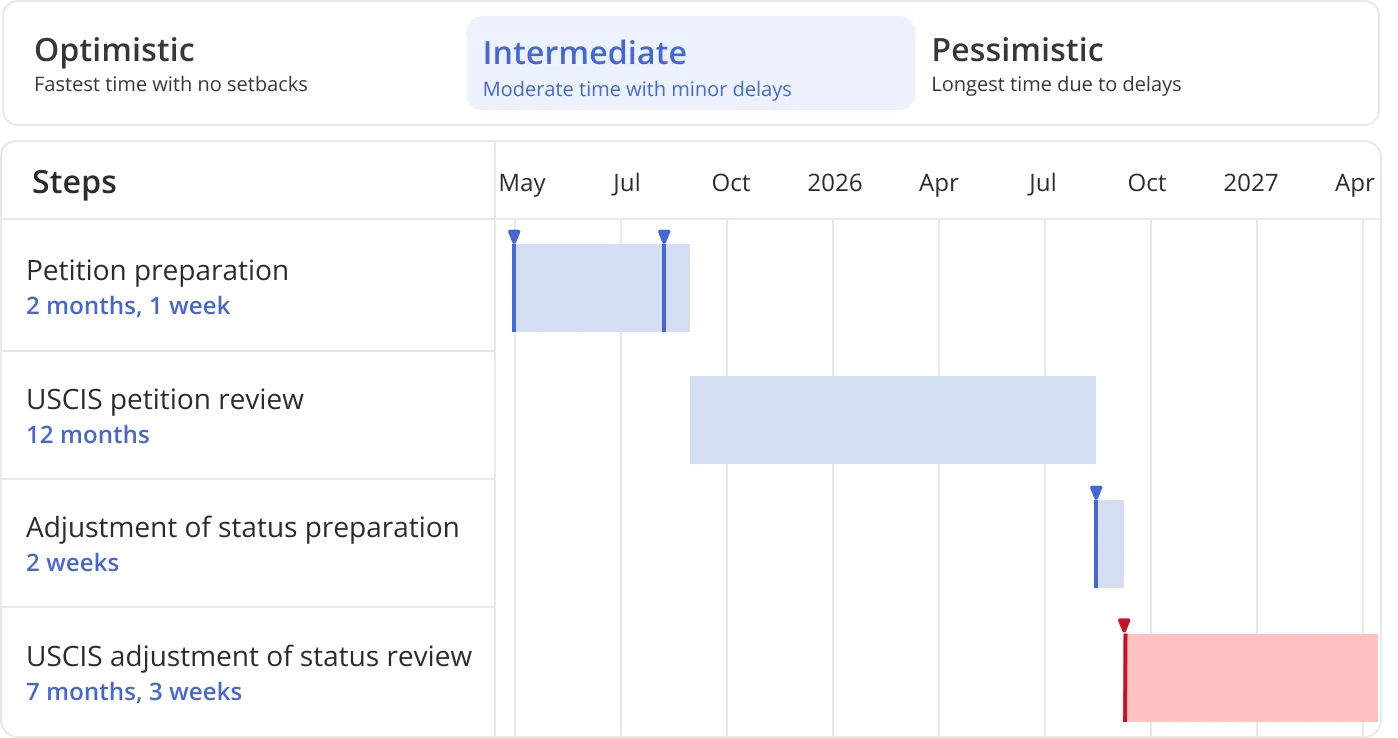
Premium processing is an optional service that guarantees USCIS will take an initial action on your visa petition within 15 calendar days of receiving it. An initial action means USCIS will either approve the petition, deny it, issue a Request for Evidence (RFE) or a NOID. It doesn't guarantee approval, but it removes the months of waiting.
The premium processing fee through February 28, 2026 is $2,805. Starting March 1, 2026, that fee increases to $2,965. If you're planning to file soon, timing your submission before the end of February could save $160 per petition.
To request premium processing, you can file Form I-907 together with your I-129 petition. If the petition is already pending, you may upgrade it at any time by submitting Form I-907 separately and paying the applicable fee.
Keep in mind that if USCIS issues a Request for Evidence (RFE), the 15-day processing clock will pause. Once you respond with the required documents, a new 15-day period begins. Even with an RFE, premium processing typically results in a decision much faster than the standard three- to eight-month timeline.
For HR teams managing multiple transfers, the additional cost is often justified by the predictability it provides, allowing you to plan onboarding and internal timelines around a defined response date.
USCIS has updated its payment methods in recent years. The agency no longer accepts personal or business checks for paper-filed petitions. Your options are:
One common and costly mistake is submitting the wrong fee amount. If your payment doesn't match what USCIS expects based on your employer category and petition type, the agency will reject the entire filing and return it. This can cost you weeks and push your processing time even further out. Double-check your fee calculation against Form G-1055, the official USCIS fee schedule, before you submit.
Filing online can speed up receipt notices and reduce the chance of a rejection based on payment errors or incorrect forms. For petitioners filing multiple visa petitions per year, the online system also provides better tracking.
WE CAN HELP
Need more clarity?
Find quick answers to frequent visa questions from our legal experts
Can my spouse work on an L-2 visa?
Yes. Your spouse and unmarried children under 21 can accompany you under L-2 status. L-2 spouses are authorized to work in the United States.
For more on dependent work options across visa types, see our spouse work authorization guide.
Can I apply for my spouse work permit before arriving in the U.S.?
Your spouse must first be in valid dependent status (H-4, L-2, or E-2) or apply for that status concurrently.
For L-2 and E-2 spouses, work authorization begins upon entry when you receive an I-94 with the "S" designation.
H-4 spouses need to file Form I-765 after arriving and being admitted in H-4 status, though concurrent filing with a change of status application is also possible.
L-1 new office or E-2: which fits my expansion?
It depends on your structure and goals. The L-1A new office route fits a qualifying multinational moving its own executive or manager, with no treaty-country or fixed-investment requirement, while the E-2 fits a treaty-country national making a substantial personal investment with no corporate-relationship requirement.
Our L-1 vs E-2 comparison breaks down when each one is the right call.
Which work visas lead directly to a green card?
The immigrant categories, EB-1A, EB-1C, EB-2 NIW, and EB-2 or EB-3 through PERM, lead directly to a green card. The temporary work visas don't grant permanent residence on their own, but several act as bridges.
An H-1B holder can move through PERM to EB-2 or EB-3, an L-1A manager to the EB-1C, and an O-1A performer to the EB-1A.
Does the L-1A visa lead directly to a green card?
The L-1A visa itself doesn't automatically convert to a green card, but it positions you for the EB-1C green card category. Your employer must file a separate I-140 immigrant petition on your behalf. The advantage is that EB-1C uses the same managerial and executive criteria as the L-1A, and it doesn't require PERM labor certification.
Other blogs for every step of your visa journey
Your immigration forms - what each one is for and what to check before you sign
9 mins read | Oct 13, 2026
How to write an RFE response letter and organize the evidence behind it
9 mins read | Oct 12, 2026
Laying off a sponsored employee on H-1B: what the company owes and what the employee has left
8 mins read | Oct 9, 2026