This guide is published by Tukki, a U.S. immigration service provider that helps professionals and companies navigate work visas and green cards like the EB-2 NIW, EB-1A, O-1A, H-1B, and more. Tukki offers dedicated immigration attorney support, visa eligibility assessments, and full case management from petition preparation through approval.
The EB-2 NIW visa is a U.S. employment-based green card that lets certain professionals self-petition for permanent residency without an employer sponsor, a job offer, or PERM labor certification. NIW stands for the National Interest Waiver, and the category falls under the second-preference employment-based visa (EB-2). Where a standard EB-2 visa requires an employer to sponsor you and test the labor market, the EB-2 NIW asks USCIS (U.S. Citizenship and Immigration Services) to waive that requirement because your work serves the national interest of the United States.
This makes the EB-2 NIW one of the most flexible green card options for researchers, entrepreneurs, medical professionals, academics, and other highly skilled workers whose contributions reach beyond a single employer. This guide breaks down every EB-2 NIW requirement, walks through the Dhanasar three-prong criteria with evidence strategies, and covers costs, processing time, and what makes a strong national interest waiver petition.
Who is eligible?
The EB-2 NIW is open to foreign nationals who qualify for the EB-2 category and who can show that waiving the job offer and labor certification is justified because their work is in the national interest. Applicants generally fall into two groups:
Advanced degree professionals. You hold a U.S. master's degree or higher, or a foreign equivalent. A bachelor's degree plus at least five years of progressive, post-bachelor experience in the same field also counts as the equivalent of an advanced degree.
Individuals with exceptional ability. in the sciences, arts, or business, meaning a level of expertise significantly above that ordinarily encountered in the field.
Unlike other EB-2 applicants, EB-2 NIW candidates do not need employer sponsorship if they can prove their work has substantial merit and national importance. That independence is what draws entrepreneurs, independent researchers, and professionals with nontraditional career paths to this route. If you are weighing the national interest waiver against the extraordinary ability category, our EB-2 NIW vs EB-1A comparison walks through which profile fits each one. If you are not sure whether the EB-2 NIW fits your background, try Tukki's Visa Match tool to compare options based on your profile and goals.
Why choose the EB-2 NIW over other green card categories?
The EB-2 national interest waiver stands out from other employment-based green card categories in several ways. Here is what works in your favor and what to plan around.
EB-2 NIW advantages:
Ability to self-petition without employer sponsorship. You file on your own behalf, which suits founders, independent researchers, and professionals with nontraditional paths
No permanent job offer or PERM labor certification required, skipping one of the longest steps in the green card process
A direct path to permanent residency (green card), not just a temporary work visa
Recognizes both advanced degree professionals and individuals with exceptional ability, so more than one profile can qualify
Flexibility in future work. You are not tied to a specific employer or role once approved
EB-2 NIW limitations:
Requires strong evidence that your work benefits the U.S. national interest. A thin endeavor statement is the most common reason petitions stall
The standard of proof is demanding, and adjudication carries real subjectivity. Two reviewers can read the same record differently, which is why narrative and structure matter
The process is evidence-intensive and can be lengthy to prepare
Every country faces a wait for visa availability, and for applicants born in India or China the backlog can stretch for years (covered in the processing time section below)
EB-2 NIW requirements
An EB-2 NIW petition has two layers. First you qualify under the EB-2 category. Then you clear the national interest waiver test. Both have to hold up.
EB-2 eligibility
You must first qualify under the EB-2 category through one of the following:
Advanced degree. Holding a U.S. master's degree or higher, or a foreign equivalent. Here you mainly provide official academic records.
Bachelor's degree plus 5 years of experience. Holding a U.S. bachelor's degree, or a foreign equivalent, together with at least five years of progressive post-bachelor experience in the same or a closely related specialty. Documentation should include official academic records, an equivalency evaluation if the degree is foreign, and letters from employers verifying the five years of progressive experience.
Exceptional ability. If you do not meet the degree-based requirements, you can still qualify by proving exceptional ability in the sciences, arts, or business. This means a degree of expertise significantly above that ordinarily encountered in your field, shown by meeting at least three of the following: an official academic record; letters showing at least ten years of full-time experience in your occupation; a license or certification to practice your profession; evidence of a high salary or remuneration reflecting exceptional ability; membership in professional associations; recognition for achievements and significant contributions by peers, government entities, or professional organizations; or other comparable evidence.
National interest waiver test
Beyond EB-2 eligibility, you must show that waiving the job offer and labor certification is justified. Under the Matter of Dhanasar framework, that means proving your proposed endeavor has substantial merit and national importance, that you are well positioned to advance it, and that, on balance, the United States would benefit from waiving the labor certification requirement. The three prongs are broken out in detail below.
Intent to continue working in your field
You need to show that you plan to pursue your area of expertise in the United States. This does not require a specific job offer. It can be through a startup, consulting, research, or other professional activity.
Comprehensive documentation
Strong supporting evidence is essential. A complete petition pairs your credentials with academic records, recommendation letters, publications, proof of achievements, and a clear narrative connecting your work to a U.S. national priority. A petition with the right credentials but a weak narrative can still draw a Request for Evidence (RFE).
The EB-2 NIW criteria: the Dhanasar three-prong test
To win the national interest waiver, USCIS applies the three-prong test from Matter of Dhanasar: (1) that the foreign national's proposed endeavor has both substantial merit and national importance; (2) that the foreign national is well positioned to advance the proposed endeavor; and (3) that, on balance, it would be beneficial to the United States to waive the requirements of a job offer and thus of a labor certification. If these three elements are satisfied, USCIS may approve the national interest waiver as a matter of discretion.
For a step-by-step walk-through of preparing each prong, see our guide on how to apply for an EB-2 NIW. PhD candidates can also read our EB-2 NIW self-petition walk-through for PhDs.
Prong 1: Your proposed endeavor has substantial merit and national importance
The first prong focuses on the specific endeavor you propose to undertake. In an EB-2 NIW petition, the endeavor is your professional plan for the United States: what you intend to work on, develop, or contribute once you obtain permanent residency. USCIS evaluates not just your past achievements but your forward-looking project, so a strong endeavor statement reads like a work plan, with goals, specific activities, and expected outcomes.
On substantial merit
Matter of Dhanasar holds that an endeavor's merit can be shown across areas such as business, entrepreneurialism, science, technology, culture, health, or education. A significant economic impact can help, but it is not required, since merit can be established without an immediate or quantifiable economic return. Research, pure science, and contributions to human knowledge can qualify even without a clear path to economic benefit.
On national importance
Matter of Dhanasar also notes that an undertaking can carry national importance when it has implications at a national or even global level within a given field, such as improved manufacturing processes or medical advances. USCIS does not judge impact strictly by geography. Even a venture centered on one region of the U.S. can be considered nationally important if its implications extend more broadly.
Documentation you need
U.S. government strategy documents and policy plans that define the national interest.
Federal funding announcements and grants in your field.
Congressional or White House reports.
State or regional economic development plans.
U.S. agency press releases or public statements.
Policy or initiative databases.
USCIS may push back if:
Your endeavor is framed as benefiting only one company, city, or small community, instead of a broader U.S. need.
USCIS views the endeavor as mainly generating private profit rather than serving a public interest.
The description is vague, with no clear national-level impact.
USCIS sees no clear link between your work and recognized U.S. interests.
Claims about importance are not backed by data, research, or credible expert testimony.
How to overcome that:
Use third-party letters from independent experts explaining the national value of your contributions.
Frame the endeavor in national terms, showing how it addresses a challenge the U.S. considers critical, such as public health, innovation, energy, competitiveness, or education.
Provide evidence of broad impact: statistics, research, reports, and expert letters showing relevance at a regional or national level.
Show scalability or replicability. Even if you start local, explain how the model can expand across other states or the country.
Connect your work to existing U.S. policy priorities, such as Department of Energy, NIH, NSF, or Department of Commerce reports.
Qualifying examples
Developing AI-based medical diagnostics that improve early disease detection nationwide.
Creating cybersecurity frameworks to protect critical U.S. infrastructure.
Advancing clean energy technologies such as solar efficiency or carbon capture.
Research in quantum computing or semiconductor innovation that strengthens U.S. competitiveness.
Conducting research on cancer treatments or other major public health challenges.
Expanding access to telemedicine for underserved rural communities in the U.S.
Building startups that create high-value jobs in key sectors such as biotech, fintech, or clean tech.
Developing technologies to support sustainable agriculture and food security.
If you are not ready yet:
Start projects or research that tackle issues of broader significance, such as healthcare access, renewable energy, innovation, or education.
Publish articles, policy papers, or thought pieces that connect your work to national priorities.
Look for ways to scale your impact beyond a local community. Pilot programs are fine, but show potential for replication across the U.S.
Participate in conferences or forums that highlight national-level challenges.
Prong 2: You are well positioned to advance that endeavor
The applicant
Here USCIS evaluates you, not just the idea. They want evidence that you personally have the skills, track record, and resources to make this endeavor succeed.
Track record of success
Your past achievements that show you've already had an impact (publications, patents, grants, leadership roles, awards).
Credentials
Your academic and professional qualifications (degrees, licenses, certifications, specialized training).
Evidence of the advancement of the endeavor
Proof that your proposed plan isn't just an idea but is already in motion. This could be contracts, an active company, ongoing research projects, or letters of intent (LOIs) from partners/collaborators.
Documentation you need
Detailed personal statement describing the endeavor and its broader importance.
Data showing economic, scientific, healthcare, cultural, or societal impact.
Contracts, grants, or other funding linked to the project.
CV/resume showing relevant education, experience, and achievements.
Evidence of past success: publications, citations, patents, leadership roles, awards.
Letters of recommendation from independent experts confirming your ability to advance the endeavor.
Letters of recommendation from experts confirming the impact of your work to the national interest.
USCIS may push back if:
The impact of your work is applicable only to your employer.
Your role in past achievements is unclear.
Recommendation letters are vague or only from close colleagues.
There's no proof you can carry the endeavor forward in the U.S.
How to overcome that:
Provide clear evidence of your personal contributions to past successes.
Secure strong, detailed recommendation letters from recognized, independent experts.
Show concrete plans or resources already in place that will help you advance the endeavor.
If you are not ready yet:
Strengthen your track record by completing publications, securing patents, or obtaining grants.
Gain leadership roles in projects or organizations related to your field.
Build collaborations with U.S. institutions, universities, or companies to show access to resources.
Gather independent recommendation letters from credible experts outside your immediate workplace.
Prong 3: On balance, the U.S. benefits from waiving the job offer and labor certification
The third prong is the balancing test. USCIS evaluates whether bypassing the standard labor certification process is justified because your contributions are valuable enough that requiring a job offer would slow your impact on the national interest. Adjudicators weigh several factors:
Would labor certification be impractical?
For example, you are an entrepreneur or founder planning to create jobs rather than fill one, your expertise is too specialized to capture in a standard job posting, or your field evolves so quickly (AI, clean tech, national security) that the labor certification timeline would delay critical work.
Would the U.S. still benefit even if qualified U.S. workers are available?
You may bring a unique perspective, innovation, or global connection that advances U.S. interests beyond what others could offer, such as a renewable energy expert leading technology transfer into U.S. companies.
Is there urgency or high national importance?
Contributions in public health, climate change, cybersecurity, or national defense can carry time sensitivity. When delaying your work through the months-long PERM process could hinder progress on a national priority, that argues in favor of the waiver.
Documentation you need
There is no separate document set for this prong. It draws on the evidence already submitted for prongs 1 and 2, combined with strong legal argument tying it together.
USCIS may push back if:
Your work seems replaceable by U.S. workers through the normal labor certification process.
The evidence does not show urgency or national importance.
How to overcome that:
Emphasize why your contributions go beyond what a typical job posting could capture.
Provide independent expert testimony linking your work to U.S. priorities.
Show that the country benefits more from waiving the requirement than from keeping it.
If you are not ready yet:
Frame your work in terms of why it cannot be limited to one employer, as with entrepreneurs or researchers who need flexibility to collaborate widely.
Engage in projects that have a clear public benefit rather than purely private commercial gain.
Document instances where labor certification would be impractical, such as a role that spans multiple institutions.
How much does the EB-2 NIW visa cost?
The total cost of an EB-2 NIW green card petition depends on government filing fees, whether you choose premium processing, and immigration attorney fees.
Fee
Amount
Form I-140 filing fee
$700
Asylum Program Fee (self-petitioners)
$300
Premium processing (Form I-907, optional)
$2,805
Adjustment of Status (Form I-485, if filing from within the U.S.)
$1,440
For a full breakdown of I-140 filing fees and categories, see our Form I-140 guide. Attorney fees vary with the complexity of your case and the firm you work with. For a general breakdown, see our guide on how much an immigration lawyer costs.
Keep in mind that preparing the petition, including drafting the endeavor statement, gathering evidence, and collecting recommendation letters, often takes more time and effort than the filing itself. Budget for that as well. For a personalized cost and timeline estimate based on your visa type and nationality, check the pricing tool.
EB-2 NIW processing time and timeline
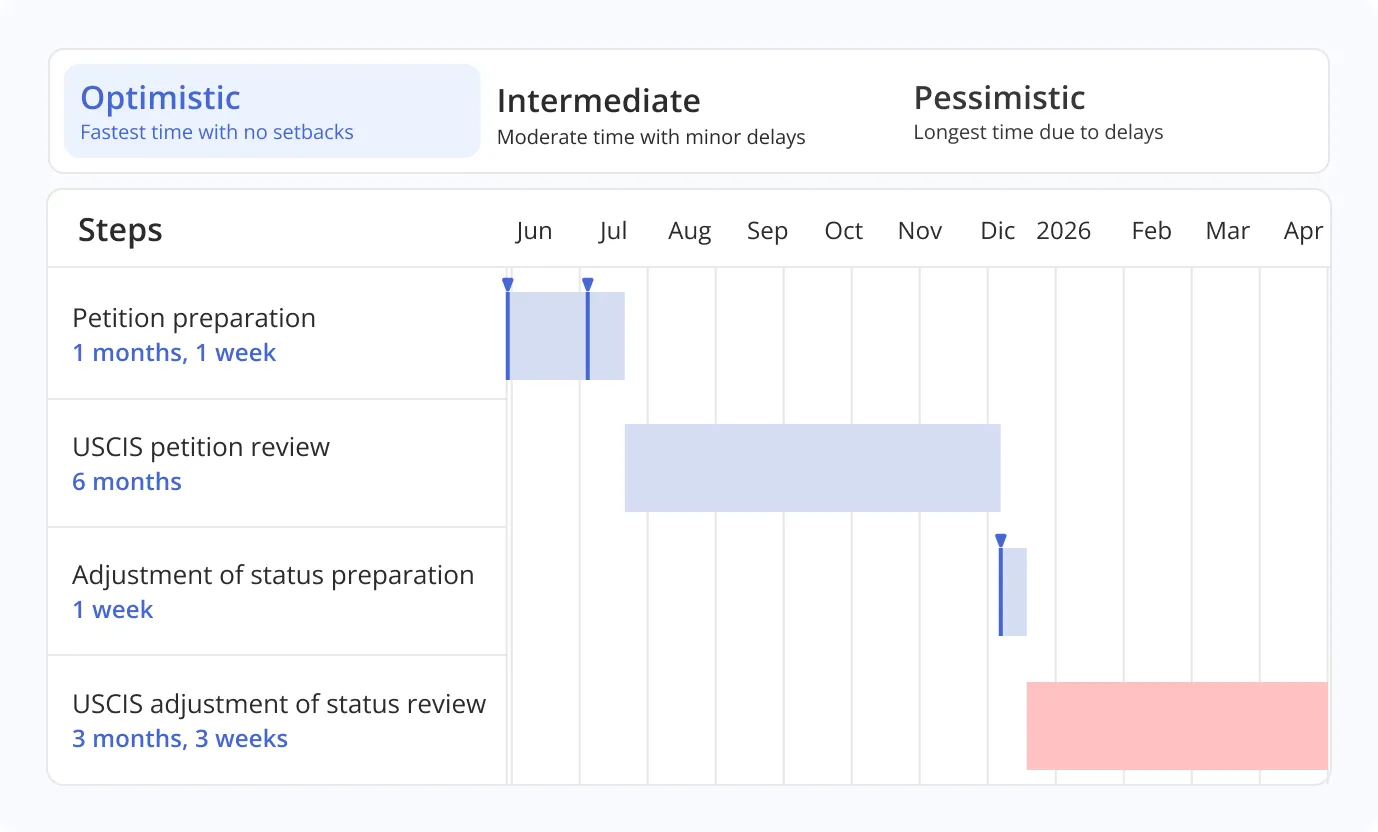
EB-2 NIW processing time depends on two separate clocks: how long USCIS takes to adjudicate your I-140 petition, and when your priority date becomes current under the Department of State's Visa Bulletin. Both have to clear before you receive a green card.
Processing type
Estimated timeline
Standard processing (Form I-140)
6-12 months (varies by USCIS service center workload)
Premium processing (Form I-140)
45 business days for an initial response
Adjustment of Status (Form I-485)
8-14 months once your priority date is current
Consular processing
2-6 months once your priority date is current
With premium processing, USCIS guarantees an initial response on your EB-2 NIW I-140 within 45 business days. That response can be an approval, a denial, or a Request for Evidence (RFE). If USCIS issues an RFE, the clock restarts once you respond. For a category-by-category breakdown of premium timelines, see our guide on I-140 premium processing time by EB category.
EB-2 NIW priority dates and the India and China backlog
Premium processing speeds up adjudication of the petition, but it does nothing for visa availability. EB-2 is an oversubscribed category, so your country of birth determines how long you wait for a green card once the I-140 is approved.
Most countries. The EB-2 final action date moves close to current in many months, with a wait measured in months rather than years.
India and China. These two countries carry the longest EB-2 backlog, and the wait can stretch for several years because of the per-country cap on green cards.
Because these cut-off dates change every month, applicants born in India or China should monitor the Visa Bulletin to know when they can file for adjustment of status or consular processing.
How to apply for the EB-2 NIW green card
The EB-2 NIW process runs from establishing eligibility through to your green card. Here is what to expect.
1. Confirm your EB-2 eligibility. Establish that you qualify through an advanced degree, a bachelor's degree plus five years of progressive experience, or exceptional ability. Gather official academic records and, for a foreign degree, an equivalency evaluation.
2. Define your endeavor. Draft the endeavor statement that anchors the whole petition: what you will work on in the United States, why it has substantial merit, and how it carries national importance. This is the document USCIS scrutinizes most.
3. Build your evidence portfolio. Gather documentation for each Dhanasar prong: publications, patents, grants, leadership roles, awards, contracts, and policy or funding sources that establish national importance.
4. Collect recommendation letters. Aim for letters from independent experts who can speak to your track record and to the national value of your work. Letters from people outside your own organization carry more weight than those from close colleagues.
5. File the I-140 petition. File Form I-140 (Immigrant Petition for Alien Workers) with all supporting evidence. As a self-petitioner, you file this yourself, and you can opt for premium processing for a faster initial response.
6. Wait for a decision. USCIS will approve, deny, or issue a Request for Evidence (RFE). If you get an RFE, respond thoroughly and within the deadline.
7. Apply for permanent residence. Once your I-140 is approved and your priority date is current on the Visa Bulletin, apply for your green card through Adjustment of Status (Form I-485, if you are already in the U.S.) or consular processing at a U.S. embassy abroad. As a lawful permanent resident, you will have full work authorization in the United States.
EB-2 NIW vs other green card pathways
The EB-2 NIW is one of several employment-based routes to a green card, and the right one depends on your profile.
EB-1A. The extraordinary ability green card also allows self-petition and usually has a shorter visa backlog, but it sets a higher evidentiary bar. If you are choosing between the two, our EB-2 NIW vs EB-1A comparison maps each profile to the better fit.
PERM-based EB-2 and EB-3. These require an employer to sponsor you and complete PERM labor certification. Our guide on choosing between PERM EB-2 or EB-3 covers when employer sponsorship makes sense over the national interest waiver.
From a temporary visa. Many professionals reach the EB-2 NIW after time on a work visa such as the H-1B or O-1A. The NIW is attractive at that stage because it does not require continued employer sponsorship.
Final thoughts
The EB-2 NIW is a powerful path to permanent residency for professionals whose work serves the national interest of the United States. Where employer-sponsored routes tie you to a job offer and the labor certification process, the national interest waiver rewards individuals who demonstrate both strong qualifications and the potential to contribute significantly to the country.
Success in this category comes down to the story you tell. Credentials open the door, but the endeavor statement, the evidence behind it, and the connection you draw to a U.S. national priority are what carry the petition. Applicants who frame their work in national terms, position themselves as capable of advancing it, and back every claim with independent evidence give themselves the strongest chance.
Tukki is a U.S. immigration service provider that helps foreign nationals build and file their EB-2 NIW green card petitions, with dedicated immigration attorney support and full case visibility from petition prep through green card approval.