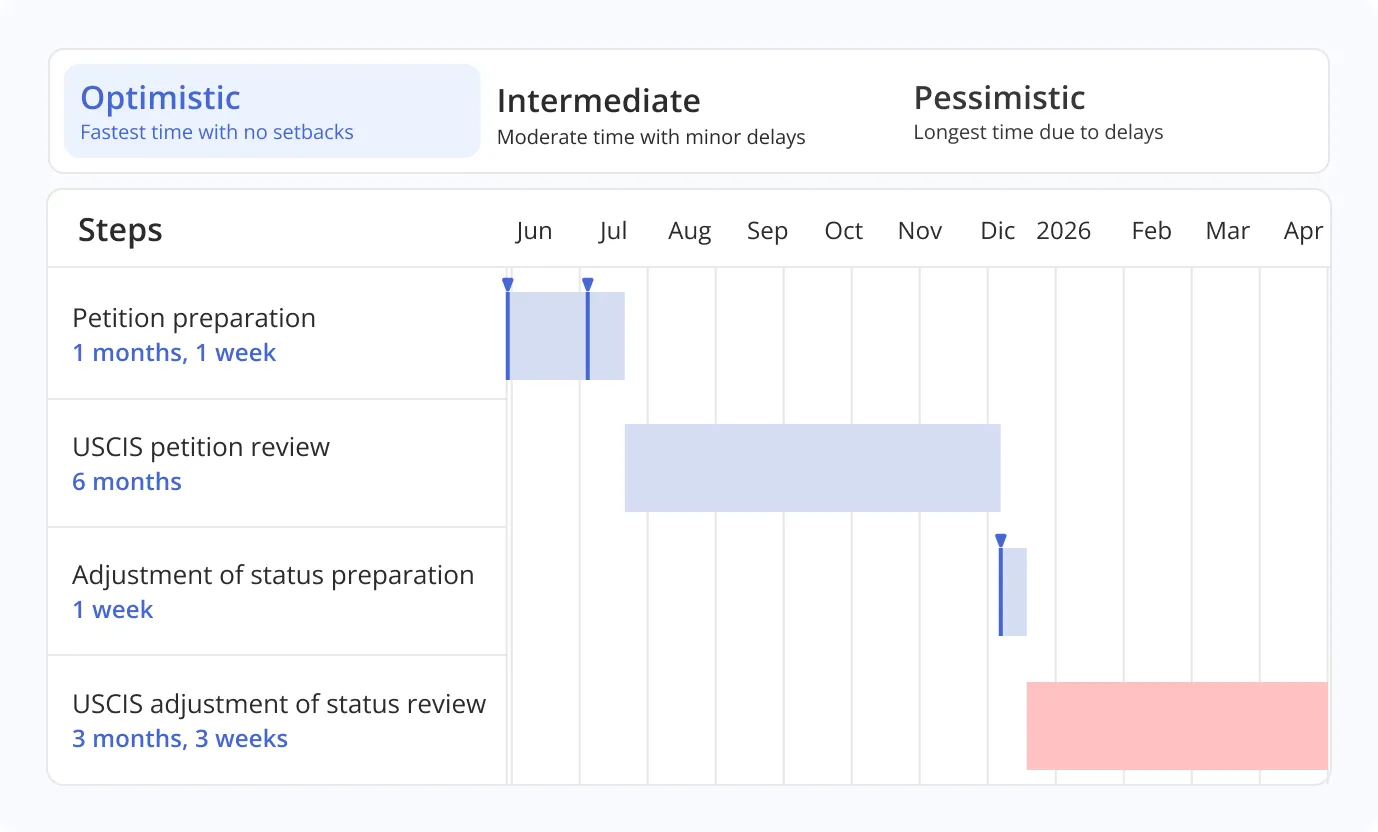
This guide is published by Tukki, a U.S. immigration service provider that helps professionals and companies navigate work visas and green cards like the H-1B, EB-2 NIW, EB-1A, O-1A, and employer-sponsored PERM cases. Tukki offers dedicated immigration attorney support, visa eligibility assessments, and full case management from petition preparation through approval.
PERM is the labor certification that an employer must obtain from the U.S. Department of Labor (DOL) before sponsoring a foreign worker for an EB-2 or EB-3 green card. PERM stands for Program Electronic Review Management, and although people often call it "the PERM visa," it is not a visa. It does not grant work authorization, status, or permission to remain in the United States. It is the gatekeeping step that tests the U.S. labor market before a permanent job can go to a foreign worker.
Before a company can offer a permanent job to a foreign worker, PERM requires it to prove that it tried to recruit U.S. workers, that no qualified and willing U.S. worker applied, and that the foreign worker will be paid at or above the prevailing wage. Once the PERM is certified, the employer files the I-140 immigrant petition, and when a visa becomes available the worker applies for the green card through Adjustment of Status or consular processing. This guide breaks down every PERM step, how a case becomes EB-2 or EB-3, the documentation both sides need, and the real costs and processing time.
Who needs a PERM labor certification?
PERM is an employer-driven process, so it splits cleanly between two parties. The employer carries the labor certification: defining the job, requesting the prevailing wage, running recruitment, and proving it can pay the wage. The foreign worker supplies the credentials that show they meet the job's minimum requirements. Both have to hold up for the green card to go through.
Most employment-based green cards in the EB-2 and EB-3 categories run through PERM. The main exceptions skip it entirely:
EB-2 National Interest Waiver (NIW) does not require an employer, a job offer, or PERM, because USCIS treats the applicant's work as inherently beneficial to the United States. It is an altogether different process covered in our EB-2 NIW guide.
EB-2 Exceptional Ability does require an employer and a job offer in the sciences, arts, or business, but bypasses PERM because the applicant meets a defined exceptional-ability standard.
EB-1 categories such as EB-1A (extraordinary ability) and EB-1C (multinational managers) do not use PERM.
Workers comparing pathways can use Tukki's Visa Match tool to see which green card options fit their profile.
The PERM process step by step
The PERM process for green cards runs in distinct stages, and every stage depends on the one before it. A mistake can force the employer to start over. End to end, the full PERM process averages 22-24 months, longer if the DOL issues an audit.
Step 1: Define the job duties and requirements
Everything begins with the job description. It determines the prevailing wage, whether the case lands in EB-2 or EB-3, the recruitment obligations, and how likely U.S. workers are to qualify. Minimum requirements must reflect what the role actually needs, nothing more and nothing less, and typically cover the degree (associate's, bachelor's, master's, or PhD), years of experience, years of training, specific skills or tools, language requirements, and any standard licenses or certifications.
This stage is a balancing act. More senior requirements mean fewer U.S. applicants will qualify, but they also raise the prevailing wage and risk exceeding DOL standards for the role, which forces the employer to justify business necessity and can trigger an audit or denial. Requirements drawn too broadly invite more qualified U.S. applicants, and a single qualified, willing U.S. worker blocks the PERM for that position. Requirements drawn too strictly can lead to audits and denials. Employers have to balance business needs, DOL standards, and budget at the same time.
Step 2: Prevailing wage determination (about 6 months)
After defining the job, the employer submits a prevailing wage request to the DOL, which issues a prevailing wage determination setting the minimum salary for that occupation in that location. The DOL calculates it from the job duties, required education, required experience, special skills or licenses, the level of independence and responsibility, and the city and state where the work is performed.
Step 3: Recruitment, the labor market test (30 days plus a 30-day quiet period)
Recruitment gives U.S. workers a fair chance to apply and generates the documentation the employer must keep in case of an audit. For professional roles the mandatory steps include a 30-day job order with the State Workforce Agency, two Sunday newspaper advertisements in a major newspaper, and a Notice of Filing posted at the worksite for at least 10 consecutive business days. Employers generally complete every step inside a 30-day window so the 30-day quiet period can start the day after the last ad comes down.
The employer then evaluates each applicant against the minimum requirements and whether they are ready, able, and willing to take the job under the offered conditions. A single U.S. worker who meets the minimum requirements and is willing to take the job is enough to block the PERM for that position.
Step 4: File the PERM (ETA-9089, 14-16 months to process)
Once recruitment is complete, the employer prepares the recruitment report and files the PERM application (Form ETA-9089) with the DOL. Processing times are long and often exceed a year. The DOL may approve the application, deny it, or issue an audit. In an audit, the employer must produce all recruitment materials, all resumes received, applicant evaluations, proof of the Notice of Filing, newspaper tear sheets or publisher affidavits, and any other recruitment or company documentation. Our guide on the PERM audit covers what triggers one and how it affects your timeline.
Step 5: File the I-140 immigrant petition
Once the PERM is certified, the employer files Form I-140 with USCIS. The analysis shifts from the job to the worker's qualifications and the employer's finances. USCIS asks three questions: does the worker meet every minimum requirement listed in the PERM, having acquired all required education and experience before the PERM was filed; is the job offer genuine and permanent; and can the employer pay the prevailing wage from the priority date until the worker becomes a permanent resident. Employers prove ability to pay with federal tax returns, annual reports, audited financial statements, or a combination of Forms 941, payroll records, and bank statements. If anything is unclear, USCIS may issue a Request for Evidence (RFE) or a Notice of Intent to Deny (NOID). Premium processing is available for most I-140 cases and guarantees a response within 15 business days. For a full breakdown of the form, see our Form I-140 guide.
Step 6: Apply for the green card
Once the I-140 is approved and the priority date is current in the Visa Bulletin, the worker files Adjustment of Status (Form I-485) if inside the U.S., or begins consular processing (Form DS-260) if outside. Adjustment applicants may also receive an EAD work permit and Advance Parole while the case is pending. Our guide on consular processing vs adjustment of status compares the two routes.
How PERM determines whether a case is EB-2 or EB-3
PERM is a single process, but it supports two distinct employment-based green cards: EB-2 (advanced degree or exceptional ability) and EB-3 (professionals, skilled workers, and other workers). Both follow exactly the same PERM steps. The difference is what the job requires, not what the worker has on their resume. A candidate with a master's degree can still land in EB-3 if the job only requires a bachelor's, and a candidate with only a bachelor's can qualify for EB-2 if the job requires a bachelor's plus five years of progressive experience. Our guide on choosing between PERM EB-2 or EB-3 walks through the trade-offs.
EB-2 classification
A job is EB-2 when it requires one of the following:
Advanced degree. The position requires a master's degree or higher, or its foreign equivalent, and the PERM must clearly state that the advanced degree is a minimum requirement.
Bachelor's degree plus five years of progressive experience. The job requires a bachelor's degree and five years of post-bachelor's progressively responsible experience in the field. "Progressive experience" means duties that increased in complexity and responsibility over time, not five years of static or entry-level tasks.
Examples of EB-2-level roles include senior, managerial, and director positions; computer and information research scientists; statisticians; lawyers; and physicians, dentists, or other graduate-level medical roles.
EB-3 classification
A job is EB-3 when its minimum requirements fall into one of three groups:
Professionals. The job requires a bachelor's degree, or foreign equivalent, with no progressive experience required. Most corporate and professional positions, including many STEM roles, fall here.
Skilled workers. The job requires at least two years of education, training, or experience but no bachelor's degree. Examples include technicians, supervisors, and specialized trades.
Other workers. The job requires less than two years of training or experience, such as factory, hospitality, agricultural, and entry-level operational roles.
EB-3 professional examples include accountants, marketing specialists, most engineers, and most technology roles. EB-3 other-worker examples include warehouse and production line workers, hospitality and service roles, agricultural workers, and office clerks.
Documentation requirements are identical for EB-2 and EB-3
Even though the job requirements differ, the documents needed for PERM and I-140 are the same in both categories. PERM evaluates the job and the employer's recruitment efforts; the I-140 focuses on whether the worker meets every minimum requirement listed in the PERM, whether there is a bona fide permanent job offer, and whether the employer has had, currently has, and will continue to have the ability to pay the offered wage from the priority date onward.
PERM documentation checklist
Employer documentation (PERM and I-140)
Corporate information. Legal company name, SS-4 EIN, business address and the worksite location, number of employees, a description of operations, and financial standing.
Job description and requirements. Detailed duties, minimum education, minimum experience, any specific skills, tools, certifications, licenses, or software, and a clear justification that the requirements reflect true business needs.
Recruitment evidence (audit file). Mandatory even if no audit occurs: all newspaper ads and publisher affidavits, printouts of all other postings, the SWA job order confirmation, the Notice of Filing with posting dates, resumes received, and a recruitment report explaining why each U.S. applicant was not qualified. The audit file is not submitted up front but must be retained for at least five years.
Ability to pay the prevailing wage. Federal tax returns, annual reports, audited financial statements, or a combination of Forms 941, payroll records, and bank statements. Ability to pay is one of the most common reasons for I-140 delays or denials, especially for startups, small companies, or employers with fluctuating revenue.
Employee documentation (PERM and I-140)
Educational evidence. Diplomas, official transcripts, and credential evaluations for foreign degrees.
Experience evidence. Letters from previous employers listing job titles, duties, dates of employment, and verification of the required experience.
Identity documentation. Passport biographical page and an updated resume.
Licenses or certifications. Only when the job genuinely needs them, such as medical licenses, technical certifications, or professional registrations.
How much does PERM cost?
The PERM labor certification itself carries no government filing fee. The DOL does not charge to process the prevailing wage request or the ETA-9089, and by law the employer, not the worker, must pay all PERM-related costs, including recruitment advertising. The fees arrive at the I-140 stage and beyond.
Cost
Amount
Prevailing wage request (DOL)
No fee
PERM labor certification, ETA-9089 (DOL)
No fee
Recruitment advertising (employer pays)
Varies, typically $1,000-$5,000+
Form I-140 filing fee
$700
Asylum Program Fee (employers with 25+ employees)
$600
Asylum Program Fee (small employers and nonprofits)
$300
Premium processing (Form I-907, I-140 only, optional)
$2,965
Adjustment of Status (Form I-485, if filing from within the U.S.)
$1,440
Premium processing applies only to the I-140, not to the PERM labor certification, so it cannot speed up the DOL stages. For a category-by-category breakdown of I-140 premium timelines, see our guide on I-140 premium processing time by EB category, and to file the upgrade itself, our Form I-907 guide. Attorney fees vary with case complexity.
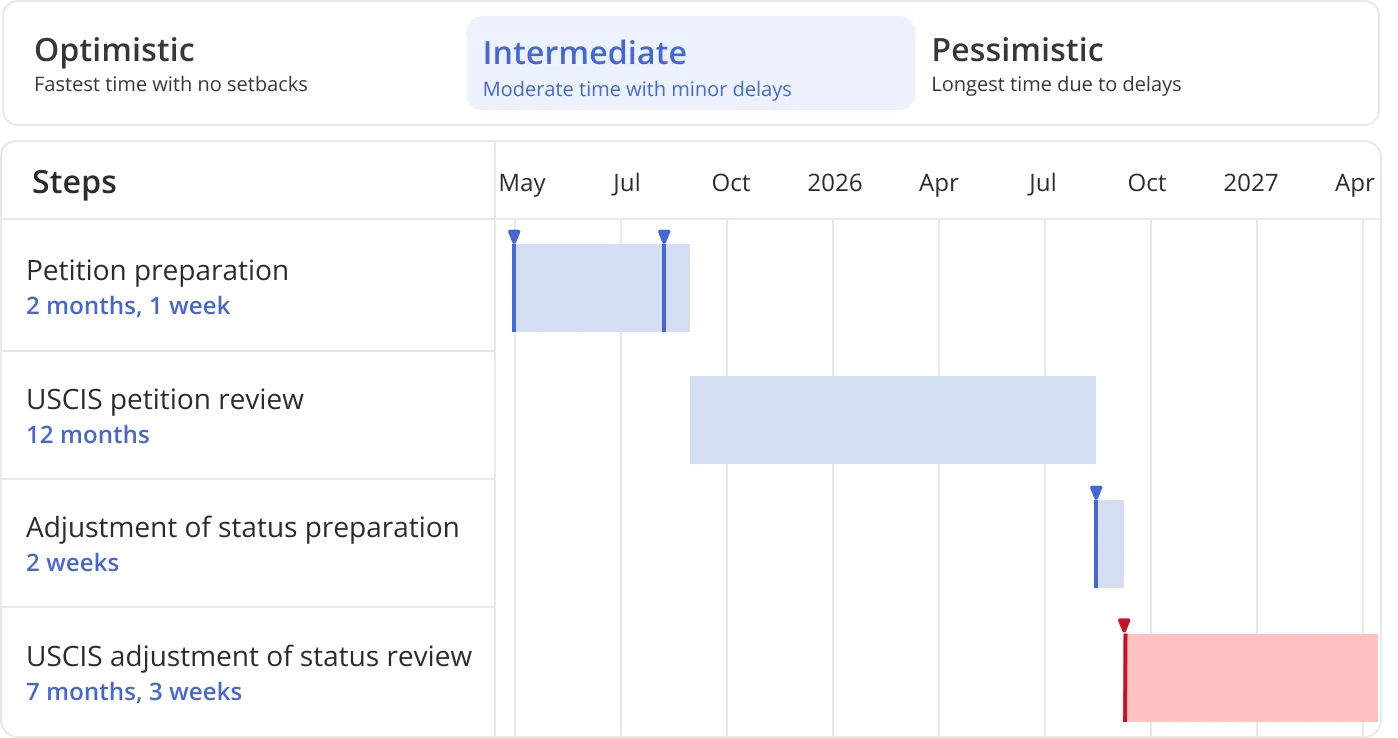
PERM processing time and timeline
The PERM timeline stacks several stages, and the green card wait at the end depends on the worker's country of birth.
Stage
Estimated timeline
Prevailing wage determination
About 6 months
Recruitment plus quiet period
About 60 days
PERM (ETA-9089) DOL processing
14-16 months (longer with an audit)
I-140 standard processing
Varies by service center
I-140 premium processing
15 business days
Adjustment of Status (Form I-485)
8-14 months once the priority date is current
Consular processing
2-6 months once the priority date is current
For a deeper look at the DOL stages, see our PERM processing time guide.
Priority dates and the EB-2 vs EB-3 backlog
Although EB-2 and EB-3 follow the same PERM steps, they move through the green card queue at different speeds because they use different categories in the Department of State's Visa Bulletin, which updates monthly. The priority date is the day the DOL receives the PERM, and it fixes the worker's place in line. Even after an I-140 approval, applicants can wait months or years for that date to become current, depending on their country of birth, and that wait determines when they can file for a green card, when they can obtain work or travel permits through Adjustment of Status, and the overall timeline to permanent residency. EB-2 is not always faster than EB-3, since per-country demand can make one category retrogress past the other in a given month.
Our guide on how to read the visa bulletin explains priority dates, final action dates, and dates for filing. When the line stalls, our explainer on why the visa bulletin is not moving covers retrogression and the per-country cap. During long waits, a worker can continue in H-1B, L-1, or another applicable nonimmigrant status. If the worker changes employers after the I-140 is approved, our guide on changing jobs after I-140 approval explains AC21 portability and what happens to the priority date.
PERM denials, RFEs, and delays
PERM is systematic, but several factors can complicate a case.
PERM denial. Common causes include improper recruitment, errors in the job description, problems with forms or timelines, a qualified U.S. worker who applied, audit inconsistencies, layoff-related restrictions, or requirements viewed as tailored or unjustifiable.
I-140 denial. Typically because the worker cannot prove they met the requirements at the time of PERM, the employer cannot prove ability to pay, inconsistencies exist between the PERM and I-140 documents, or USCIS finds deficiencies in the reference letters, transcripts, or credential evaluations.
Visa Bulletin delays. Even after I-140 approval, the priority date may take months or years to become current, depending on the worker's country of birth. If an Adjustment of Status application is later denied, our guide on how long you can stay after an I-485 denial covers the options.
Final thoughts
PERM is the foundation of most employer-sponsored green cards, and its outcome rests largely on decisions made at the very first step. The job description sets the prevailing wage, fixes whether the case is EB-2 or EB-3, defines the recruitment obligations, and shapes how exposed the case is to a qualified U.S. applicant or a DOL audit. Get that wrong and the employer can be forced to start over after more than a year of work.
For employers, the PERM process rewards careful planning, accurate recruitment, and clean documentation kept ready for an audit. For workers, the key is making sure your education and experience clearly meet every minimum requirement listed in the PERM before it is filed, and then tracking your priority date through the Visa Bulletin.
Tukki is a U.S. immigration service provider that helps companies and foreign workers run PERM labor certifications and EB-2 and EB-3 green card cases, with dedicated immigration attorney support and full case visibility from prevailing wage through green card approval.