Form I-290B after a denial: motion to reopen, motion to reconsider, or appeal
9 mins read | Oct 16, 2026
WHAT EACH KIND OF PROVIDER DOES
Contributor
Tukki
Reading time
9 mins read
Date published
Sep 11, 2026
How to choose an immigration lawyer usually gets framed as a budget question, because price is the part you can compare in an afternoon.
The harder question is who will be responsible for your case, whether you can reach that person, and how you will find out when something needs your attention. Two providers can quote the same number and run entirely different processes behind it.
Three broad service models handle employment-based U.S. immigration work:
Each one is the right answer for somebody. Finding a good immigration lawyer is a question of fit rather than ranking. The best immigration law firm for a colleague's petition can be a poor fit for yours. What your case needs matters more than the size of the letterhead.
The cost side lives elsewhere. Our breakdown of what immigration help costs covers fee models and totals. Our guide to what an immigration lawyer costs goes through flat fee versus hourly billing and how retainers work.
What you'll find here is the other half of the decision: four questions you can put to any provider on a call this week, and what each answer tells you.
Talk to an immigration attorney about your case
Federal regulation at 8 CFR 292.1 sets out the short list of people who may represent you, and for an employment-based case two categories matter.
The first category is an attorney. Under 8 CFR 1.2, an attorney is a member in good standing of the bar of the highest court of a U.S. jurisdiction, and eligible to practice law there. That jurisdiction can be any state, territory, possession or commonwealth, or the District of Columbia. The definition also requires that the attorney is not under any order suspending, enjoining, restraining or disbarring them.
Immigration is federal law, so bar admission anywhere in the United States is enough. An attorney admitted in New York can represent you if you live in Texas. That is not a warning sign by itself, as long as you check the admission with the licensing bar.
The second category is an accredited representative, a non-attorney approved through the Department of Justice Recognition and Accreditation program. The program is run by the Executive Office for Immigration Review (EOIR). EOIR publishes a public roster, so the credential is verifiable in a minute.
Recognition under 8 CFR 1292.11 is limited to non-profit, federally tax-exempt organizations serving primarily low-income and indigent clients. A recognized organization that charges fees must have a written policy for clients who cannot pay.
Accreditation has two levels and a fixed term:
Everyone else sits outside the list. USCIS runs its warning campaign under the Spanish term, and puts it plainly: a notario público, a notary public, is not authorized to provide legal services related to immigration. Only an attorney or an accredited representative at a recognized organization can give legal advice on your case.
The wording matters because the title means different things in different countries. In many Spanish-speaking countries a notario is a credentialed lawyer, while in the United States a notary public is not.
A consultant or form-filling service that gives you legal advice is engaged in the unauthorized practice of law. The filing still arrives at USCIS with your name on it.
Here is the whole list in one view, with how to check each credential.
| Who | May represent you before USCIS | How to verify |
|---|---|---|
| Attorney | Yes, if admitted to and in good standing with any U.S. state bar and not under an order restricting practice | The licensing state bar's public directory |
| EOIR accredited representative | Yes, within the accreditation level, working for an EOIR-recognized organization | The EOIR recognition and accreditation roster |
| Law student or law graduate | Only under an attorney's direct supervision and without payment from you | Named alongside the supervising attorney on Form G-28 |
| Notary public, notario público, consultant or form preparer | No | Not applicable, this is the unauthorized practice of law |
The three models differ less in legal skill than in what they are built to absorb.
Those structures produce different answers to the four questions below. None of the answers is wrong. They are trade-offs, and knowing which one you are making is most of what separates a decision from a guess.
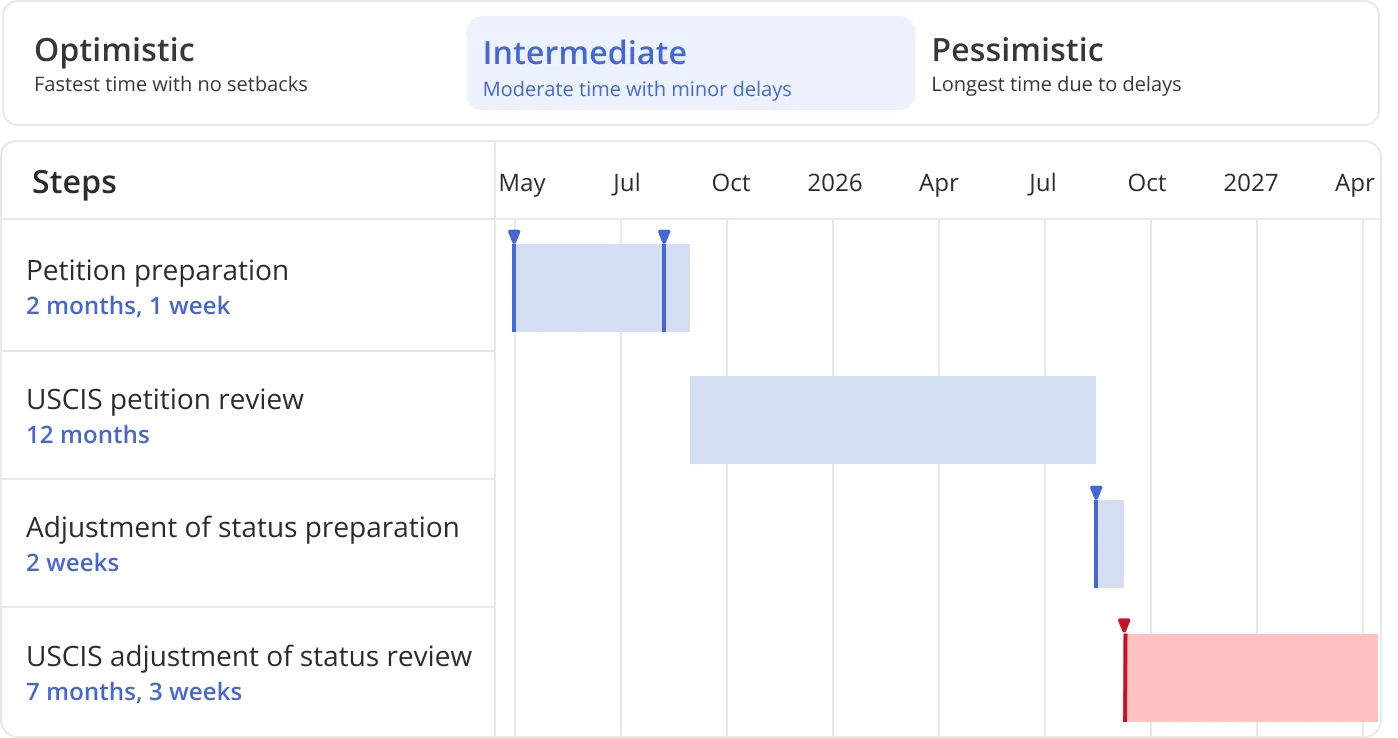
Form G-28, Notice of Entry of Appearance as Attorney or Accredited Representative, is how a representative establishes with the Department of Homeland Security that they are eligible to represent you. It has to be filed in each case, and USCIS only recognizes a G-28 that is properly completed and signed by both the representative and you. Our guide to Form G-28 walks through the form itself.
Here is what it settles. The person named becomes the attorney or accredited representative of record, and under 8 CFR 292.5 notices, service and correspondence run to that person. Part 4 lets you choose whether USCIS sends original notices and secure identity documents to your representative, with copies to you. Signing also puts that person under the professional conduct rules at 8 CFR 292.3, which DHS enforces with sanctions up to expulsion from practice.
What the G-28 does NOT do is promise that the signer is the only person who touches your file. That idea circulates widely and has no basis in the regulations.
Paralegals draft, junior attorneys assemble exhibits and senior attorneys review, in firms of every size. When someone stands in for a limited purpose such as an interview, they file their own G-28 and the original representative stays of record and keeps receiving the notices.
Ask three questions instead of one:
In a large firm those are frequently three different people, and a partner signing while an associate drafts is ordinary practice. In a boutique the answers often collapse into one or two names. In a managed service the attorney signs and reviews while a defined team runs document collection around them.
Any of these works. Not getting the names is the problem.
Response time is the biggest source of complaints about immigration providers and the easiest thing to test before you sign. Ask what the typical turnaround on an email is, who that email reaches, and what happens if you do not hear back. Then notice how long the provider took to answer your own first enquiry.
Billing structure shapes this more than people expect. Under hourly billing every question carries a price, which tends to make clients ration questions and save them up. Under a flat fee, asking costs nothing extra, so the practical limit becomes staffing rather than your own hesitation. Neither model is better in the abstract, and they create different habits.
The other variable is who is on the other end. A named attorney replying directly gives you legal judgment on the first response. A case manager replying directly gives you a faster answer on status and documents, with legal questions routed onward.
Global firms spread across time zones can answer around the clock and can also lose a day to a handoff. Ask whether legal questions reach an attorney or stop at an intake layer.
If you are still weighing whether you need representation at all, our post on whether you need an immigration lawyer covers where self-filing is realistic.
Case status visibility is the difference between knowing what is outstanding and emailing someone to find out. The USCIS online tools tell you very little on their own. They show receipt-level status and published processing times once a petition has been filed, and they say nothing about the months before filing when evidence is being gathered.
That stretch is where most of the waiting and most of the anxiety sit. Our guides to checking USCIS case status and reading Form I-797 notices explain what the online tools do show.
Ask what you will be able to see and when. Some firms work by email and send a summary when a stage closes, which suits a client who would rather not be involved day to day. Others give you a portal listing outstanding documents, drafts under review and filing dates.
Ask a follow-up: who keeps it current, and how often. A portal nobody updates is worse than a weekly email, because it looks like information.
Ask how document collection runs, too. One large upload at the start, with silence until the petition is ready, puts all the feedback at the end. That is the point where a weak exhibit is most expensive to fix.
This is the question providers volunteer least often, and the one that separates them most. A Request for Evidence (RFE) is a notice from USCIS asking for more proof before it decides, and it sets its own response deadline. Miss it and USCIS decides on the record it already has.
Our guide to USCIS Requests for Evidence covers why they arrive. Our piece on how long USCIS takes to respond to an RFE covers what happens once you file one.
Three things are worth pinning down before you sign.
If your employer is paying, ask who the provider represents. On an employer-sponsored petition the company is the petitioner and you are the beneficiary. Ask whether a Form G-28 names you as well, and ask how the provider handles the moments when your interests and the company's diverge.
That tension is a structural fact of sponsored cases, and a provider who has thought about it will say so plainly.
If you are mid-case and thinking about moving, our guide to switching immigration lawyers covers how the change works without losing your priority date. That is the date that fixes your place in line for a green card.
A large full-service firm is a reasonable answer for a complex multi-country corporate structure. Having corporate, tax and employment lawyers down the hall carries real value, and a smaller shop cannot replicate it. That matters when the case involves:
The trade-off is more layers between you and the person drafting, usually with hourly billing.
A boutique immigration law firm is a strong answer when your case sits squarely in a category the firm files constantly. It also suits you if you want direct access to the person writing the petition. Depth in one lane tends to mean the firm has seen your evidentiary problem before.
The trade-off is capacity, since a small team is a small team.
A managed service fits well when the case is a defined employment-based filing. Most of the work there is evidence strategy, document coordination and keeping a long process moving without losing weeks to silence.
The trade-off is scope, because a managed service is built around the categories it files rather than every corner of immigration law.
| What to check | Large full-service firm | Boutique immigration firm | Managed service |
|---|---|---|---|
| Who signs the G-28 | Often a partner, with associates and paralegals drafting | Frequently the attorney you spoke to | The reviewing attorney, with a defined preparation team |
| Who answers you | Varies by seniority and time zone | Usually the same small group throughout | A named contact for process, attorneys for legal questions |
| Case visibility | Commonly email updates at stage boundaries | Direct but informal, depends on the individual | Typically a client-facing view of what is outstanding |
| RFE and denials | Usually new billable work unless agreed up front | Varies by firm, ask before signing | Ask whether the response sits inside the quoted price |
| Strongest fit | Multi-entity structures and cases touching several practice areas | Repeat work in a narrow set of categories | Defined employment-based petitions run over months |
Fees and inclusions change, so confirm anything in this table with the provider directly rather than assuming it holds across a category.
Knowing how to choose an immigration lawyer comes down to asking four things and writing the answers down:
A provider who answers all four clearly is telling you how they operate. A provider who answers vaguely is telling you something too. These are the questions to ask an immigration lawyer on a first call, and they work equally well on a firm of four hundred and a firm of four.
Tukki helps skilled professionals and their employers with U.S. work visas and green cards, from H-1B and O-1A nonimmigrant visas through EB-1A and EB-2 NIW petitions for permanent residence.
Our attorneys prepare, review and sign the petitions, and they are who you speak to about legal questions on your own case.
Tukki quotes one end price that already includes government filing fees and any RFE response the case needs.
You can see the figure for your category and nationality in the pricing tool.
If you want a straight answer on which category fits your profile and what your case would involve, book an intro call and ask the four questions.
WE CAN HELP
Need more clarity?
Find quick answers to frequent visa questions from our legal experts
Can I file for a green card while on an O-1 visa?
Yes. The O-1 is treated as dual-intent friendly in practice, even though it isn't a formal dual-intent visa like the H-1B. You can file an I-140 and, if your priority date is current, an I-485 concurrently while maintaining O-1 status.
Many O-1A holders move directly to EB-1A self-petitions using evidence they've already gathered.
What is PERM?
A PERM (Program Electronic Review Management) is a labor certification issued by the U.S. Department of Labor. It does NOT give immigration status. Instead, it confirms that no qualified and willing U.S. worker is available for the job and that the employer will pay at least the prevailing wage. It is the first step toward most EB-2 and EB-3 green cards.
What is EB-1A?
A visa for individuals with extraordinary ability.
Can a TN visa convert to a green card directly?
No. There's no direct conversion from TN status to permanent residence. You'll need to go through a separate employment-based green card process (EB-1A, EB-2, EB-2 NIW, or EB-3) while managing the nonimmigrant intent requirement of your TN status.
Other blogs for every step of your visa journey
Form I-290B after a denial: motion to reopen, motion to reconsider, or appeal
9 mins read | Oct 16, 2026
EB-2 NIW approval rate: what the published numbers show and where cases fail
8 mins read | Oct 15, 2026
Form I-539: how to extend or change your status without leaving the U.S.
8 mins read | Oct 14, 2026