Form I-290B after a denial: motion to reopen, motion to reconsider, or appeal
9 mins read | Oct 16, 2026
PRICING THE HELP, NOT FILING FEES
Contributor
Tukki
Reading time
9 mins read
Date published
Jul 19, 2026
The fees for immigration services in 2026 fall into a range rather than a single price, because how much help costs depends on the model you choose: doing it yourself carries only the government filing fees, an attorney typically adds a few thousand dollars in professional fees per case, and an end-to-end managed service bundles the legal work, the platform, and the filing into one predictable price. What you pay for help is a separate question from what you pay the government, and mixing the two is the most common reason people misjudge the cost.
This guide lays out the three ways to get through an immigration case and prices each one honestly, so you can match the spend to your situation whether you are an individual applicant or an HR buyer handling cases for a team. We are not ranking the models. Each one fits a different case, and by the end you should know which fits yours.
The first thing to separate is government filing fees from the fees for immigration services, because they behave completely differently. Government filing fees are fixed amounts set by U.S. Citizenship and Immigration Services (USCIS) and the Department of State, the same for everyone filing the same form, and you pay them no matter who prepares your case. The cost of help is what you pay a professional or a service to do the work, and it is market-based, so it varies by provider, model, and case complexity.
Think of it this way: the government fee is the price of the ticket, and the cost of help is the price of having someone plan the trip, pack the case, and get you to the gate on time. You always pay the ticket. Whether you pay for help, and how much, is the decision this article is about.
A quick example makes the split concrete. An H-1B or a green card carries USCIS filing fees that are the same regardless of who files. What changes from one applicant to the next is whether they prepared the petition alone, paid an attorney by the hour, or bought a flat-fee service that included the filing. This post is about that second number, the cost of help. For the per-form government fees themselves, our U.S. work visa cost guide lists them form by form, and work visa sponsorship cost covers the employer-paid side.
Doing an immigration case yourself costs only the government filing fees, with no professional fee on top, and in exchange you take on the preparation, the legal judgment, and the risk of errors. For a straightforward filing where the facts are clean and the form is well documented, this is a real option, and plenty of people complete cases this way. Your out-of-pocket cost is whatever USCIS or the Department of State charges for the forms your case needs, and nothing more.
What you take on is the work and the responsibility. You research which forms apply, gather and translate the evidence, complete each form correctly, and respond to any USCIS questions on your own. If USCIS issues an RFE, a Request for Evidence asking for more documentation, you draft the response yourself, and a weak response can lead to a denial that costs you the filing fee and the time. The trade-off is straightforward: you save the professional fee and carry the case yourself.
DIY tends to fit simpler, well-trodden filings where you have time to learn the process and the stakes of a delay are manageable. It fits less well when the case is complex, the timing is tight, or a denial would put your status or your job at risk. Our guide on whether you need an immigration lawyer walks through where that line usually falls, case by case.
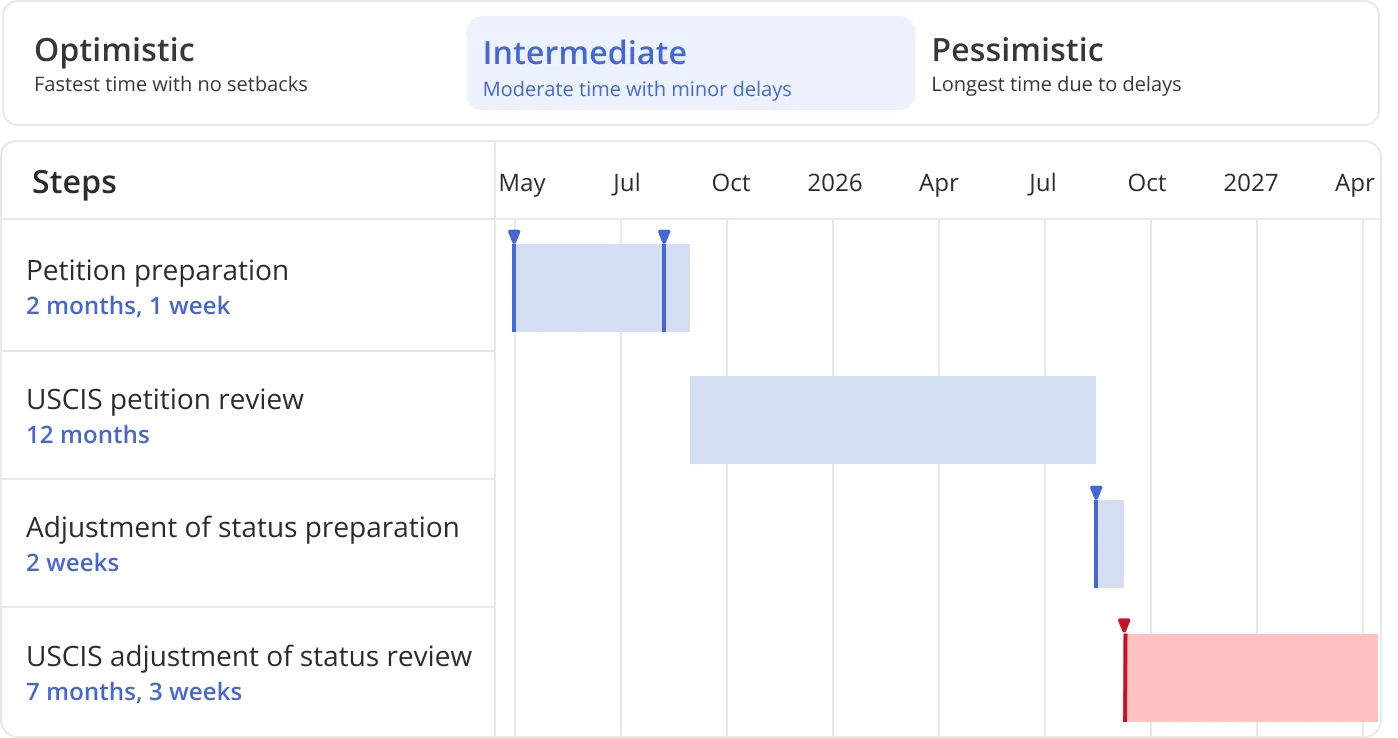
An immigration attorney adds a professional fee on top of the government filing fees, and that fee is usually structured in one of two ways: a flat fee per case or an hourly rate. Which one you encounter depends on the attorney and the type of case, and each answers a different kind of need. A flat fee gives you a known number before work begins, which suits cases where the scope is predictable. Hourly billing charges for time spent, which suits cases where the scope is genuinely uncertain and hard to quote up front.
Flat fees for a single employment-based case commonly range from about $2,000 to $8,000 or more in professional fees, depending on the visa type and how much documentation the case demands. A well-documented self-petition or a complex green card sequence sits toward the higher end, while a more routine filing sits lower. Hourly rates for immigration attorneys generally fall between roughly $150 and $400 an hour, so the total on an hourly case depends on how many hours it takes, which is exactly what makes it harder to predict.
The important detail for budgeting is what the fee does and does not cover. Some flat fees cover one stage only, so a multi-stage green card might be quoted as separate fees for each stage, and an RFE response may be billed on top. Others cover the whole case including RFEs. Ask which before you sign, because the sticker price and the all-in price can differ. For a deeper look at attorney pricing structures, our immigration lawyer cost guide breaks down flat versus hourly in detail.
An attorney fits when your case needs legal judgment: an unusual fact pattern, a prior denial, a tight deadline, or a category where the evidence has to be argued rather than simply assembled. In those cases the professional fee buys expertise applied to a specific problem, and you are paying for the judgment as much as the paperwork.
An end-to-end managed service bundles the legal work, a case-management platform, and the filing into a single price, so instead of separate invoices for each stage and each RFE, you pay one predictable fee for the whole case. This is the model Tukki uses, and it fits people who want the legal expertise of an attorney combined with visibility into where their case stands at every step. The price covers the preparation, the attorney review, the filing, and the responses USCIS may ask for, which keeps the number stable from start to finish.
What distinguishes a managed service is the combination of three things in one price: experienced immigration attorneys who build and file the case, a platform that shows you what has been done and what comes next, and continuous support so you are not left guessing between updates. For an individual, that means one number and a clear view of progress. For a company, it means the same case handled with a dashboard where HR can see the status of every employee's case in one place, and where the beneficiaries keep a direct line to the attorneys handling their filings.
The managed model fits when predictability and visibility matter as much as the legal work itself. An individual juggling a case alongside a demanding job values not having to chase updates, and a company managing several cases at once values seeing the whole portfolio without emailing for status. Because the fee is quoted per case up front, you know the cost before you commit, and RFE responses are included rather than billed as extras. For startups and teams weighing this route, our guide on the best immigration services for startups compares how to choose a provider.
The right spend on immigration services comes down to matching the model to your case, not to finding the lowest number, because the cheapest option on paper is not always the one that fits your situation. Three factors move the decision: how complex your case is, how many filings you are handling, and how much you value visibility and having the work carried for you. A simple, single filing with time to spare points one way; a complex or high-stakes case, or a whole company's worth of cases, points another.
Here is how the three models compare on price and what they include, so you can line them up against your own case.
| Model | What you pay | What it includes | Fits when |
|---|---|---|---|
| DIY | Government filing fees only | You prepare and file everything | The case is simple and you have time |
| Attorney (flat or hourly) | Government fees + professional fee (roughly $2,000 to $8,000+ flat, or $150 to $400/hour) | Legal preparation and judgment, scope varies by quote | The case needs expertise on a specific problem |
| Managed service | Government fees + one bundled service fee | Attorneys, platform visibility, filing, and RFE responses in one price | You want predictability and case visibility, or you manage several cases |
Whatever model you choose, ask one question before you commit: what is included in the price, and what is billed separately. The gap between a quoted fee and the all-in cost usually hides in extras like RFE responses, per-stage billing, or add-on filings. Tukki quotes one end price that already folds in the government fees your case needs and any RFE response, so the number you see is the number you pay, with no separate surprises mid-case. You can see your own figure for your visa type and nationality with the pricing tool, and if you are still deciding which visa applies, the visa match tool narrows it down first.
Tukki is a U.S. immigration provider that helps skilled professionals and their employers with work visas and green cards, from H-1B and O-1A to EB-1A and EB-2 NIW, combining experienced attorney support with a platform that keeps your case visible at every step. Whether you are handling one case or a company's worth of them, our team can show you what the help will cost before you commit.
Individuals can book an intro call to talk through their case, and companies weighing a managed program for a team can book a demo of the platform.
WE CAN HELP
Need more clarity?
Find quick answers to frequent visa questions from our legal experts
How does the EB-2 NIW standard compare to EB-1A?
They are different tests and the evidence does not transfer cleanly. EB-1A is decided on criteria plus a final merits determination, while the NIW is decided on the three Dhanasar prongs.
Our comparison of EB-2 NIW and EB-1A and our explainer on the final merits determination cover the difference.
Can I work in the U.S. while waiting for my green card through consular processing?
Consular processing does not provide any interim U.S. work authorization. If you need to work in the U.S. while waiting, you'll need to maintain a separate work visa (like an H-1B or L-1).
This is one of the main reasons many applicants already in the U.S. prefer adjustment of status, which allows them to apply for an EAD while the green card is pending.
Can I switch to an H-1B after a STEM OPT denial?
It can be possible if you have a sponsoring employer and secure a cap-subject registration and selection, or qualify for a cap-exempt H-1B. The cleaner path is filing a change of status while you are still inside your grace period and lawfully present.
Our OPT to H-1B transition guide covers the cap, the lottery, and the cap-gap timing that shapes whether this route fits your calendar.
Can my own startup sponsor my H-1B visa?
It can, but only if you hold a minority ownership stake and the company has a governance structure that gives others genuine authority over your employment. If you're the majority owner, USCIS will likely find that no valid employer-employee relationship exists.
The safest approach is to self-sponsor through a properly structured company with co-founders or board members holding majority control.
Other blogs for every step of your visa journey
Form I-290B after a denial: motion to reopen, motion to reconsider, or appeal
9 mins read | Oct 16, 2026
EB-2 NIW approval rate: what the published numbers show and where cases fail
8 mins read | Oct 15, 2026
Form I-539: how to extend or change your status without leaving the U.S.
8 mins read | Oct 14, 2026