You have a valid visa and an EAD at the same time - which one you work on and why it matters
8 mins read | Oct 6, 2026
FROM OPT TO PERMANENT RESIDENCE
Contributor
Tukki
Reading time
11 mins read
Date published
Sep 9, 2026
Hiring a graduating international student starts out smooth, and that is worth saying before anything else. The student arrives with work authorization already in hand, which is why the first year feels easy and why so many companies are caught out by the second one. What happens after that depends on the route the employee takes, and one of those routes runs all the way to a green card.
Three separate clocks govern the years that follow, and each one is set by a different agency.
This article walks the student visa to green card route one filing at a time. What gets filed at each stage, who files it, what the company pays, and where the path breaks. It is written for whoever carries immigration inside the company, from a first-time sponsor to an established mobility program.
The costs below are the government fees a sponsoring employer carries, verified against the USCIS fee schedule in September 2026. Attorney fees sit on top and vary by provider. Our pricing tool shows what the legal side runs at each stage.
Talk to our immigration team about sponsoring your international hires
Sponsoring a new graduate from F-1 to green card means three distinct legs, and the employer isn't the filer on all of them. Knowing who holds the pen on each filing is the difference between a calendar that works and one that quietly misses a deadline nobody owned.
Post-completion OPT is requested on Form I-765, the Application for Employment Authorization. The designated school official at the university has to recommend it in the student records system first.
The employer's role is smaller. You need a job that matches the field of study. For the STEM extension you also need E-Verify enrollment and a signed Form I-983, the training plan that documents supervision and learning objectives. An employer not enrolled in E-Verify cannot support a STEM OPT extension, which cuts the runway from 36 months to 12.
H-1B takes three filings. An electronic registration in March, then a certified Labor Condition Application from the Department of Labor if the registration is selected, then Form I-129 with USCIS.
Some employers skip the lottery entirely. Universities, affiliated nonprofit research organizations, nonprofit research organizations and government research organizations are cap exempt and can file any time of year. If your company has a research affiliation with a university, check whether that status applies before planning around a March deadline. Our guide to H-1B cap-exempt employers covers the categories.
The green card leg has two employer filings. PERM labor certification goes to the Department of Labor, and Form I-140, the Immigrant Petition for Alien Worker, goes to USCIS.
Only at the very end does the filing return to the employee. They file Form I-485 to adjust status to permanent resident, usually alongside applications for an employment authorization document and advance parole.
The F-1 to H-1B to green card timeline runs roughly four to seven years for a new graduate. It runs longer if the employee was born in India or China. The table below is the spine of the process: what is filed in each period, who files it, and the failure mode for that step. Government fees have their own section further down.
| Year | What gets filed | Who files it | What can go wrong |
|---|---|---|---|
| Year 1, at graduation | Form I-765 for post-completion OPT, after DSO recommendation | Student | Filed late or outside the window, leaving a gap with no work authorization |
| Year 1, first months | Form I-983 training plan if the degree is STEM and the employer is on E-Verify | Student and employer jointly | Employer not enrolled in E-Verify, so no 24-month extension is possible |
| Year 1, March | H-1B electronic registration for the cap | Employer | Not selected. There is no appeal and no waitlist |
| Year 1, spring | Labor Condition Application, then Form I-129 if selected | Employer | LCA wage level set too low, or a specialty occupation challenge on the role |
| Year 2, 1 October | H-1B status begins, three years | Employer already filed | Cap-gap, the automatic extension of F-1 status and OPT work authorization, ran out before this date |
| Year 2 to 3 | ETA-9141 prevailing wage determination, then PERM recruitment | Employer | PWD comes back above the offered salary, forcing a raise or a re-file |
| Year 3 to 4 | ETA-9089 PERM application, then Form I-140 | Employer | PERM audit adds months, or the case is denied and recruitment restarts |
| Year 4 onward | H-1B extensions past the six-year limit under the American Competitiveness in the Twenty-First Century Act (AC21) | Employer | Nothing, if PERM or I-140 was filed early enough to qualify |
| Final step | Form I-485 with I-765 and I-131, when the priority date is current | Employee | Job change or role change during the wait, requiring Supplement J, the form confirming the new role is the same or similar to the one on the I-140 |

Two filings carry government fees: the H-1B petition and Form I-140. A petitioner with 25 or fewer full-time equivalent employees in the United States pays a reduced rate on three of them.
| Fee | Standard petitioner | 25 or fewer FTEs |
|---|---|---|
| H-1B registration | $215 | $215 |
| Form I-129 base fee | $780 | $460 |
| ACWIA training fee | $1,500 | $750 |
| Fraud Prevention and Detection Fee | $500 | $500 |
| Asylum Program Fee | $600 | $300 |
| H-1B stage total | $3,595 | $2,225 |
| Form I-140 filing fee | $715 | $715 |
| Asylum Program Fee (I-140) | $600 | $300 |
| I-140 stage total | $1,315 | $1,015 |
| Total, both stages | $4,910 | $3,240 |
Nonprofits and government research organizations are exempt from the Asylum Program Fee entirely, and certain nonprofit and government research employers are also exempt from ACWIA. A 20-person startup should budget $3,240 across the two stages rather than $4,910.
Premium processing costs $2,965 on Form I-129 and on Form I-140 after the inflation adjustment that took effect on 1 March 2026, and it buys a 15-business-day response window. It earns its price in three situations.
When neither stage is under date pressure, the same money can stay in the budget.
Check the CPT record before the offer goes out. Some programs issue Curricular Practical Training from the first day of enrollment. If the graduate's work authorization traces back to one, verify the school's standing and the student's record now. A CPT record that USCIS later treats as improperly issued can surface years later, in the middle of an otherwise clean adjustment of status case.
Our guides to H-1B sponsorship costs for employers and work visa sponsorship cost break the budget down further.
Some of these costs are a policy choice and some are not.
On the H-1B side, the Department of Labor regulation at 20 CFR 655.731 is direct. An employer may not make the employee pay any part of the required wage back to the company. Any deduction that pushes effective pay below the required wage is a violation.
That rule captures the ACWIA training fee explicitly, and the Fraud Prevention and Detection Fee is the employer's by statute. The whole H-1B stack sits with the company and cannot be moved to the employee, even by agreement.
PERM is stricter still. Under 20 CFR 656.12(b), the employer must pay the costs of preparing, filing and obtaining labor certification, and an employee may not pay them or reimburse the employer for them. Recruitment advertising, the newspaper ads, the job order, and the attorney fees attributable to the PERM case are all on the company. The narrow exception is the employee's own legal fees for representation that is genuinely separate from the employer's case.

After that point the rules relax. Form I-140 and Form I-485 fees, and the employment authorization and advance parole applications that go with adjustment of status, are not regulated the same way. Who pays becomes a matter of company policy.
Most employers who sponsor to permanent residence cover the I-140 and leave the family's adjustment fees to the employee. Some cover everything for the principal employee only. Whichever line you draw, write it down before the first offer rather than negotiating it case by case.
Our guides to the Labor Condition Application and building a company immigration policy cover the mechanics.
Two figures you may have seen quoted don't belong in a 2026 budget.
The first is a $100,000 supplemental H-1B fee introduced in September 2025. The U.S. District Court for the District of Massachusetts vacated it on 8 June 2026 in California v. Mullin, and the First Circuit denied a stay on 24 July 2026. USCIS is complying with the vacatur, though the agency's own fee schedule document still prints the line.
The second is a proposal published on 25 August 2026 that would charge $103,265 on every cap-subject petition, including those filed under the advanced degree exemption. Comments are open until 24 September 2026. A proposed rule becomes a budget line only once it is final.
Most F-1 to green card cases that fail come apart at one of three handoffs, where one clock expires before the next one starts, rather than at adjudication. The table below is worth keeping next to the offer letter.
| Break point | When it hits | What happens to the employee | What the employer can do about it |
|---|---|---|---|
| OPT ends with no lottery selection | 12 months after graduation for non-STEM, 36 for STEM | Work authorization ends, 60-day grace period, then departure | Enroll in E-Verify early, consider cap-exempt affiliations, look at O-1 or an overseas placement |
| Cap-gap runs out | 1 April following the fiscal year the petition was filed for | Employment must stop even though the petition may still be pending | File in premium processing, and track the April date rather than the 1 October date |
| PERM started too late | Around the start of year 5 of H-1B status | No basis for extension past six years, status ends | Start the prevailing wage request by the end of year 3 of H-1B status |
Post-completion OPT gives a bachelor's or master's graduate 12 months of work authorization. A degree on the STEM designated list, with an E-Verify employer and a signed Form I-983, adds 24 months, for a total of 36. That is the entire runway, and it maps to three March registration windows for a STEM graduate and one, sometimes two, for everyone else.
The odds on each of those attempts changed in 2026. A DHS final rule effective 27 February 2026 replaced uniform random selection with weighted selection by wage level. Entries in the pool now scale with the wage level of the role.
| OEWS wage level | Entries in the selection pool |
|---|---|
| Level IV | 4 |
| Level III | 3 |
| Level II | 2 |
| Level I | 1 |
A new graduate offered an entry-level salary sits, by design, in the weakest position in the draw. If the role can legitimately be scoped and paid at a higher wage level, that is now a selection decision and not only a compensation one. Our breakdown of H-1B prevailing wage levels explains how the levels are set.
When the runway ends without a selection, three routes stay open. A cap-exempt employer, a different classification such as O-1 or an intracompany transfer after a year abroad, or an overseas placement that keeps the person employed until the next March. Alternatives to the H-1B visa covers the routes that work for early-career hires.
Cap-gap carries an F-1 student's status and OPT work authorization forward automatically. It applies once a cap-subject H-1B petition requesting a change of status has been timely filed on their behalf.
Under a final rule effective 17 January 2025, that extension now runs to 1 April of the fiscal year the petition was filed for. It used to end on 1 October.
The longer window is genuine relief, and it also creates the trap. Employers read "April" as safety and stop tracking the case.
If the petition is still pending on 1 April, or is denied, the employee's authorization ends on that date. It does not end on the H-1B start date written in the calendar. The 60-day grace period that follows a status end is not automatic in every scenario, and it carries no work authorization.
Two practical rules follow. The April date goes on the HR calendar as a hard stop, and any case still pending in February gets upgraded to premium processing.
We walk the sequence in OPT to H-1B transition and the annual rhythm in the H-1B cap season HR calendar.
H-1B status is capped at six years. Two provisions of the American Competitiveness in the Twenty-First Century Act extend past that limit, and both require that something already be on file.
Neither is available to an employee whose PERM was filed last month.
Working backward from the six-year mark is what sets the start date, and the math runs longer than most HR calendars assume.
| PERM stage | How long it takes | What sets the clock |
|---|---|---|
| ETA-9141 prevailing wage determination | Roughly 3 months. At the end of August 2026 the Department of Labor was working on requests filed in May 2026 | Queue at the National Prevailing Wage Center |
| Recruitment | At least 30 days | Fixed in regulation |
| Quiet period before filing | At least 30 more days after the last recruitment step closes | 20 CFR 656.17 |
| PERM analyst review | Close to 10 months. Review was reaching applications filed in November 2025 | Backlog at the Atlanta National Processing Center |
Add those together and the prevailing wage request needs to go out around the end of year 3 of H-1B status to leave any margin. None of that duration is anyone's processing speed.
Our PERM processing time guide tracks the current queues, and employer-sponsored green card covers the full sequence. The choice between EB-2 and EB-3 gets made at this stage too, and it changes the wait that follows. See PERM EB-2 or EB-3.
The priority date is the day the Department of Labor accepts the PERM application. It fixes the employee's place in a queue the employer cannot speed up.
Once the I-140 is approved, the remaining wait is set by the monthly Visa Bulletin and by statutory per-country limits. Nothing happening inside your company or your law firm moves it.
Two charts run each month and only one of them governs at a time. Dates for Filing tells you when an adjustment application may be submitted. Final Action Dates tells you when a green card can be issued.
For September 2026, USCIS directs all employment-based adjustment applicants to use the Final Action Dates chart. That instruction is reissued every month and it changes. Read the chart directive before you read the dates, and pull both from the current Visa Bulletin rather than from a figure quoted in an article.
What doesn't change month to month is the shape of the queue.
| Country of birth | Where EB-2 and EB-3 sit | What that means from the offer letter |
|---|---|---|
| Most of the world | A couple of years behind the present | Roughly a four to six year project |
| China | Between the other two | Longer, with H-1B extensions likely needed |
| India | More than a decade behind | Measured in decades, spent on AC21 H-1B extensions |
That gap is statutory, and a faster law firm cannot close it. Each country gets the same share of the annual employment-based allocation regardless of how many of its nationals are in line. Two employees hired the same week can be four years and twenty years from the same outcome.
Dates can also move backward when demand in a category outruns the numbers available that year. That is retrogression, and it is why a date that looked current in one bulletin can be out of reach in the next.
Say this out loud in the offer conversation. The alternative is an employee who concludes in year six that somebody has been slow.
Reading the bulletin correctly matters more than watching it. Our guides to how to read the visa bulletin and why the visa bulletin is not moving explain the two charts and the retrogression mechanic.
When the date does become current, the employee files Form I-485 at $1,440, usually alongside Form I-765 at $260 and Form I-131 at $630. H-1B to green card covers the overlap between maintaining status and adjusting it.
All fees, processing queues and Visa Bulletin dates in this article are current as of September 2026. Government fees change by rule and the bulletin changes monthly, so verify against USCIS and the Department of State before you commit numbers to a budget.
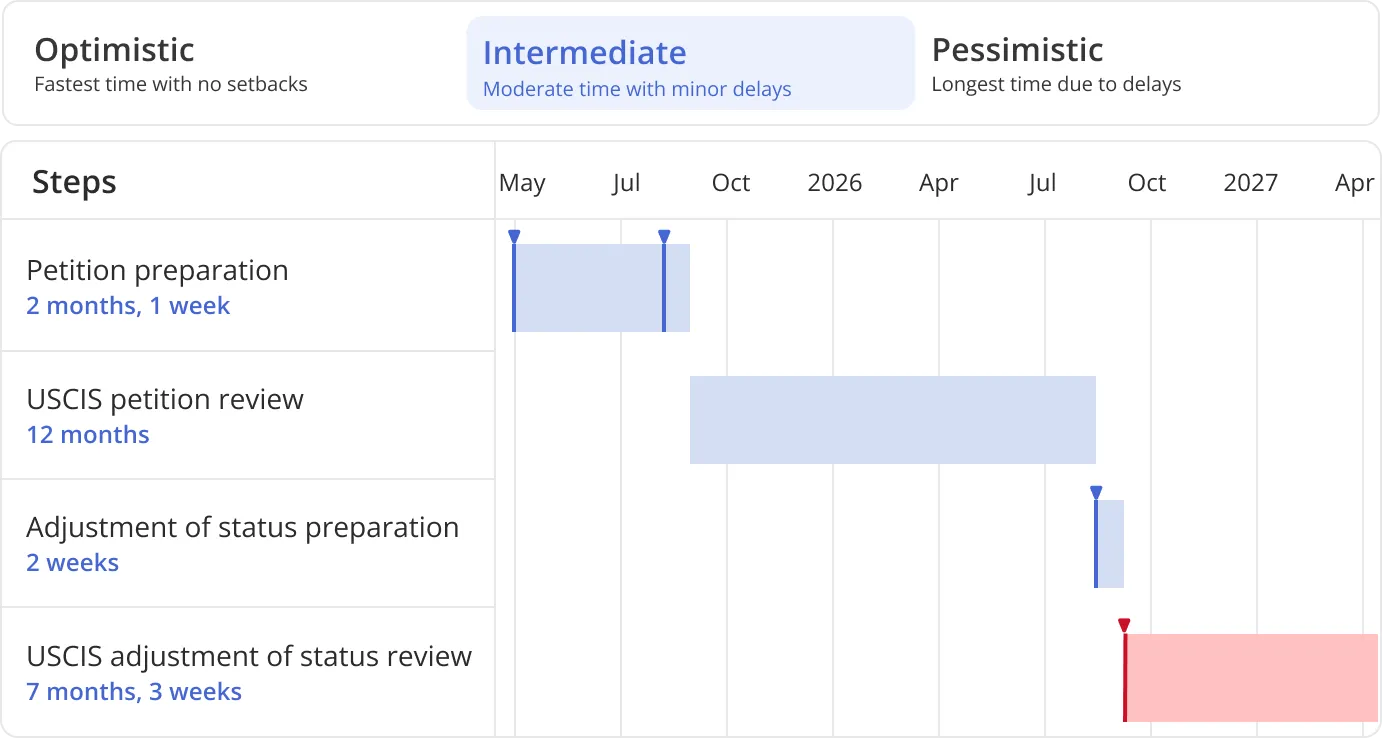
The OPT to green card path is manageable on a calendar and unmanageable from memory. A single hire generates six dates to track:
Ten hires generate sixty of those dates, and the one that gets missed is always the one nobody was assigned. Running several student visa to green card cases at once is a tracking problem long before it becomes a legal one.
Hiring international students at any volume means holding all of that in one place. Tukki gives HR one view of where every sponsored employee sits, from the OPT end date through the registration window to the PERM start trigger and the priority date.
Immigration attorneys build the H-1B petition, run the PERM recruitment, and prepare the I-140 and the adjustment package. Sponsored employees get a direct line to those attorneys for their own questions, so status anxiety does not route through HR.
If sponsorship is new to your company, our guide to how to sponsor a foreign worker covers what the first case asks of you.
WE CAN HELP
Need more clarity?
Find quick answers to frequent visa questions from our legal experts
Can I file Form I-907 online?
Yes, for many I-129 and I-140 combinations, when the underlying petition is also eligible for online filing through myUSCIS. The USCIS I-907 page lists which combinations are currently online-eligible, since the program expands as more categories come on.
Does either the L-1A or L-1B require a college degree?
No. Neither the L-1A nor the regular (individual) L-1B petition has a formal education requirement.
The L-1A is based on managerial or executive capacity, and the L-1B is based on specialized knowledge of the company rather than academic credentials.
However, L-1B petitions filed under a blanket L program do require the employee to meet additional criteria, including specific educational or experience thresholds.
This distinction sets the L-1 apart from the H-1B visa, which generally requires at least a bachelor’s degree or its equivalent as a core eligibility requirement.
What counts as a lawful reason to reject a U.S. applicant?
A reason tied to the job requirements listed on the ETA Form 9089. Under 20 CFR § 656.24(b)(2)(i), an applicant is qualified if they can perform the duties in the normally accepted manner, or can acquire the necessary skills during a reasonable period of on-the-job training.
Preference, cultural fit and internal seniority bars are not lawful job-related reasons in this context.
Do all companies that sponsor visas file for the H-1B?
No. Companies that sponsor visas can file under several categories, including the O-1 for people with extraordinary ability, the L-1 for intracompany transfers, the TN for Canadian and Mexican professionals, and the E-3 for Australian nationals.
The H-1B is the most common, but an employer that says it doesn't sponsor H-1B roles may still support another visa that fits your profile.
Is H-1B selection first-come, first-served?
No. The H-1B lottery is not a first-come, first-served process.
Selections are made randomly after the registration window closes.
Other blogs for every step of your visa journey
You have a valid visa and an EAD at the same time - which one you work on and why it matters
8 mins read | Oct 6, 2026
J-1 Research Scholar, Specialist and Trainee - the three categories employers use
8 mins read | Oct 5, 2026
RFE or NOID - what a notice of intent to deny means for your case
9 mins read | Oct 2, 2026