Form I-290B after a denial: motion to reopen, motion to reconsider, or appeal
9 mins read | Oct 16, 2026
H-1B TO GREEN CARD PATHWAY
Contributor
Tukki
Reading time
12 mins read
Date published
May 27, 2026
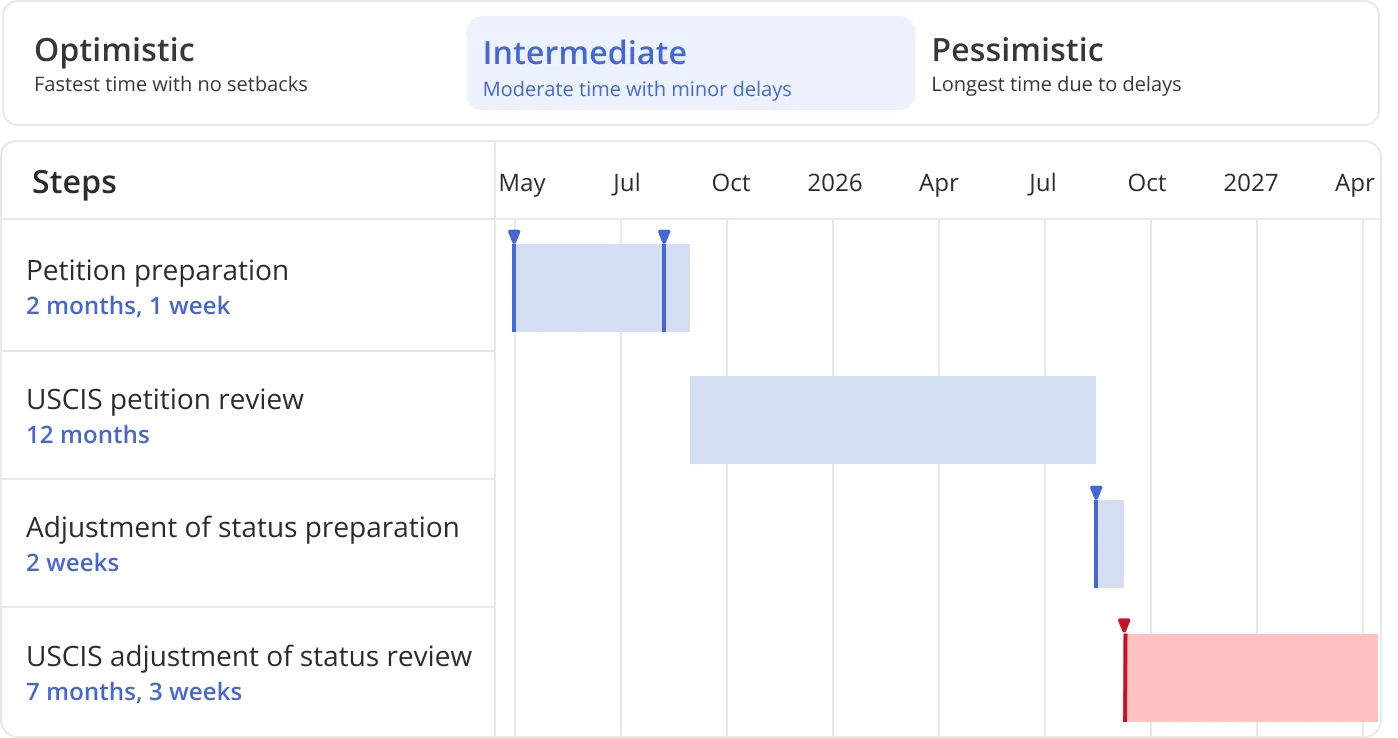
Update, May 2026 USCIS policy memo. On May 21, 2026, USCIS issued memo PM-602-0199 framing Form I-485 adjustment of status as discretionary relief reserved for cases with unusual or outstanding equities. The heightened standard applies to every pending and future I-485, regardless of when it was filed. Consular processing abroad is now positioned as the default green card path, though I-485 remains available and is still approved when the discretionary review weighs in the applicant's favor. This guidance is still new, and how USCIS applies it in practice is likely to keep developing. We'll flag where it changes practice in the sections below.
Last reviewed: May 27, 2026.
There are several paths to a green card, and the H-1B to green card route is one of the most common: a three-step process that runs through the Department of Labor and USCIS. Most H-1B workers go through PERM labor certification, then Form I-140 to USCIS, then Form I-485 adjustment of status (or DS-260 consular processing if they're abroad). The total timeline runs five to ten or more years for Indian and Chinese nationals because of the Visa Bulletin backlog, and roughly two to three years for everyone else. This guide walks through what each step actually involves, who is responsible for what, and the AC21 provisions that keep your H-1B alive past the six-year cap while the green card moves.
Most H-1B workers move to a green card through the standard PERM, I-140, I-485 sequence. The H-1B is a dual-intent visa, which means filing for a green card doesn't put your H-1B status at risk the way it would on an F-1 or B-2. That single fact is why most employer-sponsored green card cases in the U.S. start from an H-1B.
PERM labor certification is the first step. Your employer files Form ETA-9089 with the Department of Labor after running a recruitment process designed to test the U.S. labor market for your role. PERM certification typically takes 22 to 24 months end-to-end, including the prevailing wage determination that has to happen before recruitment can start. Audits can extend that timeline further.
Form I-140 is the second step. Your employer files Form I-140 with USCIS after PERM is certified, classifying you under one of the employment-based preference categories (usually EB-2 or EB-3). The I-140 confirms USCIS agrees with the EB category your employer claimed; your priority date was already set by the date DOL received your PERM filing. Premium processing is available on the I-140 if you want a faster decision (covered below).
Form I-485 is the third step, if you're inside the U.S. when your priority date becomes current. Form I-485 is the adjustment of status application that converts your nonimmigrant H-1B status into lawful permanent residence. If you're outside the U.S. when your priority date is current, you go through consular processing using DS-260 instead. Our consular processing vs adjustment of status guide walks through how to choose between the two.
The employer files PERM and the I-140. Both are formally the employer's filings, and the employer (not the employee) signs the petition. The employee gives the employer documents (degree, transcripts, experience letters, resume) but the case belongs to the employer through I-140 approval.
The employee files Form I-485 in their own name once a priority date is current. The employer is no longer the filer at that stage, though many employers continue to pay attorney fees for I-485 work as a benefit.
| Country of birth | PERM | I-140 | Priority date wait | I-485 / consular | Total range |
|---|---|---|---|---|---|
| All other countries (ROW) | 22 to 24 months | 6 to 9 months (or 15 business days with premium processing) | Often current or near-current | 12 to 18 months | 2 to 3 years |
| India (EB-2 or EB-3) | 22 to 24 months | Same as above | Decade-plus | 12 to 18 months | 10 to 15+ years |
| China (EB-2 or EB-3) | 22 to 24 months | Same as above | Multi-year | 12 to 18 months | 5 to 10 years |
The PERM and I-140 timeline is roughly the same across countries because USCIS doesn't differentiate by nationality at those stages. The country-of-birth gap shows up at the priority-date wait because the Visa Bulletin's 7% per-country cap caps how fast India and China can move through any given fiscal year.
PERM is the longest single step in the H-1B to green card pathway, and it's where most of the upfront cost lives. Your employer is testing whether qualified U.S. workers are available for the role at the prevailing wage. If recruitment turns up no qualified U.S. applicants, PERM certifies and you move forward to I-140.
The first sub-step is the prevailing wage determination. Your employer (or their attorney) files Form ETA-9141 with the Department of Labor's National Prevailing Wage Center. The DOL reviews the job description, location, and required qualifications and assigns one of four wage levels: Level 1 (entry), Level 2 (qualified), Level 3 (experienced), or Level 4 (highly specialized). The prevailing wage determination usually takes four to six months in 2026.
The wage level matters because the offered wage on PERM has to equal or exceed it, and because Wage Level 1 is often challenged on green card cases for the same reasons it gets challenged on H-1Bs. Our H-1B prevailing wage levels guide walks through how DOL sets each level.
Once the prevailing wage is in hand, your employer runs recruitment. For professional positions, DOL requires a job order with the state workforce agency, two Sunday newspaper ads, and at least three of ten additional recruitment activities (job fairs, employer website, employee referral with cash incentives, campus recruiting, trade journals, professional organizations, private employment firms, search firms, on-campus recruiting, and ethnic/local newspapers). All of this has to happen in a strict window relative to the PERM filing.
Recruitment usually takes 60 days plus a 30-day quiet period before PERM can be filed. Any qualified U.S. applicant who applies has to be considered in good faith, and the employer documents the reason for not hiring each applicant.
Form ETA-9089 is filed electronically with DOL once recruitment is complete. The form summarizes the recruitment results, the prevailing wage determination, the job duties and requirements, and the foreign worker's qualifications. DOL adjudicates ETA-9089 in three ways: certification (approval), audit (request for the full recruitment file), or supervised recruitment (a second, DOL-monitored recruitment round).
End-to-end PERM in 2026 typically runs 22 to 24 months: four to six months for the prevailing wage, three months for recruitment, and fourteen to sixteen months for DOL to adjudicate the filed ETA-9089. PERM audits add three to six months, and supervised recruitment can add a year or more. Our PERM processing time guide breaks down each sub-step with the current DOL data.
Once PERM is certified, your employer files Form I-140 with USCIS. The I-140 establishes that you qualify for the EB category being claimed and locks in your priority date (which is the date DOL received your PERM filing, not the date the I-140 is filed).
PERM doesn't define the EB category; the I-140 does. Most H-1B-to-green-card cases file under EB-2 (advanced degree professionals) or EB-3 (skilled workers and professionals). EB-2 requires a U.S. master's or higher, or a U.S. bachelor's plus progressive post-bachelor experience. EB-3 covers bachelor's-level professional roles and skilled workers with at least two years of training or experience.
The strategic question is which category to claim. EB-2 sits higher in the preference order, but EB-3 cutoff dates sometimes move ahead of EB-2 for India and China, which is why some applicants downgrade from EB-2 to EB-3 after the I-140 is approved. Our PERM EB-2 or EB-3 guide covers when each category is the right call and how downgrade filings work.
USCIS offers premium processing on I-140 for $2,965 with a 15-business-day response window for EB-1A, EB-2 standard, and EB-3 cases. EB-2 NIW and EB-1C have a 45-business-day window under premium. Premium processing only accelerates the I-140 adjudication, not the priority date or the I-485. Our I-140 premium processing time by EB category guide covers the exact windows per category.
For a complete walkthrough of what Form I-140 actually contains, see our Form I-140 guide.
For the PERM, your priority date is the date DOL received your PERM application. It's your place in line. Once your priority date is earlier than the cutoff date in the Visa Bulletin for your category and country of birth, a visa number is available and you can file Form I-485 (or move forward at the consulate). Our how to read the Visa Bulletin guide walks through how to find your row each month.
For India- and China-born applicants, the priority-date wait often outlasts the H-1B's six-year cap. That's where AC21 comes in: its provisions let you extend H-1B status in one-year or three-year increments past the six-year cap while you wait for a current priority date.
Form I-485 is filed by you, not your employer, once your priority date is current and you're physically inside the U.S. Adjustment of status converts your H-1B nonimmigrant status into lawful permanent residence without leaving the country.
You can file I-485 in the month USCIS announces the Visa Bulletin chart that lets your priority date through. USCIS picks between the Final Action Dates chart and the Dates for Filing chart each month and posts which one applies for I-485 filings. If you can file, you submit Form I-485 along with optional Form I-765 (work permit) and Form I-131 (Advance Parole) to keep work authorization and travel flexibility while the I-485 is pending. Our Form I-485 guide walks through every supporting form.
If your priority date is current at the time the I-140 is filed, you can file I-140 and I-485 concurrently (in the same package). Concurrent filing is common for EB-1A and EB-2 NIW self-petitions from ROW countries because those categories often have current priority dates. For employer-sponsored EB-2 and EB-3 cases originating from H-1B, concurrent filing is rare for India and China because the priority date is typically far behind the cutoff at the time of I-140 filing.
The May 2026 USCIS memo changes the calculus on concurrent and standalone I-485 filings: USCIS now reviews every I-485 under a heightened discretionary standard, weighing positive and negative factors in the applicant's record before approval. Filings continue to be accepted and many are still approved, but if your record has any flags (overstays, unauthorized work, misrepresentation), it's worth discussing consular processing with an attorney before committing to the I-485 route.
Once Form I-485 is filed, you can apply for Form I-765 to get an Employment Authorization Document (EAD), and Form I-131 to get Advance Parole for international travel. Both are typically issued in three to six months. The EAD lets you work for any employer, not just your H-1B sponsor, but using it triggers a switch from H-1B status to AOS (adjustment of status applicant) status, which has different rules around travel and renewal. Our Form I-765 guide covers how to apply for the EAD.
The cleaner path is to keep your H-1B active through I-485 approval rather than switching to EAD, because the H-1B keeps your status independent of the I-485 outcome. If the I-485 is denied under the May 2026 discretionary standard, you keep your H-1B and your job rather than falling out of status. Our how long can you stay after I-485 denied guide explains the consequences of denial.
Reviewer note (pricing, to confirm before publishing). The figures in this section are not final. Corrections flagged by the prior reviewing attorney (MB):
- Recruitment advertising: draft says $5,000 to $15,000; MB says about $2,500.
- PERM attorney fee: MB suggests raising it toward $8,000 (Tukki's rate).
- I-140 filing attorney fee: MB says Tukki charges about $2,500.
- Figures assume a small employer; MB notes the $300 Asylum Program Fee is missing from employer costs.
- Family of four total: draft says about $4,380 in USCIS fees; MB's all-in figure is about $11,980 (note the draft math: 2 x $1,440 plus 2 x $950 is $4,780).
- Premium processing shows $2,965; verify against the current USCIS I-140 premium processing fee.
Total costs for the H-1B to green card pathway vary by employer (some pay everything, some pay only what the law requires) and by whether you're filing for family members alongside yourself.
PERM filing has no DOL fee, but recruitment advertising costs $5,000 to $15,000 depending on the markets and outlets. Attorney fees for PERM run $4,000 to $8,000 flat. The I-140 USCIS fee is $715, premium processing (optional) is $2,965, and attorney fees for I-140 run $2,000 to $4,000. All of these costs are required by law to be paid by the employer, not the employee, for the PERM portion. I-140 attorney fees can be paid by either party.
I-485 costs $1,440 per adult plus $950 per child under 14. Form I-765 (EAD) and Form I-131 (Advance Parole) are typically filed alongside I-485 with no additional fee. Medical exams (Form I-693) run $200 to $500 per person. Attorney fees for I-485 family packages typically run $2,500 to $5,000.
A family of four (two adults, two kids) looking at the full I-485 stage is roughly $4,380 in USCIS fees plus medical exams and attorney fees. For a complete breakdown of every fee across the full pathway, see our work visa sponsorship cost guide and US work visa cost guide.
Tukki is a U.S. immigration provider focused on employment-based visas and green cards. From H-1B sponsorship through PERM, I-140, and I-485, our licensed immigration attorneys handle every step of the H-1B to green card pathway with full case visibility for both HR teams and the H-1B beneficiary.
WE CAN HELP
Need more clarity?
Find quick answers to frequent visa questions from our legal experts
How much does green card sponsorship cost the employer?
Employer green card sponsorship through the PERM, I-140, and I-485 route typically ranges from $14,000 to $30,000. This includes recruitment advertising ($1,000 to $3,000), the I-140 filing fee ($715 plus the Asylum Program Fee), and attorney fees ($8,000 to $18,000+).
The I-485 adjustment of status fee ($1,440) is often covered by the employer but isn't legally required.
How much does it cost to renew an H-1B?
An H-1B renewal (same employer, extension of stay on Form I-129) costs the same as a new petition minus the registration fee and the fraud prevention fee. A large employer pays roughly $780 + $1,500 + $600 = $2,880 in USCIS fees on a renewal, plus $3,000 to $4,500 in attorney costs.
Renewals skip the lottery and can usually be filed any time within six months of the current I-94 expiration.
Does each employer pay separate filing fees?
Yes. Each employer must pay the filing fees for their own H-1B petition, including the base fee and any applicable fraud prevention or American Competitiveness and Workforce Improvement Act (ACWIA) fees.
If the employer wants expedited processing, they also pay the premium processing fee.
Can the short-term placement rule for H-1B workers cover a permanent move to another state?
No. The rule covers up to 30 workdays in a one-year period, or 60 where the worker keeps a work station and a U.S. residence in the area of their permanent worksite, and it requires the employer to pay lodging, travel, and meal costs throughout. Someone who has relocated their home fails the residence condition.
The provision is unavailable in any area where the employer already holds a certified LCA for that occupation.
Can dependents of O-1 or H-1B visa holders attend public school in the U.S.?
Yes. Children with O-3 or H-4 visas may attend public schools without additional authorization.
Other blogs for every step of your visa journey
Form I-290B after a denial: motion to reopen, motion to reconsider, or appeal
9 mins read | Oct 16, 2026
EB-2 NIW approval rate: what the published numbers show and where cases fail
8 mins read | Oct 15, 2026
Form I-539: how to extend or change your status without leaving the U.S.
8 mins read | Oct 14, 2026