Your immigration forms - what each one is for and what to check before you sign
9 mins read | Oct 13, 2026
AN EMPLOYER'S SPONSORSHIP GUIDE
Contributor
Tukki
Reading time
9 mins read
Date published
Jul 4, 2026
An employer-sponsored green card is the path a company uses to move an employee from temporary work authorization to permanent residence, and for most professional roles it runs through three stages: PERM labor certification with the Department of Labor, Form I-140 with USCIS, and then Form I-485 to adjust status. This guide walks HR and hiring managers through what the employer actually has to do at each stage, what it costs the company, and how long to budget for, so you can plan a green card sponsorship the way you plan any other multi-quarter project.
Temporary work-visa sponsorship and permanent green card sponsorship are two different jobs. The cost of sponsoring a temporary work visa covers petitions like the H-1B that give an employee a fixed number of years of authorization. The permanent path covered here ends in a green card, which lets the employee stay indefinitely and removes the renewal cycle you'd otherwise manage for years. If you already sponsored someone on an H-1B and want the full crossover, our guide to the H-1B to green card pathway maps how the two connect.
Employer-sponsored green card sponsorship works in three sequential stages, and each one has to finish before the next can start. The employer proves to the Department of Labor that no qualified U.S. worker is available for the role (PERM), files a petition with USCIS establishing that the employee qualifies and the company can pay the wage (Form I-140), and then supports the employee's application for the green card itself (Form I-485 if the employee is inside the United States). Miss a step or file it out of order, and the case resets, which is why the sequence matters as much as the paperwork.
The employer is the petitioner in this process, which means the company files and signs the first two stages. Your employee is the beneficiary. That split shapes who does what: PERM and I-140 are built around the job and the company, while the final green card application centers on the individual and their family. Keeping that distinction clear from the start helps HR know which documents to gather internally and which ones sit with the employee.
Below is the shape of the full path before we break down each stage.
| Stage | Who files | What it proves | Typical duration |
|---|---|---|---|
| PERM labor certification | Employer | No qualified U.S. worker is available at the prevailing wage | 22-24 months on average |
| Form I-140 | Employer | The employee qualifies and the company can pay the wage | 6 months, or 15 business days with premium processing |
| Form I-485 | Employee | The individual is admissible and a visa number is available | Depends on the priority date and country of birth |
PERM labor certification is the first stage of an employer-sponsored green card, and it's the one that lands squarely on the company. PERM stands for Program Electronic Review Management, a process run by the Department of Labor (DOL) in which the employer proves it tried to recruit U.S. workers for the role and that no qualified, willing U.S. worker applied. It also fixes the prevailing wage, the minimum salary the DOL sets for that occupation in that location, which the company commits to paying.
The process itself has a strict internal order. First, the employer defines the job duties and minimum requirements, since those drive everything downstream: the prevailing wage, whether the case lands in EB-2 or EB-3, and how many U.S. applicants might qualify. Next comes the prevailing wage determination, where the DOL calculates the required salary based on the duties, education, and location, a step that takes around six months on its own. Then the employer runs a real recruitment campaign, including a 30-day job order with the state workforce agency, two Sunday newspaper advertisements, and a notice posted at the worksite for at least 10 business days, followed by a 30-day quiet period.
One point HR should internalize early: if a single qualified and willing U.S. worker applies during recruitment and meets the minimum requirements, the employer cannot proceed with the PERM for that position. That's the labor market test working as designed, and it's why the job requirements have to be defined carefully rather than written to fit one person. Requirements that look tailored or unusually narrow can trigger a DOL audit, which adds months to an already long stage.
Because the full PERM process averages 22 to 24 months, it's the part of green card sponsorship that most affects your workforce planning. For the mechanics of the timeline from prevailing wage to certification, see our detailed breakdown of PERM processing time. And since the category you end up in shapes the later wait, the choice between the two employment-based tiers is worth reading up front in our guide on choosing PERM EB-2 or EB-3.
PERM is the clearest example of a cost the law assigns to the company rather than the employee. The Department of Labor does not charge a filing fee to submit a PERM application. What PERM does cost the employer is the recruitment spend, mainly the newspaper advertisements and any additional recruitment the case requires, plus the attorney work to define the role, run the labor market test, and assemble the audit file. Federal regulations bar the employer from passing PERM costs, including attorney fees tied to the labor certification, on to the employee.
Form I-140, the Immigrant Petition for Alien Workers, is the second stage, and it's where the case shifts from the job to the person filling it. After the PERM is certified, the employer files Form I-140 with USCIS to establish three things: that the employee met every minimum requirement listed in the PERM at the time it was filed, that the job offer is genuine and permanent, and that the company has the financial ability to pay the prevailing wage from the priority date onward. The priority date is the employee's place in line for a green card, and for PERM-based cases it's set on the day the DOL received the labor certification.
The ability-to-pay requirement catches companies off guard more than any other part of the I-140. USCIS wants proof the employer can pay the offered wage continuously, shown through federal tax returns, audited financial statements, annual reports, or a combination of payroll records and bank statements. For startups, small companies, or employers with uneven revenue, this is one of the most common reasons an I-140 draws a Request for Evidence (RFE), which is a USCIS request for more documentation before it decides. Preparing clean financials before filing keeps the case moving.
The I-140 filing fee is a USCIS charge the employer pays. Filing the I-140 is the employer's responsibility as the petitioner, so this fee, like PERM, sits with the company. If the timeline is tight, premium processing is available for most I-140 cases: it guarantees USCIS acts within 15 business days rather than the standard several months, though EB-1C and EB-2 NIW petitions run on a 45-business-day premium guarantee instead. Premium processing is worth it when a start date, a work-authorization gap, or a downstream filing depends on a fast decision, and less necessary when the priority date is years from being current anyway. That call belongs with you and your attorney, based on the specific case.
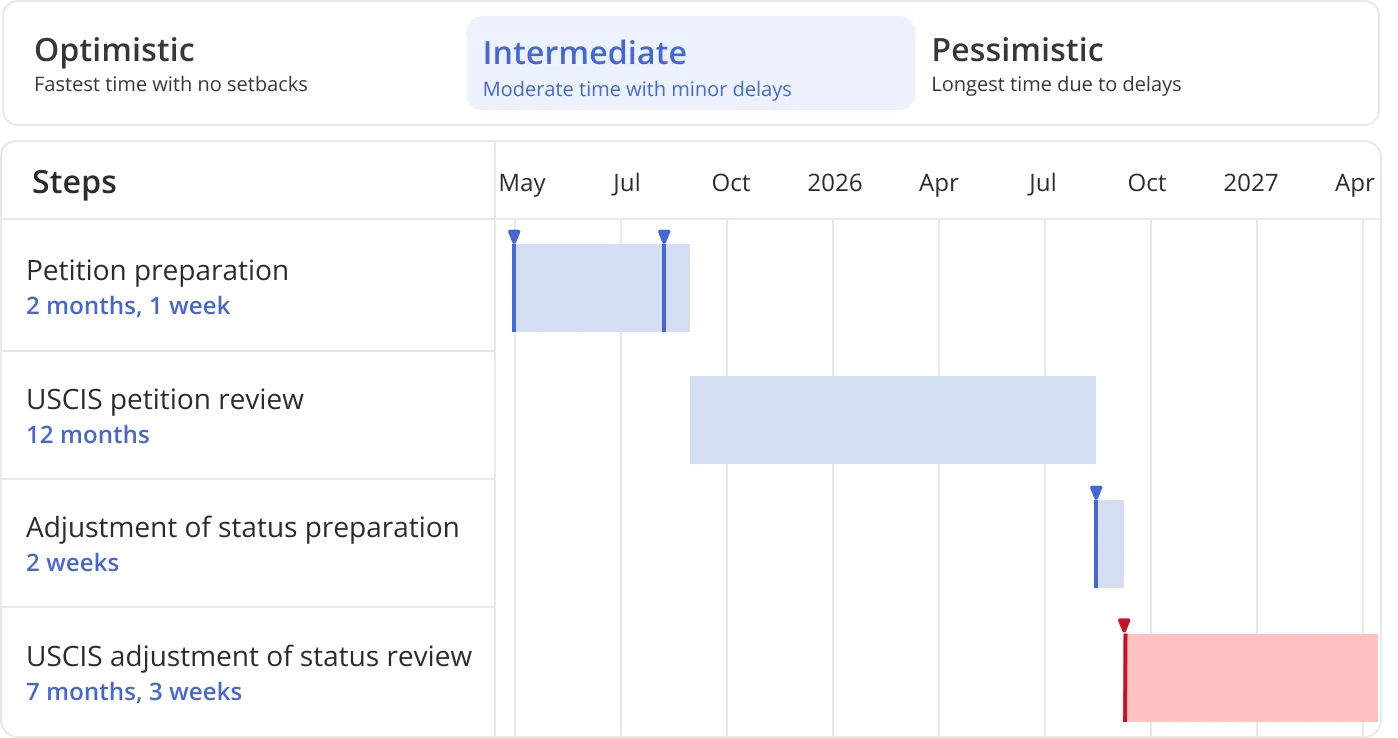
Form I-485, the application to adjust status, is the final stage, and it's the one the employee files rather than the employer. Adjustment of status means applying for the green card from inside the United States without leaving, and it becomes available once the I-140 is approved and the employee's priority date is current in the Visa Bulletin, the monthly report from the Department of State showing which categories and countries can move forward. An employee living abroad follows consular processing with Form DS-260 instead, but for someone already working for you on a temporary visa, I-485 is the usual route.
This is where the audience split becomes practical. Up to this point the company drove the case; now the individual and their family take the lead, and their questions get personal: medical exams, travel plans, work permits, and dependents. Those questions call for a direct line to an attorney who can advise the employee on their own situation, separate from anything HR needs to see. HR keeps visibility into where the case sits and what it means for the employee's work authorization, while the employee gets their own channel to legal counsel for the details of their filing.
Timing at this stage depends far more on the priority date than on USCIS processing speed. For employees born in countries with heavy backlogs, the wait for a visa number to become current can stretch for years even after the I-140 is approved, which is why reading the Visa Bulletin correctly is part of planning any green card sponsorship. During that wait, the employee typically stays in H-1B, L-1, or another applicable status, and a well-run case keeps that authorization intact the whole way through.
The I-485 stage is where costs can shift toward the employee, and the rules are looser here than for PERM and the I-140. Federal regulations require the employer to cover PERM costs and the I-140 filing fee, but they don't require the company to pay the I-485 fee or the related costs for the employee and any dependents. Many employers choose to cover some or all of the green card application as a benefit, and others leave it with the employee. Deciding that policy in advance, and telling employees clearly, prevents an awkward conversation late in a multi-year process.
The costs of an employer-sponsored green card break down by stage, and the law is specific about which ones the company must carry. PERM costs, including recruitment advertising and the attorney work tied to the labor certification, are the employer's by law and can't be shifted to the employee. The Form I-140 filing fee is also the employer's, since the company is the petitioner. From the I-485 onward, the fees can fall to the employee unless the employer chooses to cover them as part of a benefits package.
The table below shows the government fees for each stage. Where a fee is a fixed USCIS charge we've listed it; where a fee depends on employer size or hasn't been confirmed against a current schedule, we've left the amount for you to verify against the official source before you rely on it.
| Cost | Stage | Who pays by law | Amount |
|---|---|---|---|
| PERM labor certification (DOL) | PERM | Employer | No DOL filing fee |
| PERM recruitment and attorney work | PERM | Employer | Varies by case |
| Form I-140 filing fee | I-140 | Employer | $715 |
| Asylum program fee (employer) | I-140 | Employer | $600 (26 or more employees) · $300 (25 or fewer) · $0 nonprofit |
| Premium processing (Form I-907) | I-140 | Employer's choice | $2,965 |
| Form I-485 filing fee | I-485 | Employee (unless employer covers) | $1,440 |
For the exact, current government amounts, the USCIS fee schedule is the authoritative source, and the Department of Labor foreign labor certification page confirms the PERM process the employer runs. USCIS fees change periodically, so confirm each amount before you build a budget around it. For a broader employer view of sponsorship generally, our guide to what a visa sponsorship is covers both temporary and permanent obligations in one place.
Tukki quotes one end price for the full employer-sponsored green card path, and that price already includes the government and USCIS fees along with any RFE response the case needs. The number you see when you start is the number you plan around. Firms that price per service bill each stage on its own, so a PERM fee, an I-140 fee, and an I-485 fee arrive separately over the life of the case, which means the headline figure and the final figure can be different amounts.
What Tukki bundles into that single price is the PERM preparation, the I-140 and I-485 preparation, the government filing fees, and the work to respond if USCIS issues an RFE. Within that, the law still assigns certain costs to the company: PERM and the I-140 are the employer's to pay, while the I-485 costs can sit with the employee unless you choose to cover them. Per-service pricing and end-to-end pricing are both valid ways to buy this work, and which one fits your company is your call. Seeing the full number up front simply makes it easier to compare.
Your company's exact price depends on the case, so rather than a single fixed figure, here is an illustrative example from our pricing tool. It shows what an EB-2/EB-3 PERM green card may look like when the sponsoring company has 26 or more U.S. employees and the employee is already in the U.S. adjusting status through Form I-485. Treat these numbers as a guide that can move with the case and with government fees, not a price set in stone.

Disclaimer: The timeline provided is an estimate and may vary depending on the specifics of your case and changes in government processing times, which have historically fluctuated month to month. Please use this timeline as a general guide rather than a definitive schedule. Additionally, some costs, such as fees for translating documents not in English or consultation letters from U.S. peer groups, are not included in this estimate.
Two things are worth noticing in this example. The RFE preparation line is $0, because responding to a Request for Evidence is already included in the Tukki fee rather than billed as an extra. And the government side stacks up across stages, the PERM recruitment cost, the I-140 filing fee, the asylum program fee, and the I-485 filing fee, which is exactly why seeing them inside one end price makes the budget easier to hold. To generate a personalized estimate for your company's profile and timeline, use the pricing tool, and to see which steps sit behind the number, visit our process page.
To see the end price for a specific profile, use the Tukki pricing tool, and to see exactly what each stage includes, walk through the step-by-step process page. Together they show the steps behind the number so there are no surprise line items later.
Tukki is a U.S. immigration provider that helps companies sponsor employees for permanent residence through PERM labor certification, Form I-140, and Form I-485, with a dashboard that gives HR full visibility across every case and a direct line to attorneys for the employees themselves. Whether you're sponsoring your first green card or managing a portfolio of pending cases, you get one predictable price and a clear view of where each case stands.
WE CAN HELP
Need more clarity?
Find quick answers to frequent visa questions from our legal experts
Does the employer have to pay for a laid-off H-1B employee's flight home?
Yes, when the dismissal comes before the end of the period of authorized admission. Under 8 CFR 214.2(h)(4)(iii)(E) the employer is liable for the reasonable costs of return transportation of the worker abroad.
It does not cover dependents, and it does not apply when the worker resigns.
What happens if I get an RFE on EB-5 source of funds?
Your petition pauses while you respond, and adjudication restarts once USCIS receives your evidence, which commonly adds months to a timeline already measured in years. Rebuild the chain chronologically with numbered exhibits, close each gap the notice identifies, and include signed explanations where a record doesn't exist.
An RFE isn't a denial, and well-documented cases are regularly approved after one.
What happens if my PERM was filed as EB-3 but I now have a master's?
Your new master's doesn't change the PERM. The category is set by what the job required, not what you have on your resume today.
To move to EB-2, your employer generally has to start a new PERM that requires a master's, which means a new labor market test, a new prevailing wage determination, and a new priority date.
What is the Kazarian two-step analysis?
The Kazarian two-step analysis comes from Kazarian v. USCIS. Step one asks whether you meet at least three of the ten regulatory criteria, or hold a qualifying major award, judged item by item against the plain language of each criterion. Step two, the final merits determination, weighs all of the evidence together to decide whether it shows the required level of acclaim.
The decision separated the counting step from the weighing step so that extra requirements are not loaded into the individual criteria.
Can I change employers on an O-1A visa?
Yes, but your new employer must file a new Form I-129 petition with USCIS before you start working for them. You can't simply switch jobs the way you might as a lawful permanent resident.
If you were sponsored through a U.S. agent, you may have more flexibility since the agent structure is designed to allow work with multiple entities.
Other blogs for every step of your visa journey
Your immigration forms - what each one is for and what to check before you sign
9 mins read | Oct 13, 2026
How to write an RFE response letter and organize the evidence behind it
9 mins read | Oct 12, 2026
Laying off a sponsored employee on H-1B: what the company owes and what the employee has left
8 mins read | Oct 9, 2026