You have a valid visa and an EAD at the same time - which one you work on and why it matters
8 mins read | Oct 6, 2026
TRIGGERS, TIMING, AND RESPONSE
Contributor
Tukki
Reading time
8 min
Date published
Jun 22, 2026
A PERM audit is a request for documentation from the U.S. Department of Labor, and it does not mean your case is over. PERM stands for Program Electronic Review Management, the labor certification step that comes before an employment-based green card, and when an audit lands, the Department of Labor is asking the employer to show its paperwork rather than rejecting the case.
This guide separates two readers. If you run HR or manage a sponsorship program, you'll find what triggers an audit and how to file in a way that lowers the odds of one. If you're the beneficiary waiting on your green card, you'll find what an audit means for your timing and why it isn't the same thing as a denial. Both groups tend to confuse the standard review queue with the audit queue, so there's a section on that too.
A PERM audit is the Department of Labor's request for the underlying documentation that supports a labor certification application. The application itself is filed by the employer on ETA Form 9089, and most of the evidence behind it stays with the employer at the time of filing. An audit is how the DOL asks to see that evidence before it certifies the case.
PERM is a labor certification issued by the DOL's Office of Foreign Labor Certification. It confirms that there were no able, willing, qualified, and available U.S. workers for the role, and that hiring a foreign worker won't harm the wages and working conditions of similar U.S. workers. PERM is not a visa. It gives no status and no work authorization on its own. It's the first formal step in the employer-sponsored green card process, followed by Form I-140 with U.S. Citizenship and Immigration Services and then the final immigrant visa or adjustment of status.
Because the labor certification rests on a recruitment process the employer ran months earlier, an audit is mostly a paperwork exercise. The case is still alive. The employer responds with the file it was already required to keep, and adjudication continues.
Audits come in two kinds: random and targeted. In a random audit, the Department of Labor selects cases at random regardless of how clean the filing is, so even a flawless application can draw one. A targeted audit happens when something in the filing flags review.
For HR teams, the targeted triggers are the ones you can influence. Common flags include:
None of these guarantees an audit, and none of them is automatically fatal if it does. They simply raise the chance that an analyst wants to see the supporting documents. The table below pairs each trigger with a practical way to reduce the risk before filing.
| Audit trigger | How to reduce the risk |
|---|---|
| Restrictive or unusual job requirements | Tie every requirement to the actual duties and the role as it normally exists in the labor market |
| Foreign language requirement | Document the business necessity in writing before recruitment begins |
| A seemingly qualified U.S. applicant | Keep a detailed, lawful, job-related reason for each rejection in the recruitment report |
| Recent layoffs | Confirm whether affected workers were notified and considered for the position |
| Data discrepancies | Reconcile the ETA Form 9089, prevailing wage, and ads so dates, titles, and wages match |
The most reliable way to lower audit risk is to run the labor market test exactly as the rules require and keep a complete file. The labor market test is the recruitment the employer runs to test whether U.S. workers are available for the job.
For most positions, recruitment requires a 30-day job order with the State Workforce Agency, two Sunday advertisements in a newspaper of general circulation, and a Notice of Filing posted at the worksite for at least 10 consecutive business days. Professional roles call for additional recruitment steps on top of those basics. The prevailing wage determination, which sets the minimum wage the employer must offer, has to be in hand and consistent with the wage listed on the application.
After recruitment, the employer builds and keeps the recruitment file. That file holds the ads, the publisher affidavits or tear sheets, the SWA job order, the Notice of Filing with its posting dates, every resume received, and a recruitment report explaining why each U.S. applicant wasn't qualified. This file has to be retained for at least 5 years, and it's mandatory whether or not an audit ever arrives. When HR treats the file as a deliverable from day one, an audit becomes a matter of forwarding documents rather than reconstructing them.
This is where program-level visibility earns its keep. A team that can see every case, its recruitment dates, and its document status in one place can catch a discrepancy before filing instead of explaining it after. Tukki gives HR that view across the whole sponsorship pipeline. You can see how the steps line up in our PERM visa guide, and our guide to choosing EB-2 or EB-3 covers the category decision that sits alongside the labor certification.
See how Tukki tracks every PERM case
People conflate these two stages, so it helps to separate them plainly. After a PERM is filed, it sits in the standard analyst-review queue, where a DOL analyst adjudicates the application based on what was submitted. If the analyst issues an audit, the case moves into a separate audit-review queue, which adds time and requires a documented response by the stated deadline.
The distinction matters because the two queues move at different speeds and demand different things from you. Analyst review is passive from the employer's side once the application is in. Audit review is active: there's a deadline, and missing it can cost the case. Here's how they compare.
| Analyst review | Audit review | |
|---|---|---|
| What it is | Standard adjudication of the filed application | A request for the supporting documentation |
| What you do | Wait; nothing further is required unless contacted | Submit a complete, on-time audit response |
| Queue | Standard processing queue | Separate, slower audit queue |
| Effect on timeline | The baseline timeline | Adds time on top of the baseline |
| Deadline | None for the employer | Yes, a firm response deadline |
An audit doesn't erase the work already done. The application keeps its filing date, and a successful response leads to certification just as a non-audited case would. It simply routes the case through an extra checkpoint.
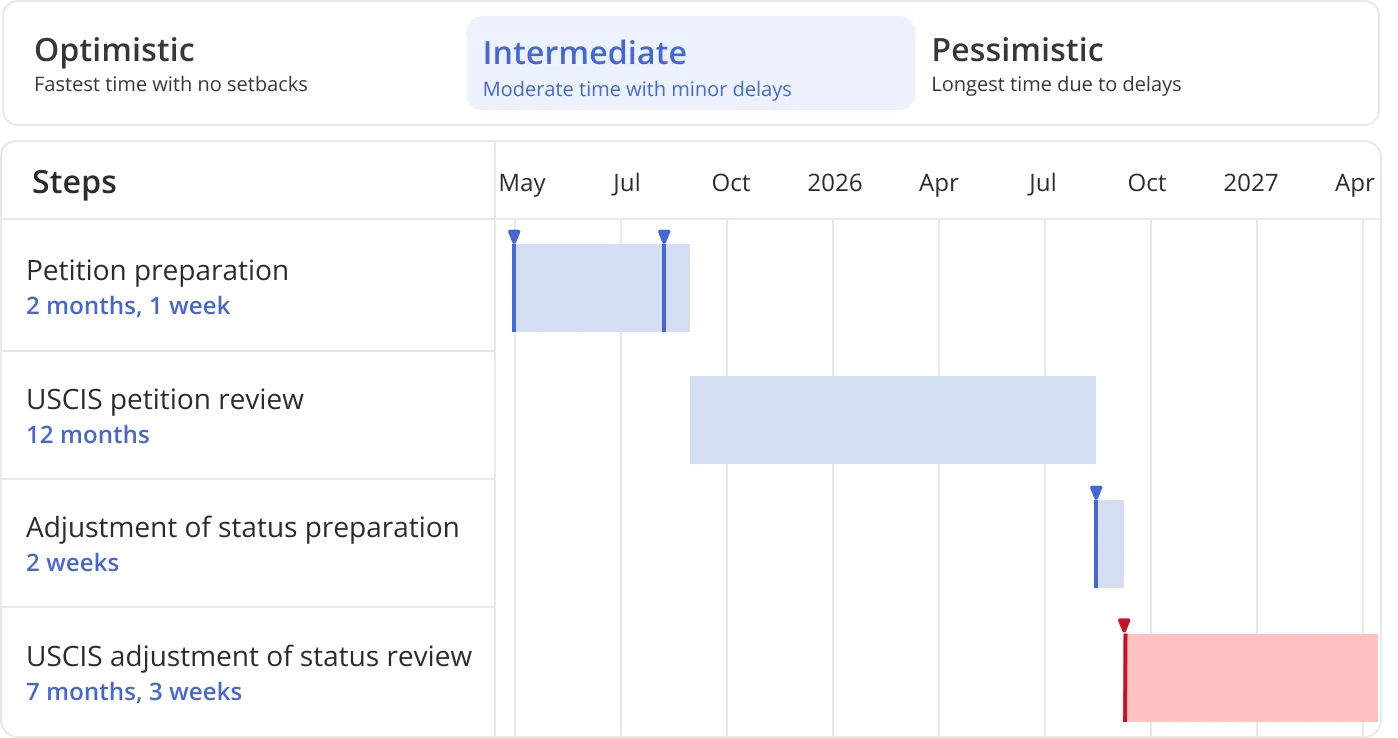
An audit extends the timeline because it moves the case into the slower audit-review queue. The full PERM process averages roughly 22 to 24 months, and it runs longer when an audit is issued. The added time isn't a fixed number, and DOL processing times shift month to month, so the honest answer for any current estimate is to check the official source rather than a figure that may already be stale.
For the most recent processing times, including how long the audit queue is running, see the DOL Foreign Labor Application Gateway. Our PERM processing time guide walks through each stage from prevailing wage to certification so you can see where an audit fits in the sequence.
The timeline picture also depends on what happens after PERM. Once the labor certification is approved, the employer files Form I-140, the Immigrant Petition for Alien Workers, with USCIS. Premium processing is available for most I-140 cases and guarantees a USCIS response within 15 business days, which can recover some time on the back end even if the PERM stage ran long. Our Form I-140 guide and our I-140 premium processing time guide cover that step in detail.
If you're the beneficiary, the most useful thing to know is that an audit is a documentation request aimed at your employer, not a judgment about you. The Department of Labor is asking the petitioner to show the recruitment file. You aren't required to produce anything, and the case isn't lost because it was audited.
What changes for you is timing. Your case shifts into the audit queue, which means the wait before certification gets longer, and the exact length depends on current DOL processing. Your priority date, the place in line that governs when a green card becomes available, is set when the PERM is filed and doesn't move because of an audit. So while certification may take longer, your spot in the broader queue holds.
Your work authorization comes from your current status, usually an H-1B or similar nonimmigrant visa, and not from the PERM itself. An audit on the labor certification doesn't change your ability to keep working under that status. If you're tracking how the pieces connect from a work visa to permanent residence, our H-1B to green card guide lays out the full pathway.
This is also where direct legal support matters for the beneficiary specifically. Tukki gives beneficiaries a direct line to the immigration attorney handling the case, so when an audit shows up you can ask what it means for your situation and get a straight answer rather than waiting for a relayed message.
Talk to an attorney about your case
A strong audit response is the recruitment file, organized and submitted in full before the deadline. The Department of Labor states a response date with the audit notification, and that date is firm. A complete, on-time response is what moves the case back toward certification.
The response should include the SWA job order, the two Sunday newspaper advertisements with publisher affidavits, the Notice of Filing with its posting dates, the resumes received, and the recruitment report explaining each rejection with lawful, job-related reasons. Because the file was required from the start, a well-run case can usually respond quickly. The risk comes from gaps, missing affidavits, mismatched dates, or rejection reasons that weren't documented at the time. An immigration attorney reviews the response so the package answers what the DOL asked and the explanations hold up.
If the response satisfies the DOL, the labor certification is granted and the case proceeds to the I-140 stage. In some instances the DOL may order supervised recruitment, where it directs and oversees a fresh round of recruitment, which adds further time. That's a separate path from a standard audit, and it's worth knowing the difference if it comes up.
Tukki is a U.S. immigration provider that helps skilled professionals and their employers move through employment-based green cards, from PERM and the I-140 petition to permanent residence, with dedicated attorney support at every step. HR teams get full visibility across the sponsorship pipeline so recruitment dates and documents line up before filing, and beneficiaries get a direct line to the immigration attorney on the case. When an audit arrives, the file is ready and the response goes out on time.
WE CAN HELP
Need more clarity?
Find quick answers to frequent visa questions from our legal experts
How long does PERM take in 2026?
PERM processing at DOL has fluctuated significantly. Audits and supervised recruitment add months on top of the base window.
The full timeline (prevailing wage plus recruitment plus DOL review) commonly runs over a year before the I-140 can be filed. See Tukki's PERM visa guide for the current timeline.
Can an employer sponsor a green card for an employee who is still abroad?
Yes. The employer still runs PERM and files the Form I-140 the same way, since those stages prove the job and the company's ability to pay regardless of where the employee lives.
The difference comes at the final stage: an employee outside the United States completes the process through consular processing with Form DS-260 at a U.S. embassy rather than filing Form I-485 to adjust status from inside the country.
Is PERM a visa or a work permit?
No. PERM is not a visa, nor does it provide work authorization or permission to stay in the U.S. It is only the labor certification needed before an employer can file the I-140 immigrant petition.
Does a PERM audit mean my case is denied?
No. A PERM audit is a request for documentation from the Department of Labor, not a denial. The employer submits the recruitment file it was already required to keep, and the case continues toward certification once the response is reviewed.
How long does prevailing wage determination take?
Roughly 6 months in 2026. PWD is filed on Form ETA-9141 and has been in the 5-7 month range for most of the past year. Check flag.dol.gov/processingtimes for the latest.
Other blogs for every step of your visa journey
You have a valid visa and an EAD at the same time - which one you work on and why it matters
8 mins read | Oct 6, 2026
J-1 Research Scholar, Specialist and Trainee - the three categories employers use
8 mins read | Oct 5, 2026
RFE or NOID - what a notice of intent to deny means for your case
9 mins read | Oct 2, 2026