Your immigration forms - what each one is for and what to check before you sign
9 mins read | Oct 13, 2026
A FOUNDER'S FRAMEWORK FOR CHOOSING
Contributor
Tukki
Reading time
10 mins read
Date published
Jun 14, 2026
Finding the best immigration service for startup founders comes down to matching a type of support to your stage and case mix, rather than picking a name off a list.
Early on, you may only need your own founder visa sorted out, but a year later you might find yourself sponsoring your first international hires, or bringing over a key software engineer from home, suddenly answering to a board about immigration timelines.
This guide lays out what a startup actually needs from immigration help, the caveats worth keeping in mind from the start so nothing catches you off guard, and what each type of immigration support is and the criteria to compare them on.
We'll keep this focused on choosing a service for your startup. If you'd like to review the routes specific to founders, our O-1 visa for startup founders guide is a good place to start.
A startup needs immigration support that moves at the speed of the business and stays predictable enough to plan around. Unlike a large company with a dedicated mobility team, a founder is usually the one weighing the spend while also handling hiring and fundraising in the same week, so the support you choose has to do two jobs: get the founders' own status sorted, then scale to cover hires without becoming a second full-time job for someone on the team.
Most startups hit immigration in two waves: first the founders' own status and visas, then sponsoring the first international hires. The right support for the first wave isn't automatically right for the second.
Wave one is the founders' own status. Before you can sponsor anyone, you need to be in the country legally and able to run the company, and the route you take depends largely on whether you need an employer to file for you at all. For a founder without a traditional employer, three groupings cover most situations:
Wave two is the first hires. Once you start sponsoring people beyond the founders, the common path is the H-1B, for specialty occupation roles that need at least a bachelor's degree in a specific field. It's cap-subject: most new petitions go through an annual lottery before they can even be filed, which adds timing risk you have to plan hiring around. Our H-1B visa guide explains the lottery, wage levels, and eligibility.
The setup you choose should carry the founders from wave one into wave two without a disruptive handoff, so the team that files your O-1A or EB-2 NIW can also run your first H-1B when the hiring starts.
Speed and predictability matter more at a startup because a delayed visa can stall a hire, a product launch, or a founder's ability to stay in the country and run the company. A slow response doesn't just cost time: a candidate takes another offer, a start date slips past a funding milestone, or a founder loses work authorization at the wrong moment. Because the team is small, one stuck case affects a larger share of the company than it would at a corporation.
Predictable cost is the other half of it. A founder budgeting against a runway needs to know what immigration will cost before committing, which is why how a service prices its work matters as much as what it charges. Our guide to U.S. work visa costs breaks down every fee category, and as the team grows our employer guide to H-1B sponsorship cost gets specific about the company spend.
There are five common types of immigration help a startup can choose from, and each is a genuinely different setup rather than a better or worse version of the same thing. They differ in who does the work, how it gets checked, how you're billed, and how much the founders see along the way, so knowing what each option is lets you match it to where your company actually sits.
A solo immigration attorney is a single licensed lawyer who handles your cases directly, usually as an independent practice. You work with one person from start to finish, so the lawyer who answers your email is the same one preparing your petition, which gives you a direct relationship and a consistent point of contact.
A solo practice can be the right call when your case volume is low and fairly standard, such as a single founder visa or an occasional hire, and when you want one consistent relationship over a structured program. Because everything runs through one person, capacity is tied to that individual's bandwidth, so it suits a stage where cases arrive one at a time rather than in clusters.
A traditional immigration law firm is an established practice with multiple attorneys, paralegals, and a defined process for moving cases. Work is distributed across a team, with reviews built into the workflow and depth across many case types, so larger firms bring institutional knowledge to unusual situations and absorb volume that would overwhelm a single practitioner.
A traditional firm can be the right call when your cases are complex, high-stakes, or unusual enough to benefit from deep specialization, or when you expect enough volume that a team structure helps. How you experience the firm often depends on your account size, since a startup's handful of cases sits alongside much larger clients.
A boutique, startup-focused firm is a smaller practice that concentrates on the cases startups bring, often founder visas and early hires, with attorneys who know the venture context. The team is lean and hands-on, and because they work with companies at your stage regularly, they tend to speak the language of fundraising rounds, equity, and fast hiring, which makes the back-and-forth quicker since you spend less time explaining how a startup works.
The best boutique immigration service for a tech startup entering the U.S. market often shows up at this stage, because the firm already understands cross-border expansion and founder routes. A boutique firm can be the right call when you want startup-fluent counsel and a close working relationship, and when your case mix leans toward the founder and early-hire profiles these firms see most. Pricing here is frequently a flat fee per case, which helps with budgeting, though the exact structure varies by firm.
An end-to-end immigration provider combines a technology platform with a legal team, so case management and legal work sit in one place. This is the model Tukki is built on: a software platform that gives the founder or HR lead a live dashboard showing where every case stands, paired with attorneys who handle the filings, so each sponsored employee gets a direct line to the lawyer on their case. Review is layered into the workflow rather than handled as a single pass, and the platform keeps deadlines, documents, and status visible across the whole portfolio, so the founder isn't the one remembering which extension is due next.
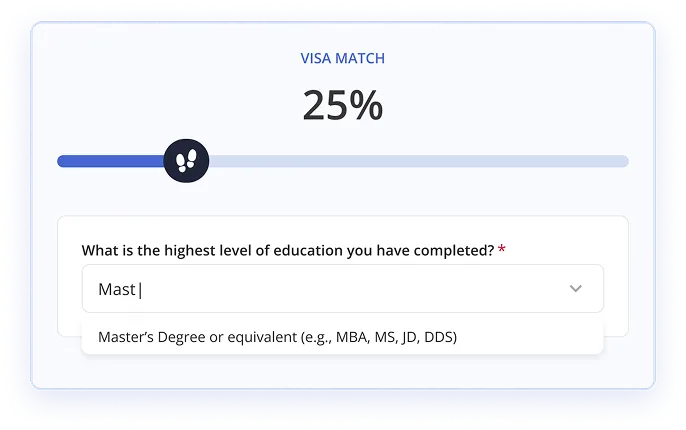
This option splits the experience deliberately by audience: the person running the company gets portfolio-level visibility to plan and brief leadership, and each beneficiary gets attorney access for questions specific to their own case. An end-to-end provider can be the right call when you're managing more than one or two cases at a time, when you want predictable subscription or managed-program pricing, and when both the company and the employees need to see progress without chasing anyone. Our visa match tool gives a profile-based starting point for comparing routes.
Keeping immigration in-house or doing it yourself means the company handles cases with its own people and tools rather than outside counsel. For a founder filing a straightforward petition, or a company with someone on staff who has real immigration knowledge, this keeps control internal and avoids outside fees. What you build is what you get: the quality of review, the visibility into each case, and the response speed all depend on the internal knowledge and systems you put in place.
A DIY or in-house approach can be the right call when a case is simple and well-documented, when the founder has time to learn the process, or when the company has enough recurring volume to justify dedicated internal expertise. The trade-off to weigh is risk tolerance: a wrong attestation can trigger an RFE, a Request for Evidence where USCIS asks for more documentation before deciding, which can add months. Whoever handles the filing also has to keep up with current rules, since the USCIS guidance on working in the United States sets the requirements each category must meet. Our guide on whether you need an immigration lawyer walks through where the DIY line usually sits.
When you compare immigration services for a startup, weigh them on five dimensions that decide how the relationship actually feels: responsiveness, quality control, the experience your employees get, cost predictability, and visibility into every case. Together these determine whether immigration becomes a manageable part of running the company or a recurring source of stress, so rather than asking which service is best in the abstract, score each option against these dimensions for your own stage and case mix.
The matrix below describes what each option typically offers on each dimension. It's a descriptive reference, not a scorecard: there's no winner column, because the right answer depends on your company, not on a ranking.
| Option | Responsiveness | Quality control | Employee experience | Cost predictability | Case visibility |
|---|---|---|---|---|---|
| Solo attorney | Direct to one person, limited by their bandwidth | Single reviewer | Personal, depends on the individual | Often hourly | Email or phone, no shared dashboard |
| Traditional law firm | Through a team, varies by account size | Multiple reviewers, process-driven | Routed via HR or an assigned contact | Hourly or per case | Varies by firm |
| Boutique, startup-focused firm | High touch, startup-fluent | Smaller team, hands-on | Founder-friendly, startup context | Often flat fee | Varies |
| End-to-end provider (platform plus legal) | Platform status plus a legal team | Layered review built into the workflow | Beneficiaries get a direct line to attorneys | Subscription or managed | Live dashboard for HR |
| In-house / DIY | Immediate but limited to internal knowledge | Whatever the company builds | Owned internally | Salary plus tooling | Whatever you build |
Match the option to your stage and case mix. There is no single best setup, only the best fit for where you are.
Responsiveness comes down to how fast you get answers and whether you have to chase to get them. At a startup, a slow reply can hold up a start date or leave a founder guessing during a funding conversation, so the practical question is who carries the burden of following up. A solo attorney is fast when they have bandwidth and slower when they're stretched, a team-based firm spreads the load but can route you through layers, and a platform-backed provider shows status without anyone sending a follow-up email at all.
Quality control is about how a service catches errors before they reach USCIS, since a missed detail can trigger an RFE and add months to a case. A single reviewer means one person's judgment, which is consistent but has no second set of eyes, whereas multiple reviewers or a layered workflow build in checks at each step. For high-stakes or unusual cases, that extra review can be the difference between a clean approval and a request for more evidence, so weigh it against how complex your case mix is.
The experience your sponsored employees get is a separate question from how the company is served, and it's easy to overlook when you're focused on the spend. A beneficiary's questions are personal and specific: what documents to gather, what a notice means, how a job change affects their status. Routing all of that through the founder or HR slows everyone down and puts a non-lawyer in the position of relaying legal answers, so the options differ here in whether each employee gets a direct line to an attorney or goes through an internal contact.
Cost predictability depends on the pricing model, and immigration support is generally billed one of three ways: hourly, a flat or fixed fee per case, or a subscription or managed program. Hourly billing tracks the work but makes the final number hard to forecast, a flat fee per case gives you a known price for a defined scope, and a subscription or managed program spreads cost across a portfolio. Service fees sit on top of fixed government charges like the USCIS filing fees, so for a founder budgeting against runway the structure matters as much as the rate. Our guide to immigration lawyer cost breaks down each pricing model and what to watch for.
Visibility is whether you can see, at any moment, where each case stands without asking. With one or two cases an email thread is enough, but once you're running several at different stages, the questions get harder to track: which extension is due next, which petition is waiting on an employee's documents, which case just got an RFE. A shared dashboard gives the founder or HR lead a portfolio view to forecast and brief leadership, while email and phone setups keep that picture in someone's head.
Before you sign with any immigration service, ask a handful of direct questions that reveal how the relationship will actually run, because the answers expose how each option handles the five dimensions above. A founder weighing a real spend needs to know who does the work, what it costs, and what happens when a case goes sideways.
The answers tell you which option you're really buying. A service that can't show case status without an email is a different proposition from one with a live dashboard, and an hourly quote with RFE responses billed separately budgets very differently from a flat fee that includes them. There's no single right answer here; what matters is that the answers fit your stage, your case mix, and your tolerance for surprises.
The best immigration service for startup founders is the one whose setup matches where the company is right now, and that match usually shifts as you grow. A pre-seed founder sorting out a single O-1A or EB-2 NIW has different needs than a Series A company making its first international hires, which in turn differs from a scaling team running a dozen cases at once. Reading your own stage honestly is what turns this from a guessing game into a clear decision:
For how the employer spend grows across that arc, our work visa sponsorship cost guide lays out the budget by phase.
Your case mix matters as much as your headcount. A company built mostly on self-petition founders has lighter needs than one sponsoring a steady stream of H-1B and employer-based green card cases, so two startups of the same size can land on different setups for good reasons. There is no single best service everyone agrees on, only the one that fits your stage and case mix, so be honest about both and pick the support that matches.
Tukki is a U.S. immigration provider that helps startups and their employees with work visas and green cards, from O-1A and H-1B to EB-1A and EB-2 NIW. Founders and HR leads get full case visibility across every founder and hire, while each sponsored employee gets dedicated attorney support for their own filing.
WE CAN HELP
Need more clarity?
Find quick answers to frequent visa questions from our legal experts
When should we start PERM for an employee on H-1B?
Request the prevailing wage determination around the end of year 3 of H-1B status. The wage queue, the fixed recruitment period, the 30-day quiet period before filing and the analyst backlog together consume most of two years.
AC21 extensions past the six-year limit also require that a PERM or I-140 already be on file.
Can I travel internationally during the wait?
Yes, with the I-797C receipt notice plus your expired green card. CBP officers at U.S. ports of entry are trained to recognize the combination as continuing proof of permanent resident status.
Some international carriers, especially smaller regional airlines, are more comfortable with an ADIT stamp in your passport than with a paper receipt notice; if you're flying on a carrier you suspect may not recognize the I-797C, request an ADIT stamp from your local field office before traveling.
Can I make an H-1B employee pay the attorney fees?
No. Attorney fees and other costs connected to performing required H-1B program functions, including preparing and filing the LCA and the petition, are your business expenses.
A deduction that recoups them is not an authorized deduction under 20 CFR 655.731(c)(9).
Can you switch from H-1B to O-1 visa status?
Yes. You file a Form I-129 O-1 petition while in H-1B status, with the same petitioner rules as a first-time O-1 filing.
Many foreign nationals make the switch when they hit the H-1B six-year cap without an approved I-140, or when the lottery doesn't go their way and they've built up enough of a record in the meantime to qualify for O-1A.
Other blogs for every step of your visa journey
Your immigration forms - what each one is for and what to check before you sign
9 mins read | Oct 13, 2026
How to write an RFE response letter and organize the evidence behind it
9 mins read | Oct 12, 2026
Laying off a sponsored employee on H-1B: what the company owes and what the employee has left
8 mins read | Oct 9, 2026