Your immigration forms - what each one is for and what to check before you sign
9 mins read | Oct 13, 2026
FORMS, EVIDENCE, AND ASSEMBLY
Contributor
Tukki
Reading time
11 mins read
Date published
Aug 27, 2026
An adjustment of status packet, often called an AOS packet, is the complete filing you send USCIS to become a permanent resident from inside the U.S. At minimum it contains Form I-485 with the correct fee, identity and civil documents for every applicant, two passport-style photos each, evidence of the immigrant category you qualify under, and Form I-693 sealed by a civil surgeon. Most applicants also file Form I-765 for a work permit and Form I-131 for advance parole in the same envelope.
This post is the checklist itself, written for the moment when the documents are already spread across the table and the question is whether anything is missing. If you need something else first:
An I-485 can only be filed when an immigrant visa number is available to you in the month you file. Availability is set by the monthly Visa Bulletin published by the Department of State, and USCIS announces each month which of the two charts it will accept filings against: Final Action Dates or Dates for Filing.
For September 2026, employment-based adjustment applicants must use the Final Action Dates chart (current as of August 2026, and USCIS republishes this decision every month). Check the chart in force for your filing month, find your preference category, find your country of chargeability, and compare that cutoff against your priority date. If your priority date is earlier than the cutoff, or the category shows current, a number is available to you.
A packet filed when no number is available will be rejected and returned. That is a paperwork loss rather than a legal one, but it costs weeks and it puts your fee check back in the mail. If the chart reading is unfamiliar, work through how to read the Visa Bulletin and what a final action date means before you assemble anything else.
A new edition of Form I-485 dated 09/18/26 becomes mandatory for filings submitted on or after September 18, 2026. USCIS has stated there is no grace period, so a packet using the previous 01/20/25 edition that arrives on or after that date will be rejected. The change accompanies a Public Charge Ground of Inadmissibility Final Rule that takes effect the same day and adds questions to the form itself rather than reintroducing a separate public charge form.
If you're filing in the last days of a form edition's life, download a fresh copy from the USCIS Form I-485 page on the day you print, and check the edition date in the lower corner of the form against the date USCIS lists as acceptable. This is the single cheapest rejection to avoid (current as of August 2026).
Filed together, an I-485 with an I-765 and an I-131 comes to $2,330 for an applicant age 14 or older (current as of August 2026). Fees are per applicant, not per family, so a spouse and two children multiply that figure. For the full picture including the medical exam and the underlying petition, see green card cost.
This is the part that determines whether your case moves or stalls. Work through it group by group, and assemble a complete set for every applicant in the family rather than one shared set.
Two identical 2 x 2 inch passport-style color photographs per applicant, taken within 30 days of filing, on a white to off-white background, un-mounted and un-retouched. Write each applicant's name and A-number lightly on the back in pencil. Photos are a common rejection trigger because they are usually the last item collected and the easiest to reuse from an old file.
Form I-693 is completed by a USCIS-designated civil surgeon, not by your regular doctor. The exam covers a physical examination, a review of your vaccination record against the required list, and testing for certain communicable diseases. The civil surgeon completes and signs the form, then returns it to you in a sealed envelope with the flap signed or stamped across the seal.
Do not open that envelope. A packet arriving with an opened I-693 gets the form rejected, which means repeating the exam and the cost.
On timing: an I-693 signed by a civil surgeon on or after November 1, 2023 does not expire, but it is only valid for the application it was filed with, and only while that application remains pending (current as of August 2026). Filing the I-693 in the original packet is generally the cleaner path because it removes one reason for USCIS to issue a Request for Evidence later. Find a provider through the USCIS civil surgeon locator, and see immigration medical exam cost for what to budget. Full requirements are on the USCIS Form I-693 page.
Arrests, charges, prior immigration violations, prior removal orders, and certain public benefit history all need to be disclosed on the form and addressed with documentation. Certified court dispositions for anything on your record, including cases that were dismissed or expunged, belong in the packet. Where a waiver is required, that is a separate application with its own standard, and it is the point in this process where an attorney adds the most value.
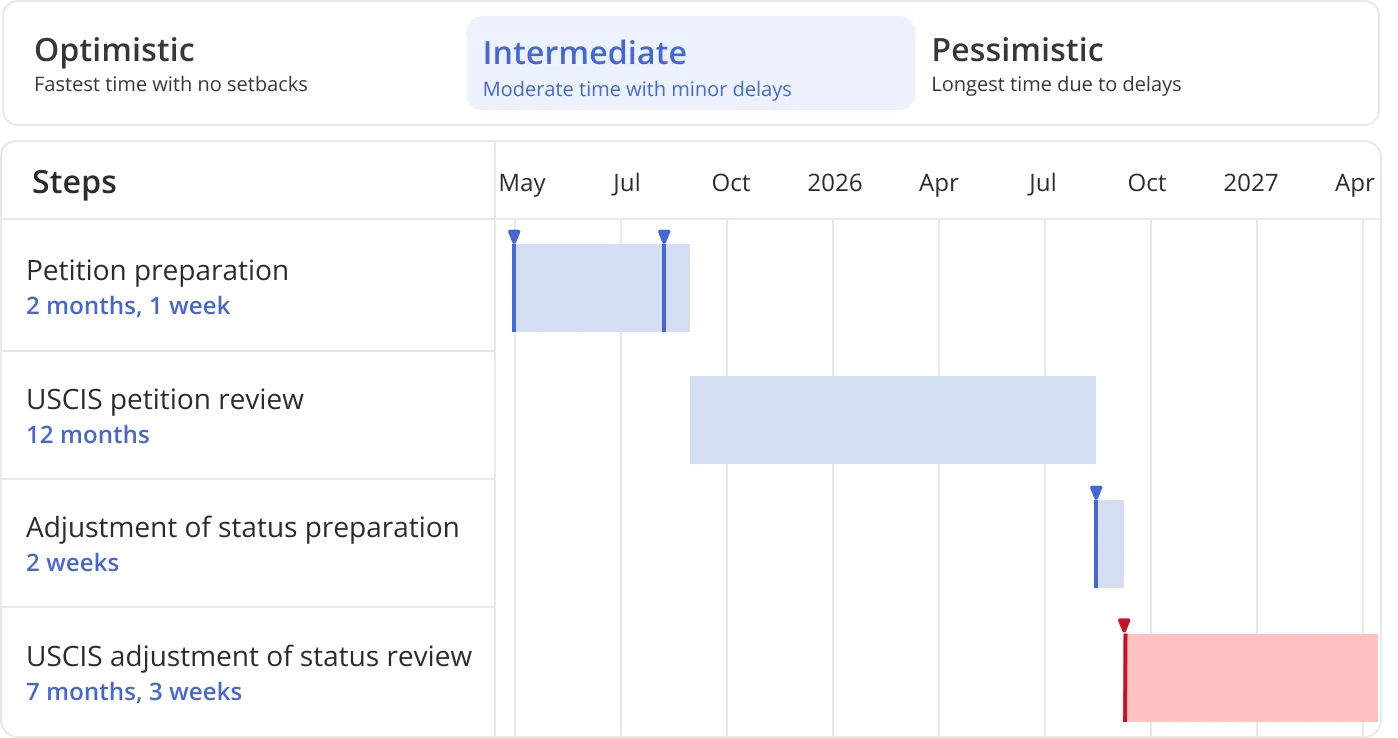
Concurrent filing means sending the immigrant petition and the I-485 in the same package rather than waiting for the petition to be approved first. It is available when a visa number is available to you at the moment of filing, which in practice means your category and country are current or your priority date is ahead of the applicable cutoff.
Two things change about the packet when you file concurrently. First, the complete petition and all of its supporting evidence go inside the same envelope, which makes for a much thicker filing and a much more important cover letter. Second, your I-765 and I-131 clocks start earlier, so work authorization and travel permission arrive months sooner than they would if you waited for petition approval.
If your priority date is not current, the petition is filed alone and the I-485 waits. The wait itself is worth understanding, because in employment-based cases it is usually the labor certification and petition legs that consume the calendar rather than the adjustment.
The order and presentation of a packet do not change the legal standard, but they do change how quickly an officer can find what they need, and officers who cannot find something issue Requests for Evidence.
Steps 1 through 7 are also a fair description of what a legal team does on your behalf. On the Tukki platform, that same sequence runs as document upload with an assigned checklist, layered paralegal and attorney review, and packet assembly, which you can see laid out on our process page.
Most rejections and RFEs trace back to a small set of items on the list above.
Fee errors. Wrong amount, wrong payee, or one payment covering multiple applicants where separate payments were needed. Rejected, returned, refile.
An expired or superseded form edition. Especially relevant in the weeks around September 18, 2026.
Missing or unsigned pages. A form printed single-sided and stapled out of order loses pages in scanning.
Uncertified translations. A translation without the translator's signed certification is treated as no translation at all.
An opened I-693 envelope, or no I-693 at all where one was required.
Photos that do not meet the specification, or photos that are visibly years old.
Thin category evidence. In employment-based cases, an employment verification letter that does not confirm the job is still available on the petition's terms. In marriage cases, relationship evidence concentrated in a single month.
If an RFE does arrive, it is a request rather than a denial, and a complete response filed inside the deadline resolves most of them. Our guide to a USCIS Request for Evidence covers how to read one and what a strong response includes.
USCIS issues a receipt notice, Form I-797C, confirming the filing date and giving you a receipt number for online tracking. A biometrics appointment notice follows, scheduling fingerprints and a photograph at an Application Support Center. If you filed an I-765 and an I-131, those decisions typically arrive well before the I-485 decision.
An interview may or may not be scheduled. Family-based cases are interviewed more often than employment-based ones, and USCIS waives the interview in many employment-based cases where the record is complete. Keep your address current with USCIS throughout, because a notice sent to an old address still counts as sent. If a case does go badly, what happens after an I-485 denial explains the timelines that follow.
Tukki handles employment-based immigration end to end, from the underlying petition through the adjustment filing, with five layers of review before anything reaches USCIS and one flat price per case that already includes government fees and any RFE response. You can see where your case stands at any point, and you have a direct line to the attorney working on it.
An attorney reviewing your packet before it ships costs less time than an RFE reviewing it eleven months after. If you're assembling a filing now, book a call and we'll walk the checklist with you.
WE CAN HELP
Need more clarity?
Find quick answers to frequent visa questions from our legal experts
How much do I need to invest for an E-2 business?
There is no fixed minimum. The investment has to be substantial in proportion to the total cost of buying or establishing the business, so a lower-cost service business can qualify with a smaller amount while a capital-heavy business needs more.
For how the proportionality test works and what counts as at-risk capital, see our post on E-2 investment requirements, and for the full spend, our E-2 visa cost breakdown.
How can legal guidance boost your success in the H-1B lottery?
Legal guidance from experienced immigration attorneys helps ensure your registration and petition are strategic, compliant, and error-free.
Attorneys can also assist in responding to requests for evidence (RFEs), improving your overall chances of approval under the new wage-based lottery system.
Does a green card expire?
The physical green card typically expires after ten years and needs renewal, but your underlying permanent resident status does not end just because the card lapses. Renewing the card keeps your proof of status current.
Your permanent residence can still be affected if you spend extended periods outside the U.S. or fail to meet the obligations of maintaining the status.
What happens to my H4 EAD if my spouse changes employers?
It depends on the I-140 status. If the H-1B holder's I-140 was approved and remains valid (not revoked or withdrawn), the H4 EAD typically stays valid even after a job change.
However, if the new employer files a new I-140 and the old one is withdrawn, you could lose eligibility.
Consult an immigration attorney to evaluate your specific situation.
What is a 214(b) visa denial and how do I overcome it?
A 214(b) visa denial means the consular officer wasn't satisfied that you have strong enough ties to your home country to ensure you'll return after your visit.
To overcome it, you need to demonstrate changed circumstances on your next application — new employment, property ownership, stronger financial documentation, or a clearer travel purpose. Focus on whatever specific concern the officer raised during your previous interview.
Other blogs for every step of your visa journey
Your immigration forms - what each one is for and what to check before you sign
9 mins read | Oct 13, 2026
How to write an RFE response letter and organize the evidence behind it
9 mins read | Oct 12, 2026
Laying off a sponsored employee on H-1B: what the company owes and what the employee has left
8 mins read | Oct 9, 2026