Your immigration forms - what each one is for and what to check before you sign
9 mins read | Oct 13, 2026
HOW EXTRAORDINARY ABILITY REQUIREMENTS ALIGN WITH THE FOUNDER JOURNEY
Contributor
Tukki
Reading time
6 mins read
Date published
Mar 19, 2026
If you're a startup founder looking to work in the United States, the O-1 visa for startup founders may be one of your strongest options. The O-1A is a nonimmigrant visa for individuals with extraordinary ability in business, science, education, or athletics. Unlike the H-1B, it has no annual cap, no lottery, and no degree requirement. You need to meet at least 3 out of 8 criteria that USCIS (United States Citizenship and Immigration Services) uses to evaluate extraordinary ability, and the achievements you've built as a founder likely map to more of them than you think.
Many founders assume the O-1A is reserved for Nobel Prize winners or world-famous scientists. It's not. The visa is designed for people who stand out in their field, and building a startup from scratch, raising venture capital, shipping a product, and earning press coverage are exactly the kinds of accomplishments that can satisfy the requirements. This guide walks through each criterion with founder-specific examples, explains how sponsorship works when you run your own company, and covers what you can do now to strengthen your case.
USCIS evaluates O-1A visa eligibility for startup founders the same way it evaluates any other applicant: against eight evidentiary criteria. You need to satisfy at least three. Here's how each criterion applies to the founder journey.
This doesn't mean a Nobel or Pulitzer. Winning a startup competition, a spot in a top accelerator like Y Combinator or Techstars, or an industry award for your product all count. Grants from recognized innovation programs can also qualify. The key is that the award must be nationally or internationally recognized, and you need to show a competitive selection process.
If you've been invited to join selective organizations that require accomplishment as a condition of membership, this criterion is in play. Think founder fellowships, invitation-only networks like Endeavor, or membership in professional bodies that vet applicants based on their track record rather than just a fee.
Media coverage is one of the most accessible criteria for founders. Articles in outlets like TechCrunch, Forbes, Bloomberg, or major trade publications that discuss you and your startup count here. The coverage must be about you specifically (not just a mention of your company in a list), and it should appear in publications with meaningful circulation. Podcasts and video interviews with established media outlets can also work.
If you've served as a judge at a startup pitch competition, reviewed applications for an accelerator, evaluated grant proposals, or mentored at a recognized program, you've acted as a judge of others' work. USCIS looks for evidence that your field recognizes your expertise enough to ask you to evaluate peers.
This is where your product, technology, or business model innovation matters. Patents, proprietary algorithms, open-source tools adopted by others, or a novel approach to solving a market problem can all demonstrate original contributions. The contribution must have real impact in the field, so showing adoption metrics, citations, or testimonials from industry experts strengthens this criterion.
Blog posts on Medium alone won't cut it, but publishing technical papers, whitepapers, case studies in respected journals or industry publications, or speaking at recognized conferences where your work is published in proceedings can satisfy this requirement. Founders who write about their domain expertise in peer-reviewed or trade publications have a clear path here.
Holding a founding or C-suite role at a company with demonstrated success, revenue, or traction helps meet this criterion. USCIS wants to see that you occupied a role that was essential to the organization's reputation or activity, and being a founder of a venture-backed startup with market traction fits squarely.
If your compensation (including equity, salary, or other remuneration) is high relative to others in your industry, this criterion applies. For founders, this can include the value of equity stakes, especially if the company has raised funding at a significant valuation. USCIS compares your remuneration to others in similar roles within your geographic region and field.
You don't need all eight. Three strong criteria with solid evidence can win the case. For a deeper walkthrough of each criterion and how to document your evidence, explore the O-1A visa guide.
Founders often weigh multiple work visa options before landing on the O-1A. Here's how the O-1A visa startup path compares to the most common alternatives.
| Feature | O-1A | H-1B | E-2 | L-1A |
|---|---|---|---|---|
| Annual cap | None | 85,000 (lottery) | None | None |
| Degree required | No | Yes (bachelor's or equivalent) | No | No |
| Minimum salary | None | Prevailing wage | None | None |
| Employer flexibility | Agent sponsorship allowed | Tied to sponsoring employer | Must invest in and direct the business | Intracompany transfer only |
| Treaty country required | No | No | Yes | No |
| Initial validity | Up to 3 years | 3 years | Up to 5 years (varies) | 3 years |
The H-1B subjects you to an annual lottery with roughly a 25-30% selection rate, requires a bachelor's degree, ties you to a single employer, and mandates prevailing wage compliance. The E-2 investor visa requires that you hold citizenship in a treaty country, which excludes founders from major markets like India, China, and Brazil. The L-1A requires an existing foreign company with a qualifying relationship to a U.S. entity, meaning you need at least one year of managerial experience abroad at a related company.
The O-1A sidesteps all of these restrictions. There's no lottery, no degree requirement, no minimum salary, and no treaty country limitation. For founders who qualify, it offers a clear advantage, along with a natural path to the EB-1A green card (Employment-Based First Preference for Extraordinary Ability) without needing PERM labor certification.
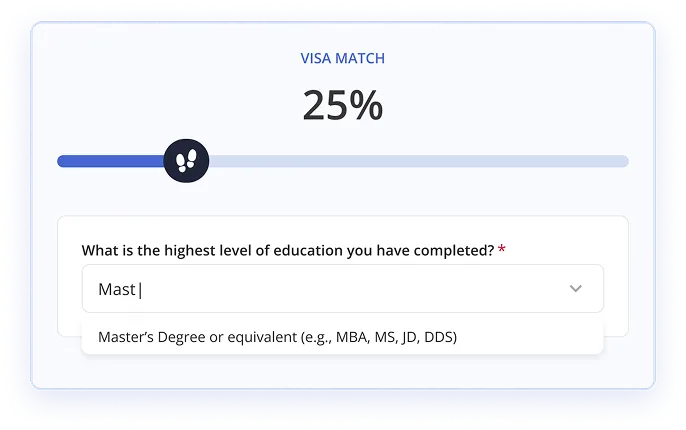
If you're not sure which visa fits your situation best, try the Visa Match tool to compare your options side by side.
One of the most common questions about the O-1 visa for startup founders is whether you can file the petition yourself. Every O-1A visa petition requires a U.S. employer, agent, or organization to serve as the petitioner and file Form I-129 (Petition for a Nonimmigrant Worker) on your behalf, but founders have clear options to make this work. If you've already incorporated a U.S. company, that company can petition for you as your employer. The business and the founder are legally separate entities, so your own startup can sponsor your O-1A. If you haven't formed a company yet, or if your company isn't the right petitioner for strategic reasons, a U.S.-based agent can file the petition on your behalf. Agent sponsorship is specifically allowed under USCIS O-1 regulations, and immigration attorneys who work with founders use this structure regularly.
The agent model is especially useful for founders who work with multiple companies or haven't yet established a single U.S. entity. In practice, most founder-led O-1A petitions go through either the founder's own company or an agent, making this visa one of the most flexible employment-based visa options for entrepreneurs.
Meeting three criteria is the minimum. Building a strong petition means going beyond the minimum with well-documented evidence and persuasive recommendation letters. Here are practical steps you can take now, even if you're months away from filing.
Document everything as you go. Save press mentions, award notifications, pitch competition results, conference invitations, and advisory board appointments. USCIS wants primary source evidence, not a narrative you piece together after the fact. The earlier you start collecting, the stronger your petition will be.
Collect recommendation letters early. Letters from investors, advisors, industry leaders, and academic experts carry real weight. Each letter should speak to your specific achievements and explain why your work rises to the level of extraordinary ability. Aim for five to eight letters from people whose opinions USCIS will respect.
Build your public profile deliberately. Publish thought leadership in industry outlets, accept speaking invitations, and participate as a mentor or judge in startup programs. These activities serve double duty: they grow your visibility in the field while generating evidence for multiple O-1A criteria at once.
Understand the timeline. Regular processing for the O-1A can take several months, so plan ahead. Premium processing costs $2,965 as of March 1, 2026, and guarantees an initial response within 15 business days. For a full breakdown of current timelines, see our O-1A processing time guide.
Learn the criteria inside out. The better you understand what USCIS is looking for, the more strategically you can build your profile. Tukki's O-1A video course walks through each criterion with real examples and shows you how to assemble a compelling evidence package.
| Detail | O-1A visa |
|---|---|
| Criteria required | At least 3 out of 8 |
| Annual cap | None (no lottery) |
| Self-petition allowed | No, requires U.S. employer, agent, or organization |
| Agent sponsorship | Yes |
| Degree required | No |
| Minimum salary | None |
| Initial validity | Up to 3 years |
| Extensions | 1-year increments, unlimited |
| Premium processing fee | $2,965 (as of March 1, 2026) |
| Premium processing time | 15 business days |
The O-1A is one of the few employment-based visa categories that doesn't penalize you for being early in your career or lacking a traditional corporate sponsor. For startup founders with a strong track record, it's a direct route to working in the U.S., and it sets up a clear path to permanent residence through the EB-1A green card.
WE CAN HELP
Need more clarity?
Find quick answers to frequent visa questions from our legal experts
Can I work for multiple employers on an O-1B visa?
Yes. If a U.S.-based agent files your O-1B petition, you can work for multiple employers, venues, labels, or promoters under that single visa.
This makes the O-1B especially practical for musicians who perform at various venues, collaborate with different artists, and take on session work across multiple projects.
Is EB-1A harder to get than the O-1A?
Yes, the EB-1A standard is higher. Both categories ask for evidence of extraordinary ability, but EB-1A requires sustained national or international acclaim and applies a final merits determination that weighs all your evidence as a whole.
Holding an O-1A is a strong signal that you can meet the EB-1A bar, but most applicants need to strengthen their evidence, especially independent expert letters and documentation of original contributions, before filing.
If you are physically in the U.S., can you work for a job abroad?
Only if you hold a visa or work authorization that allows you to work in the U.S. If your status does not permit employment, you cannot legally work—even for a foreign company paying you abroad.
Even with work authorization, it must cover the type of employment you intend to do. For example, an O-1 visa through a U.S. agent may allow you to work with multiple companies, while an Employment Authorization Document (EAD) provides broader flexibility.
How far in advance should I start collecting O-1 visa evidence?
A year gives you room to work through the whole O-1 visa checklist. Save what you have, request what third parties hold, and ask for letters while working relationships are current.
The deadline that binds is access rather than the filing date, since employer accounts, review platforms, and payroll portals close when you leave.
Can a startup count as a distinguished organization?
Yes. Distinguished means well-recognized in the relevant field, not famous with the public. A startup with reputable investors, marquee customers, industry awards, or strong trade press can qualify.
The work is assembling third-party evidence that makes the reputation visible to a USCIS officer who's never heard of the company.
Other blogs for every step of your visa journey
Your immigration forms - what each one is for and what to check before you sign
9 mins read | Oct 13, 2026
How to write an RFE response letter and organize the evidence behind it
9 mins read | Oct 12, 2026
Laying off a sponsored employee on H-1B: what the company owes and what the employee has left
8 mins read | Oct 9, 2026