Form I-290B after a denial: motion to reopen, motion to reconsider, or appeal
9 mins read | Oct 16, 2026
WHAT AN APPROVED PETITION BUYS YOU
Contributor
Tukki
Reading time
9 mins read
Date published
Sep 25, 2026
The approval notice arrives and somebody tells you the hard part is over. Then the priority date does not move, a recruiter calls, and none of the answers are in the notice.
An approved petition gives you exactly three things. Everything else in the waiting period depends on a status you have to keep alive separately, and on a calendar you do not control. Knowing which is which is most of the work.
Talk to an immigration attorney about your case and your priority date
| What the approval gives you | What it does not give you |
|---|---|
| A priority date you keep, usable for a later petition in EB-1, EB-2 or EB-3 | Any immigration status, work authorization or right to remain |
| A place in line in your category and country of chargeability | A visa number, which depends on the monthly bulletin |
| The basis for AC21 portability once the I-485 has been pending 180 days | Protection if your nonimmigrant status lapses while you wait |
What happens after I-140 approval is mostly the right-hand column, so read the row you are in and treat that column as the work. Our Form I-140 guide covers the petition itself, and I-140 premium processing covers how fast the approval arrives.
The priority date is the day the underlying case was filed, and it is the number that puts you in line. It belongs to you rather than to the employer who filed for you.
Under 8 CFR 204.5(e), an approved EB-1, EB-2 or EB-3 petition lets the beneficiary keep that priority date. The regulation extends it to "any subsequently filed petition for any classification under section 203(b)(1), (2), or (3)." If more than one is approved, you get the earliest date.
Three things break priority date retention, and all three involve petition revocation rather than a job change. Approval revoked for fraud or a willful misrepresentation. A labor certification revoked or invalidated. A determination that the approval rested on a material error. A denied petition never established a date at all, and a date cannot be transferred to anyone else.
So changing employers does not cost you the date. Moving between categories does not either, which matters when an upgrade is on the table. Our comparison of EB-1, EB-2 and EB-3 covers when that is worth doing.
Nothing about the approval lets you stay. Continuous status comes from whatever nonimmigrant classification you hold, most often H-1B, and it has to be extended on its own schedule by whoever employs you.
The approval does open up longer H-1B extensions past the sixth year, which is the other half of AC21 and belongs to its own post. One sentence is all it needs here: an approved I-140 with an unavailable priority date supports three-year H-1B extensions beyond the six-year limit.
What this means in practice is that the person watching your I-94 expiry matters more during the wait than the person who filed the petition. Our guide to going from H-1B to a green card maps the two tracks side by side.
You can change jobs once your Form I-485 has been pending 180 days or more and the new job is in the same or a similar occupational classification. That is the whole rule, and it comes from INA 204(j) and 8 CFR 245.25.
Before the I-485 is filed, AC21 portability does not exist yet. A move at that stage means the new employer starts a fresh case, and you carry your priority date into it rather than the approval. That is a real option, not a disaster, but it is a different process.
After 180 days of pendency, the position changes completely. A withdrawal by the old employer no longer kills the petition. Under 8 CFR 205.1(a)(3)(iii)(C), a petition withdrawn "180 days or more after the associated adjustment of status application has been filed, remains approved."
Changing jobs after I-140 approval is a documented move rather than an improvisation. Our walkthrough of changing employers has the mechanics, including timing the resignation.
Three conditions, and all three have to hold. I-140 portability needs the adjustment application pending 180 days or more, a qualifying new job, and a filing that tells USCIS about it.
The qualifying job is "a new offer of employment from the petitioning employer or a different U.S. employer, or a new offer based on self-employment, in the same or a similar occupational classification." Same or similar occupational classification is assessed on the duties, the skills required, the wage and the occupational codes, not on the job title.
The filing is Form I-485 Supplement J. It has two jobs: confirming that the original offer remains valid and that you intend to accept it, or requesting portability under INA 204(j) to a new full-time permanent offer. Check the current form edition on the USCIS page before you file, since editions change.
Self-employment counts, which surprises people. It is also the version most likely to draw questions about whether the offer is real, so build the documentation first.
USCIS designates one chart each month and you use the one it names. Current as of September 2026, employment-based applicants are directed to the Final Action Dates chart in the Department of State visa bulletin.
That designation is republished every month and it does change, so the lookup matters more than any number printed here. Open the USCIS adjustment of status filing charts page and read which chart it names for the month. Then find your category and country of chargeability on that chart in the bulletin.
Dates for filing let you file earlier than final action dates when USCIS designates them, which starts the 180-day clock sooner and gets work authorization into the household earlier. Final action dates govern when a case can be approved.
Our guides cover how to read the visa bulletin and what a final action date means. On the application itself, see what Form I-485 is and the adjustment packet checklist.
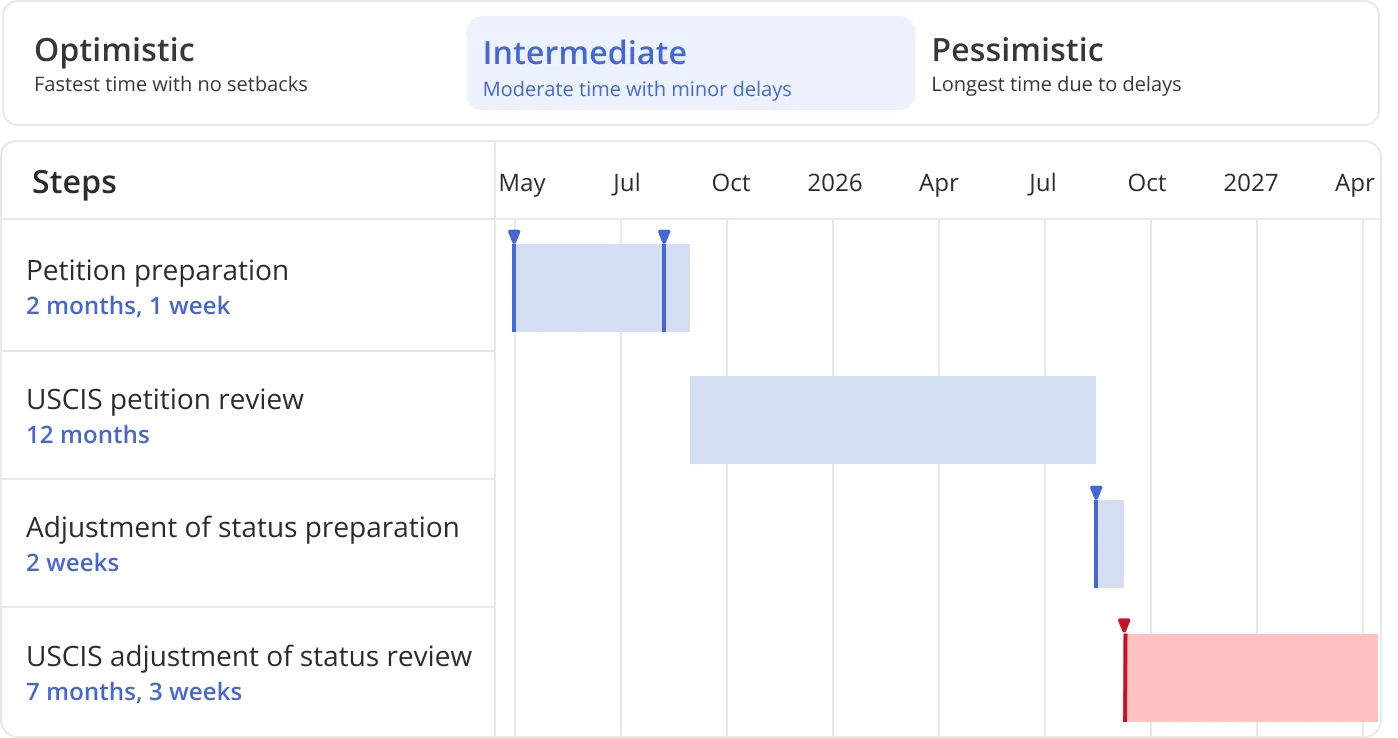
Your application waits. Priority date retrogression after filing does not undo the filing, and it does not cancel the work authorization or advance parole already issued to you.
What it does is stop the case from being approved until your date is current again. A case that was ready to approve in one month can sit for another year because the category moved backwards. That is normal rather than a sign of a problem.
The practical consequences are administrative. Employment authorization and advance parole have to be renewed while you wait. The 180-day portability clock keeps running regardless, so a retrogression period is often when portability becomes available. Our post on a visa bulletin that will not move explains why categories go backwards.
Yes, with a document in hand or a specific status, and no otherwise. Under 8 CFR 245.2(a)(4)(ii), departure by an applicant who is not in proceedings "shall be deemed an abandonment of the application."
Two exceptions carry the weight. The first is advance parole granted before you leave, where you are inspected and paroled on return. The second covers applicants in lawful H-1 or L-1 status who return still eligible for that status, resume work with the same employer and hold valid visas. H-4 and L-2 dependents are covered on the same terms.
So the safe versions are travel with advance parole issued and in your possession, and travel by an H-1B or L-1 holder who keeps the status and the job. The live risks are leaving before the document is issued, letting the underlying status lapse while abroad, and a visa stamp that expires mid-trip. Our post on travel and advance parole covers what to carry.
A derivative beneficiary does not automatically age out at 21, because the Child Status Protection Act changes the number that counts. Under INA 203(h)(1) the age used is the age on the date a visa number becomes available. That age is "reduced by the number of days in the period during which the applicable petition described in paragraph (2) was pending."
There is a condition attached. The person must have "sought to acquire the status of an alien lawfully admitted for permanent residence within one year of such availability," so a year of inaction can undo the protection that the calculation gave.
Work out the number early rather than in the month of the birthday. Our explainer on the Child Status Protection Act runs through the arithmetic.
A spouse is a separate question. Work authorization for a spouse depends on the status they hold, or on a pending adjustment application, and not on your approved petition. Our overview of work authorization options for a spouse covers both routes.
The I-140 asks where the case should finish, and the consular processing election is the answer to that question. It is not permanent, and it can be changed later.
Electing adjustment of status keeps the case inside the United States. It brings work authorization and advance parole for the applicant and the family while the I-485 is pending. It is also what makes AC21 portability available, since portability runs off the pendency of that application.
Electing consular processing sends the case to a U.S. consulate abroad. It suits people who are already outside the country or expect to be, and it avoids depending on a U.S. status through the wait. It does not produce a pending I-485, so it does not open the portability route.
Both are ordinary choices and the right one depends on where you expect to be living. Our comparison of consular processing and adjustment of status lays the two side by side.
Treat I-140 approved next steps as a small maintenance job rather than a one-time event.

AC21 portability settles one thing cleanly. After 180 days of pendency, a job change in the same or a similar occupational classification stops being a threat to the case. The approval survives an employer walking away.
What stays on the calendar is everything else. Your status, your renewals, your child's age calculation and a priority date that moves on its own schedule. Those are the items worth a reminder rather than a worry.
Tukki helps people through the employment-based green card process with attorneys answering questions on their own case, from the petition through the adjustment filing.
If your date is retrogressed, a job offer is on the table, or a birthday is coming, book an intro call and get the timing checked.
WE CAN HELP
Need more clarity?
Find quick answers to frequent visa questions from our legal experts
What is a 214(b) visa denial and how do I overcome it?
A 214(b) visa denial means the consular officer wasn't satisfied that you have strong enough ties to your home country to ensure you'll return after your visit.
To overcome it, you need to demonstrate changed circumstances on your next application — new employment, property ownership, stronger financial documentation, or a clearer travel purpose. Focus on whatever specific concern the officer raised during your previous interview.
Is online filing faster than paper for Form I-90?
Yes, online filing typically closes a few weeks to a couple of months faster than paper for the same renewal. Online filings show up in USCIS systems instantly, get receipt notices issued within days, and avoid the manual data-entry step that can introduce small errors on paper filings.
If you have access to a myUSCIS account and your case has no complications, online is the better choice.
How long does a P-1 last compared to an O-1?
An individual P-1A athlete can be admitted for up to 5 years and extend to a maximum of 10, while a P-1A team is admitted for up to 1 year at a time. The O-1A starts at up to 3 years, then renews in 1-year increments with no overall cap.
For an individual planning a long U.S. career, the P-1A offers the longest single runway, while the O-1A offers open-ended renewals.
Can you work on a visa?
Yes, many visas authorize work, but only within the limits that visa sets. A nonimmigrant work visa like the H-1B lets you work for the specific employer that sponsors you, in the role described in the petition, for the authorized period.
A green card, by contrast, lets you work for any employer, switch jobs, or stop working without asking USCIS each time.
Does volunteering count as work under U.S. immigration law?
It can, in many cases. If the activity is something that is normally paid (e.g., designing, performing, consulting), USCIS may treat it as unauthorized employment even if you are unpaid. True volunteering—like helping at a food bank, church, or charity where no one is paid—is generally allowed.
Other blogs for every step of your visa journey
Form I-290B after a denial: motion to reopen, motion to reconsider, or appeal
9 mins read | Oct 16, 2026
EB-2 NIW approval rate: what the published numbers show and where cases fail
8 mins read | Oct 15, 2026
Form I-539: how to extend or change your status without leaving the U.S.
8 mins read | Oct 14, 2026