You have a valid visa and an EAD at the same time - which one you work on and why it matters
8 mins read | Oct 6, 2026
A COMPLETE GUIDE TO HOW THE NEW WAGE-BASED LOTTERY WILL WORK AND HOW THAT WILL IMPACT YOUR SELECTION
Contributor
Tukki
Reading time
12 mins read
Date published
Feb 2, 2026
Regulations are evolving rapidly around the H-1B lottery process. In fact, it’s not even a lottery or a complete matter of luck anymore. The system has shifted towards wage-based selection. In this article, we’ll cover:
USCIS replaces all random H-1B Lottery with wage-based selection rules starting Feb 27, 2026. As part of this new rule, applicants with higher wages will be given an advantage.
Every H-1B application will still go to a single selection pool for the lottery, but the registrations with a higher wage level will be placed in the pool multiple times. For example, if you have the level IV wage level, then your entry will go into the lottery pool four times.
Basically, USCIS is increasing the chances of applications with higher wages being picked.
Here are the different wage levels and how many entries they get:
| Wage level | Role type | Lottery entries |
|---|---|---|
| Level IV | Expert/Lead | 4 entries |
| Level III | Experienced/Senior | 3 entries |
| Level II | Qualified/Intermediate | 2 entries |
| Level I | Entry level | 1 entry |
While the final selection is still a lottery, the probability of registrations with higher wages passing the lottery is higher.
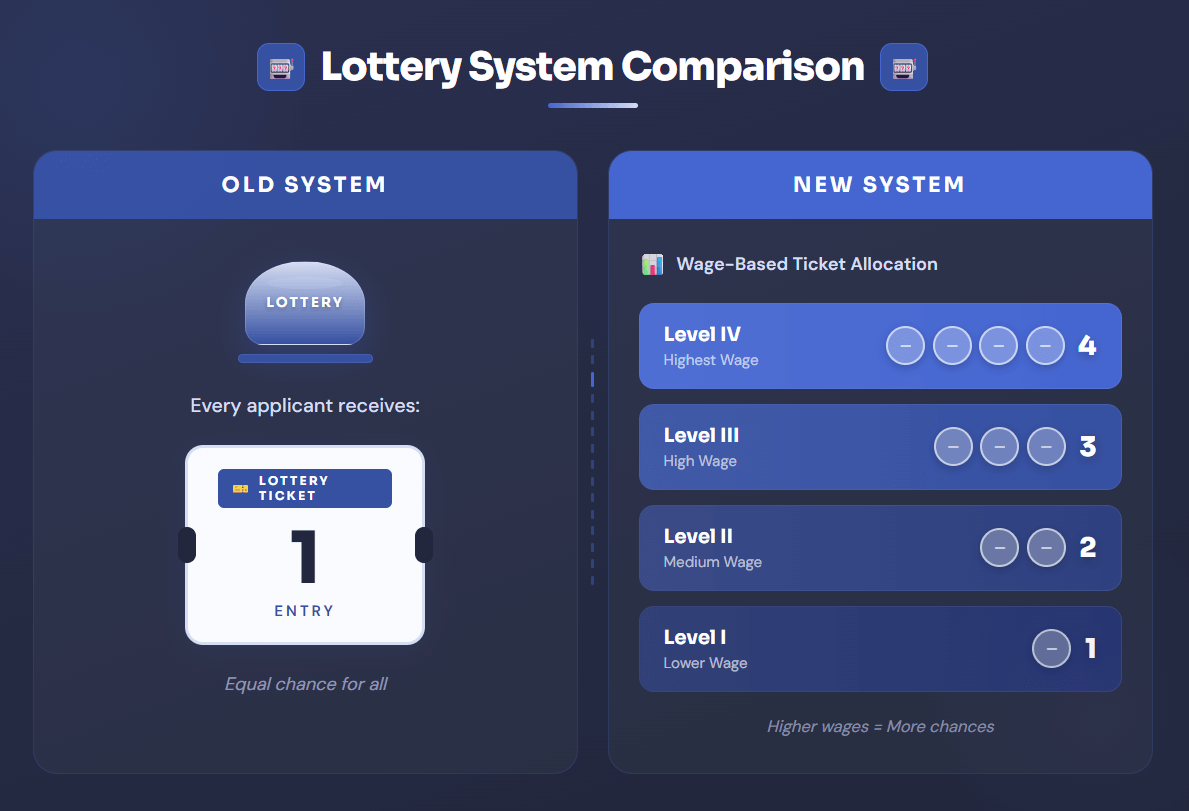
Old vs New H-1B Lottery Process Comparison
The U.S. government has already determined the wage level for different roles. You can find out the wage level for your role using the official U.S. Department of Labor site. On the site, you can select the industry, occupation code, and location to learn about different wage levels.
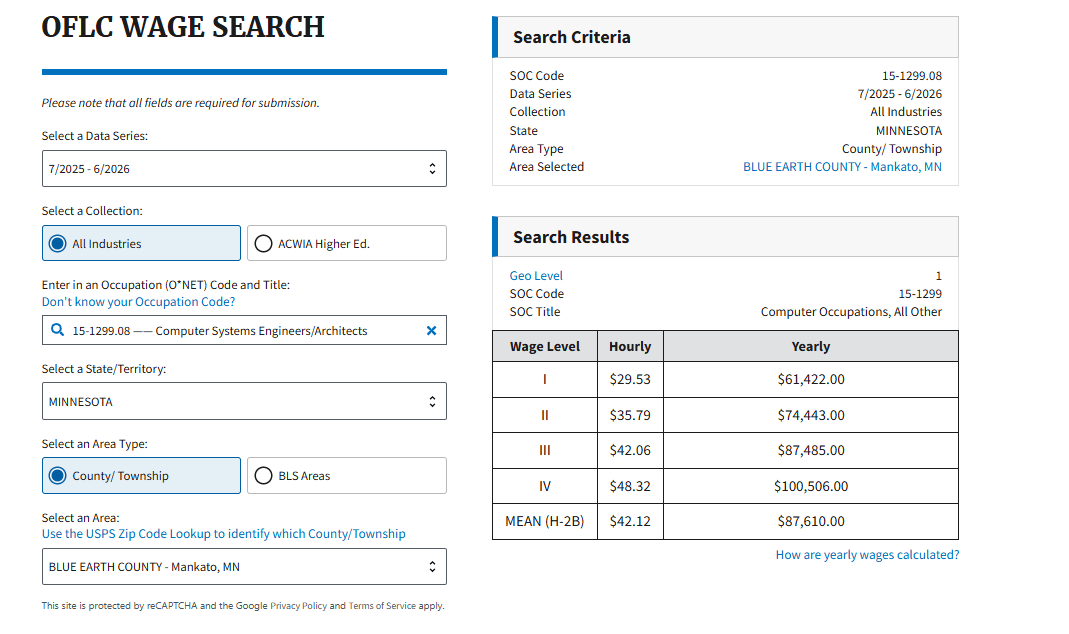
Wage search option on the U.S. Department of Labor site
The wage standards differ from location to location, even for the same role. For example, in Albany, New York, the current level I wage for a computer systems engineer is $56,160, and the level IV wage is $119, 246. On the other hand, the level I wage is $61,422, and the level IV wage level is $100, 506 in Blue Earth County, Minnesota.
With the wage-weighted change, the government plans to prioritize highly skilled foreign workers while also protecting the interests of American workers.
Matthew Tragesser, U.S. Citizenship and Immigration Services spokesman, says, “The new weighted selection will strengthen America’s competitiveness by incentivizing American employers to petition for higher-paid, higher-skilled foreign workers. With these regulatory changes and others in the future, we will continue to update the H-1B program to help American businesses without allowing the abuse that was harming American workers.”
USCIS has a cap limit for 65,000 general H-1B visas and 20,000 additional visas to applicants having advanced degrees from U.S. institutions.
While the overall cap limit is 85,000, the usual registration count is huge. For FY 2026, USCIS received 358,737 applications. As demand is massive compared to the cap limit, the lottery process becomes a non-biased way to choose applications within the threshold.
You can bypass the lottery system if you are working for cap-exempt employers, such as:
Your employer has to file Form I-129 that skips the lottery, and it goes through directly if:
Participating in the H-1B lottery is a time-sensitive, complex process that must be completed within the designated registration window. Small mistakes could lead to a request for evidence (RFE) or even straight disqualification.
Follow these steps to stay compliant with USCIS norms and prevent errors in the registration:
The key requirements for you to be eligible for H-1B are:

Latest development: The U.S. government is taking conscious steps to prevent companies from hiring foreign talent at lower rates. As a result of this, to be eligible for an H-1B visa, you must also hold a job offer that is in the appropriate wage range for that occupation and location. You can determine the wage level for your role using the official government site.
The H-1B process is primarily employer-driven, but document preparation requires effort from both employee and employer. You need to provide all your records and beneficiaries' documentation for the employer to build a case.
Documents to be handled by employees:
Documents to be handled by the employer:
Latest development: The U.S. government now allows entrepreneurs to self-sponsor H-1B visa from their own company. In such cases, you need to complete the paperwork for both sides.
Once all the documents are ready, the employer directly files them in the USCIS portal. For filing the registration, the employer needs to pay:
Latest development: Previously, filing an H-1 B petition would cost employers around $3000 to $8,000 (depending on company size). Premium processing fees are extra on top of this. But starting Sept. 21, 2025, an additional fee of $100,000 must be paid for any new H-1B visa petitions (excluding extensions, transfers, or renewals). USCIS will refund the fees if the H-1B petition is denied. This rule change makes the H-1B process expensive for employers.
H-1B registration typically happens around March for the next fiscal year. USCIS will open it early to mid-March for FY 2027, providing two weeks for registration. The lottery results will be declared at the end of March.
By the end of March, your employer can see in the USCIS portal if your registration was:
If you’re selected, your employer typically gets 90 days to file your H-1B petition with complete documentation.
It’s important to understand that lottery selection is just a pre-screening process. The actual petition review starts now. If USCIS has any questions about the documents in the process, then they send an RFE (Request for Evidence) to get more proof to approve the petition.
In case of solid documentation, the petition is approved without any RFE. Your petition could be denied if the USCIS officer is not convinced of your case.
In some cases, there is a second lottery if USCIS has not filled the cap, but usually, they reach it in March itself. If you are not selected in the lottery or denied during the petition phase, you have several fallback options, which we will discuss later in the next section.
Check our detailed H-1B visa guide
If things didn’t go in your favor during the lottery or petition process, you still have more doors to enter. You can try out the following options:
Tukki’s legal team compiled the most crucial H-1B visa application mistakes and ways to avoid them:
With the new wage-weighted selection, it’s important to understand your wage level based on the role and location. Relying on any private wage surveys will lead to misunderstanding your lottery weight.
How to avoid this issue?
Always use the government official site only to determine your wage level. Do not try to manipulate the system by trying to show a higher salary for entry-level positions. It will raise obvious red flags.
Another mistake applicants make is trying to get an advanced degree exemption without completing the master’s degree. Any kind of such misrepresentation results in straight disqualification.
How to avoid this issue?
Understand the primary criteria to enter the H-1B master’s cap well. You must hold a master’s degree from a U.S. institution only. Also, you must have completed all degree requirements by the day the petition is submitted to USCIS.
You might think that having multiple employers file H-1B applications for you will increase your chances of making it past the lottery system. But the USCIS has implemented a beneficiary-centric process where an application goes to the lottery pool only once, despite multiple applications. Also, all the applications must be legit. If not, one may also face criminal prosecution.
How to avoid this issue?
If you have multiple offers, you can prioritize the employer with a higher wage level offer to file the application for you.
Apart from the above issues, your employer must take care that the application is filled with a valid account, without any incorrect details of you and your beneficiaries, and submit the application on time.
Tukki helps prepare your H-1B case with experienced immigration attorneys through a structured, personalized process.
Once you schedule a call, our immigration attorney helps you:
Get a well-organized and human experience with Tukki. Schedule a free call to understand the process, timelines, and pricing.
WE CAN HELP
Need more clarity?
Find quick answers to frequent visa questions from our legal experts
Can my spouse work while I'm waiting for the green card?
Yes, in two ways. As an H-4 dependent spouse of an H-1B principal with an approved I-140, your spouse can apply for an H-4 EAD. Once you file I-485, your spouse can file a derivative I-485 and Form I-765 to get an EAD independent of the H-4 status.
Both routes give your spouse work authorization, but the H-4 EAD is tied to H-4 status while the I-485 EAD is independent. See our H-1B spouse work permit guide and spouse work authorization options guide for the full breakdown.
What happens if our candidate isn't selected?
Selection is by unique beneficiary, and most registrations aren't picked, so plan for it. Common options include registering again next cap season, a cap-exempt employer such as a university or affiliated nonprofit, cap-gap via STEM OPT for eligible candidates, or a different category like the O-1A.
Each candidate's best path depends on their profile, so they work it out directly with the attorneys.
How much does green card sponsorship cost the employer?
Employer green card sponsorship through the PERM, I-140, and I-485 route typically ranges from $14,000 to $30,000. This includes recruitment advertising ($1,000 to $3,000), the I-140 filing fee ($715 plus the Asylum Program Fee), and attorney fees ($8,000 to $18,000+).
The I-485 adjustment of status fee ($1,440) is often covered by the employer but isn't legally required.
Can my employer make me pay for my H-1B?
The mandatory employer fees stay with the employer by federal regulation. The I-129 base fee, ACWIA training fee, fraud prevention and detection fee, Asylum Program Fee, and Public Law 114-113 fee all come out of company funds.
The premium processing fee is the one exception: the employee can pay it when the upgrade is for the worker's benefit rather than for the employer's business needs.
Can I switch to an H-1B after a STEM OPT denial?
It can be possible if you have a sponsoring employer and secure a cap-subject registration and selection, or qualify for a cap-exempt H-1B. The cleaner path is filing a change of status while you are still inside your grace period and lawfully present.
Our OPT to H-1B transition guide covers the cap, the lottery, and the cap-gap timing that shapes whether this route fits your calendar.
Other blogs for every step of your visa journey
You have a valid visa and an EAD at the same time - which one you work on and why it matters
8 mins read | Oct 6, 2026
J-1 Research Scholar, Specialist and Trainee - the three categories employers use
8 mins read | Oct 5, 2026
RFE or NOID - what a notice of intent to deny means for your case
9 mins read | Oct 2, 2026