Your immigration forms - what each one is for and what to check before you sign
9 mins read | Oct 13, 2026
FORM I-90 TIMELINE
Contributor
Tukki
Reading time
9 mins read
Date published
Jun 2, 2026
Reviewer note (to confirm before publishing). The prior reviewing attorney (MB) read this for sense but could not verify the facts (timelines, the 36-month extension, the ADIT process). No specific corrections were raised; this needs substantive legal sign-off before publishing.
The green card renewal processing time typically runs 7 to 12 months from the date USCIS receives Form I-90 to the date your new card arrives in the mail. The exact length depends on which service center handles your case and whether USCIS issues an RFE. What protects you in the meantime is the receipt notice, Form I-797C, which automatically extends your green card's validity for 36 months from the printed expiration date. This guide covers what to expect at each step, how to prove your status during the wait, and what to do if Form I-90 is taking longer than the posted range.
In 2026, most Form I-90 cases close within 7 to 12 months. That's the range USCIS publishes on the USCIS Case Processing Times tool, and it lines up with what most permanent residents report. Inside that range, the variation comes from which USCIS service center adjudicates the case and whether anything in the case triggers extra review.
I-90 is adjudicated at multiple service centers, and each one publishes its own processing range. Online filings under IOE receipt numbers tend to land at the faster end of the range because the system catches data-entry mistakes before they become RFEs. Paper filings routed to a regional service center take longer on average because each step (initial intake, biometrics scheduling, adjudication) involves human handling.
The processing-times tool updates monthly, so before assuming a delay, check the current range for the service center on your I-797C receipt notice.
Processing time depends on three factors: which service center has your file, whether biometrics raises any flags that trigger a manual review, and whether the application has any complications (name changes, criminal history, prior immigration issues, lost card while abroad). Online filings of clean renewals close fastest, often in 5 to 7 months. Paper filings with complications can stretch to a year or more.
The Form I-90 process is a five-step sequence: filing, receipt notice, biometrics, adjudication, and card delivery. Each step takes a predictable amount of time when nothing goes wrong.
After USCIS receives your I-90, they mail Form I-797C, Notice of Action, confirming receipt and assigning a receipt number. Online filers see the receipt number in their myUSCIS account within days; the paper I-797C still arrives by mail within two to four weeks. The I-797C is important because it acts as proof of permanent resident status during the wait (covered in the next section).
If you filed Form G-1145 with your I-90, USCIS also sends a text or email when the case is accepted. Tracking status changes through the public case status page or your myUSCIS account picks up from there.
Roughly four to eight weeks after the receipt notice, USCIS sends a biometrics appointment notice (also on Form I-797C) with a specific date, time, and Application Support Center location. The appointment captures your fingerprints, photo, and signature for the new card. The appointment itself takes 15 to 30 minutes.
If you can't make the scheduled date, you can reschedule once through your myUSCIS account or by mailing a request with the scheduling notice. Missing biometrics without rescheduling can lead to a denial as abandoned.
After biometrics, the file goes to an officer for adjudication. This is the longest single step. For a clean renewal, the officer approves the I-90 within several months of biometrics. The status sequence is usually "Fingerprint Fee Was Received," "Biometrics Was Scheduled," then "Case Was Approved" or "Request for Initial Evidence Was Sent" if USCIS needs more documentation.
If you get an RFE, the response time you have is usually 30 to 60 days, and USCIS pauses adjudication until they receive your response. Our USCIS Request for Evidence guide walks through how to read and respond to an RFE.
Once approved, the status moves through "New Card Is Being Produced," "Card Was Produced," "Card Was Mailed To Me," and finally "Card Was Delivered To Me By The Post Office." Each step usually moves within one to three weeks of the previous one. Total delivery time from approval to card in hand runs three to six weeks.
Yes. The Form I-797C receipt notice for a pending Form I-90 automatically extends the validity of your existing green card by 36 months from the card's printed expiration date. That extension is built into the receipt notice itself and is recognized by employers (for I-9 work authorization), DMV offices, and CBP officers at U.S. ports of entry.
The 36-month extension started in September 2022 and applies to every I-90 filing receipt issued from that point forward. Before that, the extension was only 12 months, which created status gaps for slower cases. The 36-month version covers almost all renewal timelines, even ones with RFEs or delays.
The extension is automatic. You don't have to apply for it, you don't have to file an additional form, and you don't have to do anything beyond holding on to your I-797C. Just keep the I-797C with your expired green card and your other immigration documents.
Carry both documents together. For employers running I-9 verification, present the expired green card plus the I-797C receipt notice; together they document continued work authorization. For DMV interactions (license renewal), present both as proof of permanent resident status. For international travel returning to the U.S., present both at CBP secondary inspection if you're asked for proof of status; the I-797C extends both the work and travel authorization that the green card carries.
If the I-797C is misplaced, you can print a copy from your myUSCIS account (for online filings) or request a duplicate through the USCIS Contact Center (for paper filings).
Most renewals close before the 36-month extension on the receipt notice runs out. For the small share that don't, USCIS offers another tool: the ADIT (I-551) stamp.
For most permanent residents, the receipt notice plus the expired green card is enough proof of status. Employers, banks, and government offices recognize the combination. The 36-month extension is printed directly on the I-797C, which makes the validity easy to verify.
ADIT (Alien Documentation, Identification, and Telecommunications) stamps, also called I-551 stamps, are temporary proof-of-status stamps placed directly in your passport by a USCIS field office. The stamp is recognized as proof of permanent resident status and is most useful when you need a physical immigration document in your passport for international travel or specific employment situations.
If you're planning international travel and your green card has expired (and you'd rather not rely on the I-797C alone during reentry), an ADIT stamp in your passport gives airline check-in staff and CBP officers a recognizable proof of status. Some airlines, especially smaller international carriers, are more comfortable boarding passengers with an in-passport stamp than with a paper receipt notice.
Some employers, especially those running automated I-9 verification systems, have trouble with the receipt-notice-plus-expired-card combination if their HR software wasn't set up to handle it. An ADIT stamp simplifies the verification because it looks like a standard immigration stamp. Government contractor positions and security-cleared roles often prefer ADIT stamps for this reason.
To request an ADIT stamp, schedule an InfoPass appointment at your local USCIS field office through the USCIS Contact Center. Bring your I-797C, expired green card, and passport. The stamp is free and is typically valid for 12 months.
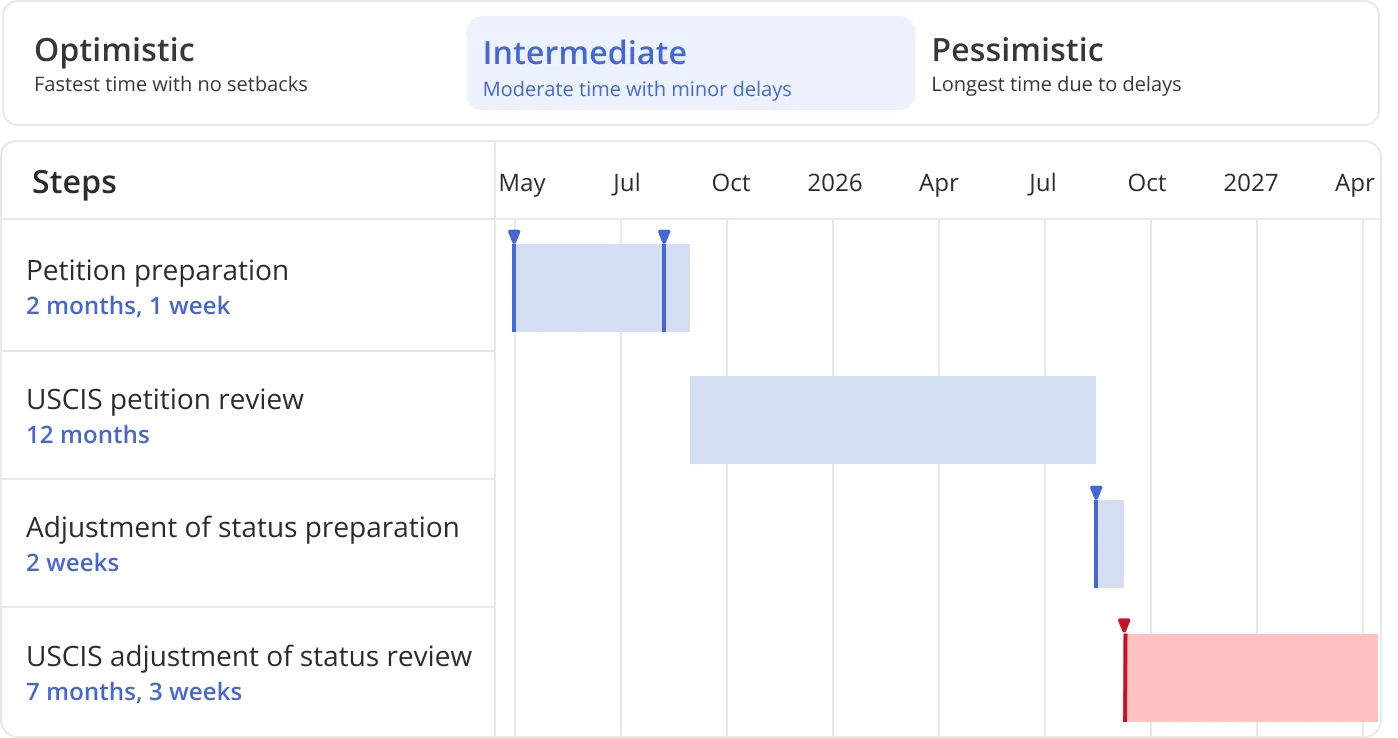
Three tools let you track Form I-90 progress: the USCIS online account, the public case status page, and the processing times tool.
The myUSCIS account at myaccount.uscis.gov is the most complete tracker. Online filings appear automatically in the dashboard, and paper filings can be linked by adding the receipt number. The dashboard shows status, sends email notifications on changes, and lets you upload documents or respond to RFEs.
The public page at egov.uscis.gov/casestatus shows the current status for any case if you have the receipt number. It's faster than logging into myUSCIS for a quick check but doesn't keep history or send notifications.
The USCIS Case Processing Times tool shows the current range USCIS is using to process I-90 at each service center. Use it to decide whether your case is within the normal window or genuinely delayed.
If you're past the posted processing time, USCIS offers three escalation channels: a case inquiry through your account, contact via Emma, and the USCIS Ombudsman as a last resort.
A case inquiry is the first escalation step. Log in to your myUSCIS account, select "Submit a Case Inquiry," and choose the reason (typically "Case is outside normal processing times"). USCIS responds within 30 to 60 days. Inquiries filed for cases inside normal processing windows are routinely rejected, so check the processing times tool first.
Emma is the USCIS virtual assistant available at uscis.gov. You can ask Emma for status updates or schedule a callback from a live agent. The callback is the most useful function; tier-two officers can pull up your specific case and tell you what's holding it.
The USCIS Ombudsman is an independent office under DHS that helps applicants whose cases are stuck after normal channels have failed. File a case assistance request at dhs.gov/case-assistance. The Ombudsman doesn't approve cases or override USCIS decisions, but they can push USCIS to take action on cases that have been ignored. Use this channel after the case inquiry and Emma callback haven't moved the case.
If the wait is causing concrete harm (you can't travel, can't work, can't get a state benefit), an immigration attorney can sometimes accelerate the case through targeted advocacy. Our immigration lawyer for green card renewal guide covers when the attorney route is worth it, and the how to renew green card guide covers the full I-90 filing process from start to finish.
WE CAN HELP
Need more clarity?
Find quick answers to frequent visa questions from our legal experts
Can I travel internationally while my Form I-90 is pending?
Yes. Your existing green card (even if expired) plus the I-797 receipt notice with the 36-month extension language is accepted by U.S. Customs and Border Protection at re-entry. If you don't have your physical green card, you can request an ADIT (I-551) stamp at a USCIS field office before you leave to make re-entry smoother.
Foreign airlines sometimes ask for additional documentation, so carry both the receipt notice and the existing card.
What is the difference between an LCA and an H-1B petition?
The LCA is a Department of Labor filing on Form ETA-9035E where the employer attests to wage and working-condition obligations. The H-1B petition is a USCIS filing on Form I-129 that asks for the visa classification itself. The LCA has to be certified first and is submitted as part of the petition.
A certified LCA does not mean an approved H-1B, and DOL's review does not verify that your attestations are accurate.
Is an immigration lawyer worth the cost?
For most people, yes.
Immigration law is complex, and a single mistake on a visa application can lead to delays, denials, or even bars on future filings.
An experienced immigration attorney knows how to build a strong petition, anticipate USCIS concerns, and respond effectively to RFEs.
The cost of hiring a lawyer is often far less than the cost of a denied petition and the time lost starting over.
Does an H-1B amendment need a new LCA?
Usually yes, and the LCA has to be certified before the amendment is filed. A move within normal commuting distance of the worksite on the existing certified LCA is the main case where the existing one already reaches the new address, and no amendment is needed either, though the certified LCA still has to be posted at the new location and the public access file updated.
Whether to certify a fresh LCA for that address anyway is a call your attorney will make on the facts, so raise the move before the employee starts there.
Can I apply for reinstatement after falling out of F-1 status?
In many cases yes, using Form I-539 with a new Form I-20 recommending reinstatement from your DSO. You generally must not have been out of status more than five months when you file, must not have worked without authorization, must intend to resume a full course of study, and must show the violation came from circumstances beyond your control.
A denied reinstatement cannot be appealed, though a motion may be available, so the application should be strong on the first filing.
Other blogs for every step of your visa journey
Your immigration forms - what each one is for and what to check before you sign
9 mins read | Oct 13, 2026
How to write an RFE response letter and organize the evidence behind it
9 mins read | Oct 12, 2026
Laying off a sponsored employee on H-1B: what the company owes and what the employee has left
8 mins read | Oct 9, 2026