Form I-290B after a denial: motion to reopen, motion to reconsider, or appeal
9 mins read | Oct 16, 2026
WHAT TO BUDGET FOR THE NIW
Contributor
Tukki
Reading time
8 mins read
Date published
Jul 5, 2026
The EB-2 NIW cost in 2026 comes down to two buckets: the government filing fees you pay USCIS, and the attorney fees you pay to build the case. Because the National Interest Waiver (NIW) lets you self-petition, you skip the PERM labor certification step that a standard employer-sponsored green card requires, so the total looks different from most employment-based cases. This guide breaks down each cost so you can budget for a national interest waiver green card with a clear number in mind.
A quick note on terms before we get into the money. The EB-2 NIW is an employment-based green card for professionals with an advanced degree or exceptional ability whose work benefits the United States. Because it waives the job offer and the labor certification, you can file it yourself without an employer. That self-petition freedom is exactly what shapes the cost of EB-2 NIW: you're paying for a legal case built around you, not a company's sponsorship budget.
The EB-2 NIW cost in 2026 has two main parts: USCIS filing fees that are fixed by the government, and attorney fees that vary by provider and case complexity. The government portion centers on Form I-140, the immigrant petition for a green card, and the fee for that form is $715 at current USCIS rates. If you also apply for your green card from inside the United States, Form I-485 adds more, and an optional faster-review service (premium processing) adds more still.
Here's how the pieces fit together. The I-140 is the core NIW filing, so every self-petitioner pays that fee. The other government fees depend on where you are in the process and whether you're already in the U.S. or waiting abroad. Attorney fees sit on top of all of it and usually make up the largest single line in a self-petition budget, since the work of proving national interest is evidence-heavy.
The table below summarizes the main line items. Read the sections that follow for what each one covers and when it applies to you.
| Cost item | Form | Fee (2026) | When it applies |
|---|---|---|---|
| Immigrant petition | I-140 | $715 | Every EB-2 NIW self-petition |
| Adjustment of status | I-485 | $1,440 | Only if you file for the green card from inside the U.S. |
| Premium processing | I-907 | $2,965 | Optional, for a faster decision on the I-140 |
| PERM labor certification | none | $0 | Waived for the NIW |
| Attorney fees | none | $5,000 to $10,000 (typical market range) | Case preparation and RFE response |
The main EB-2 NIW filing fee is the $715 charge for Form I-140, the immigrant petition that asks USCIS to classify you in the EB-2 category with a national interest waiver. This is the one fee no self-petitioner can avoid, and you pay it once when you file your petition. You can confirm the current amount on the USCIS fee schedule.
Whether you pay more than the I-140 fee depends on how you pursue the green card itself. Filing the I-140 establishes your priority date, which is your place in line for a green card, but it doesn't grant permanent residence on its own. Once a visa number becomes available for your category and country, you take one of two routes to the actual green card: adjustment of status if you're in the United States, or consular processing if you're abroad.
If you adjust status from inside the U.S., you file Form I-485, the application to register permanent residence, and that form carries a $1,440 fee. Consular processing abroad uses a different set of Department of State fees instead of the I-485. Either way, this green card step is separate from the I-140 petition fee, so build it into your plan rather than treating the I-140 as the finish line.
Premium processing is an optional service where USCIS commits to a faster decision on your I-140 in exchange for an extra fee, currently $2,965 for Form I-907, the request for premium processing. For the EB-2 NIW, USCIS aims to act within 45 business days rather than the 15 business days it targets for most other petition types, so the guarantee is slower here than the premium timeline many applicants have heard about.
Whether that fee earns its place in your budget depends on your priority date and your reason for speed. If your country's visa number is current and you're ready to move to the green card step, a faster I-140 decision can matter. If you face a long backlog anyway, as many applicants from India and China do, a quicker petition approval won't shorten the wait for a visa number, so some self-petitioners hold that fee back. It's a decision worth mapping against your priority date before you pay, and you can read more in the USCIS premium processing overview.
EB-2 NIW attorney fees typically run $5,000 to $10,000 for a self-petition, with many straightforward cases landing between $6,000 and $8,000, and this is usually the largest single cost in the whole budget. The reason is straightforward: a national interest waiver case is built on argument and evidence, not a standard form. Your attorney has to frame your proposed work as an endeavor with substantial merit and national importance, show you're well positioned to advance it, and argue that waiving the labor certification benefits the country, all under the Matter of Dhanasar framework that USCIS uses to judge these petitions.
That work drives the EB-2 NIW lawyer fees you'll see quoted. Preparing the petition means drafting a detailed endeavor statement, gathering recommendation letters from independent experts, organizing publications, patents, grants, and other proof of impact, and tying all of it to recognized U.S. priorities. A strong petition can run hundreds of pages, and the difference between a thin filing and a well-supported one often shows up in whether USCIS issues a Request for Evidence (RFE), which is a formal notice asking for more documentation before a decision.
Pricing models vary, and it helps to know what you're comparing. Some providers quote a flat fee that covers the full petition; others bill hourly or charge separately for pieces like the endeavor statement or an RFE response. When you compare quotes, ask exactly what the number includes: petition preparation, filing fees, and RFE response are the three items most likely to be bundled together or split apart, and that choice changes the total you actually pay. For a wider view of how legal pricing works, see our guide on how much an immigration lawyer costs.
The EB-2 NIW skips the PERM labor certification step, and that single fact is why its cost picture differs from a standard employer-sponsored green card. PERM is the Department of Labor process where an employer proves no qualified U.S. worker is available for the role before filing a green card petition. It requires prevailing wage requests, recruitment campaigns, and legal work that an employer usually pays for, and it adds months to the timeline. Because the national interest waiver removes the labor certification requirement, none of those PERM costs land in your budget.
Compare the two paths and the difference stands out. In a typical employer-sponsored EB-2, the company carries PERM recruitment costs and the related attorney work, then files the I-140 for you. In an EB-2 NIW self-petition, there's no employer and no PERM, so your budget is the I-140 fee, the green card step, optional premium processing, and your own attorney fees. You take on the legal cost of building the case, but you avoid the labor certification expense and gain the freedom to file without a sponsor.
That trade shapes who the NIW suits. Researchers, founders, and skilled professionals whose work extends beyond a single employer often find the self-petition worth the attorney investment, since it buys independence from a sponsoring company. If you're weighing this route against another green card option, our comparison of EB-2 NIW versus EB-1A walks through how the two self-petition categories differ, and the EB-1A cost breakdown shows a parallel budget for the extraordinary ability path. For a full walkthrough of the filing itself, see our guide on how to apply for an EB-2 NIW.
For the complete eligibility and evidence picture behind these costs, our EB-2 NIW visa guide covers the Dhanasar test and documentation in depth.
Tukki quotes one end price for an EB-2 NIW self-petition, and that price already includes the government and USCIS fees plus any RFE response your case needs. The number you see at the start is the number you pay: petition preparation, the filing fees, and responding to a Request for Evidence are all bundled into the same quote. Some firms price per service and bill each of those separately, which means their headline figure and their final figure can differ once the case moves forward. Both models are valid, and the right choice is yours; the point is to know which one you're looking at when you compare.
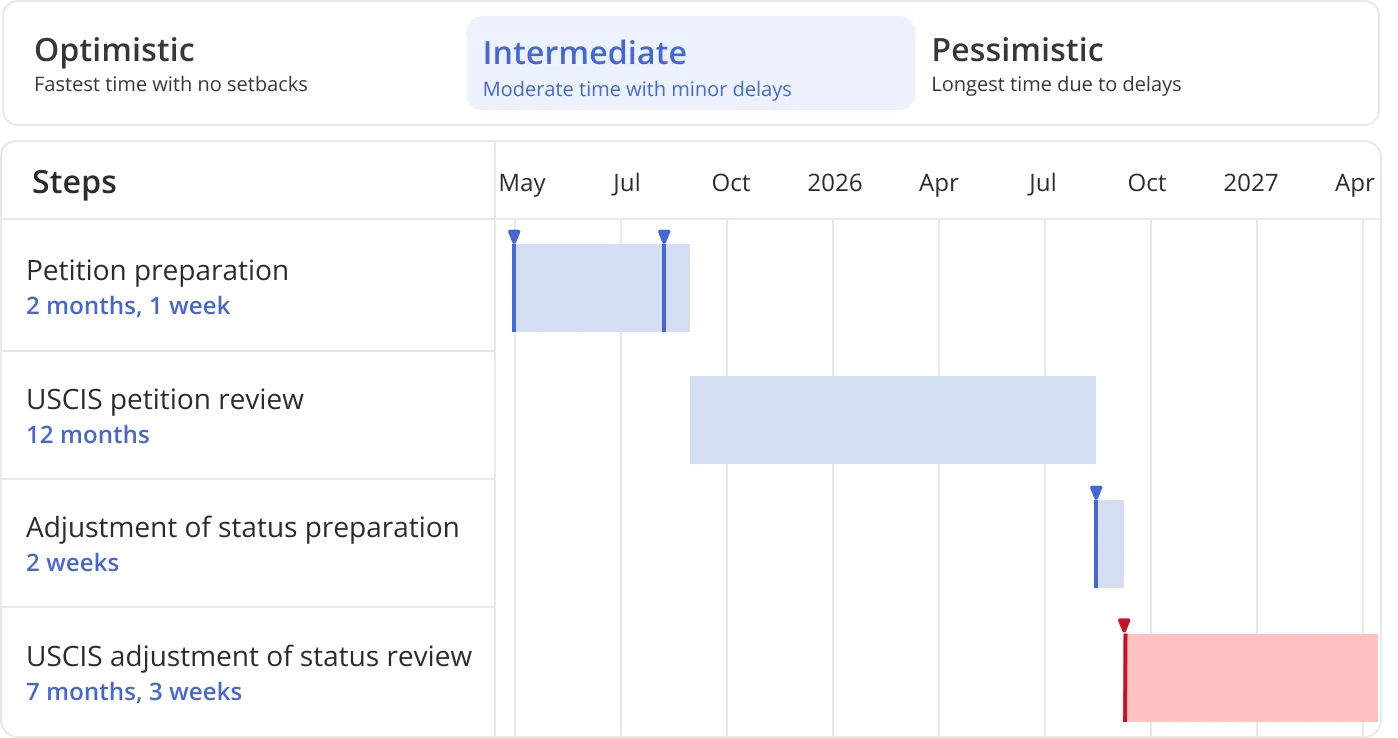
Because your exact figure depends on your profile, here is an illustrative example from our pricing tool rather than a single fixed price. It shows what an EB-2 NIW self-petition may look like for an applicant from Argentina. Treat it as a guide that can move with your case and with government fees, not a price set in stone.

Disclaimer: The timeline provided is an estimate and may vary depending on the specifics of your case and changes in government processing times, which have historically fluctuated month to month. Please use this timeline as a general guide rather than a definitive schedule. Additionally, some costs, such as fees for translating documents not in English or consultation letters from U.S. peer groups, are not included in this estimate.
Notice the RFE preparation line is $0: responding to a Request for Evidence is already included in the Tukki fee, not billed as an extra. Premium processing is optional and isn't part of this example figure, so you can add it in the tool if your timing calls for it. You can also generate a personalized estimate with the Tukki pricing tool.
Tukki is a U.S. immigration provider that helps researchers, founders, and skilled professionals with green cards like the EB-2 NIW and EB-1A, with dedicated attorney support and full case visibility from the first filing through your priority date. If you're weighing the cost of a national interest waiver against your timeline, a short call is the fastest way to get a clear number for your profile.
WE CAN HELP
Need more clarity?
Find quick answers to frequent visa questions from our legal experts
Does an EB-2 NIW RFE mean the petition will be denied?
No. An EB-2 NIW RFE is a request for more evidence on a prong USCIS is not yet satisfied on, and the case stays pending while you respond. It is not counted as a denial in the published data.
Can I get a green card without an employer?
Yes. Three employment-based green card categories let you self-petition with no employer and no PERM: EB-1A for extraordinary ability, EB-2 NIW under a National Interest Waiver, and EB-5 for investors. In each, you file your own Form I-140 (or the investor petition for EB-5) and make the case for yourself.
The rest of the employment-based categories, EB-2 and EB-3 through PERM, do require a sponsoring employer.
Can I file EB-1A and EB-2 NIW at the same time?
Yes. USCIS allows concurrent filings because each is a separate I-140 petition with its own receipt number and adjudication. The two filings cost you two sets of filing fees and attorney work, but they give USCIS two independent paths to approve your green card on the same underlying evidence.
Concurrent filing is most useful when you want maximum speed and your evidence portfolio plausibly supports both standards.
Do I need a PhD to apply for an EB-2 NIW?
No.
You may qualify with:
What is the fastest U.S. work visa to get?
For eligible candidates, the visas without a lottery or labor certification tend to move fastest. The O-1 and L-1A have no annual cap, so a qualified case can be filed at any time, and the TN can sometimes be obtained at the border for Canadian citizens within days.
Speed also depends on whether premium processing is used, which guarantees USCIS action within 15 business days for an added fee, so the right answer depends on the candidate's profile and how urgently you need them.
Other blogs for every step of your visa journey
Form I-290B after a denial: motion to reopen, motion to reconsider, or appeal
9 mins read | Oct 16, 2026
EB-2 NIW approval rate: what the published numbers show and where cases fail
8 mins read | Oct 15, 2026
Form I-539: how to extend or change your status without leaving the U.S.
8 mins read | Oct 14, 2026