Your immigration forms - what each one is for and what to check before you sign
9 mins read | Oct 13, 2026
EXTENSION RULES, THE SEVEN-YEAR LIMIT, AND WHAT I-140 MEANS FOR YOU
Contributor
Tukki
Reading time
8 mins read
Date published
Feb 19, 2026
If you're already in the United States on an L-1A visa, you surely know the clock is ticking. Under an L-1A visa, your initial period of stay is limited and, if interested in continuing to work legally, you'll need to file an L-1A visa extension at some point.
Actually, the extension process is not the problem, because is a very straightforward process. The bigger questions tend to come later: what happens when you approach the seven-year maximum period of stay? How does an I-140 petition (the immigrant visa petition your employer files for your green card) fit into your planning and what are your options if time starts running out?
Stressful thoughts, we know, but this guide walks you through the L-1A visa extension process from start to finish, clears up a critical misconception about I-140 approvals, and covers the strategies you should consider well before you approach the end of your L-1A timeline, so you feel a bit calmer.
An L-1A visa extension is filed using Form I-129, Petition for a Nonimmigrant Worker. Your employer submits this petition to USCIS (United States Citizenship and Immigration Services) on your behalf before your current immigration status expires. "Can I file the extension myself?" Nope. You can't file an L-1A extension on your own because the L-1A is an employer-sponsored intracompany transfer visa, meaning it needs a sponsor.
Each L-1A visa extension can be granted for up to two years at a time. For most L-1A holders, the initial petition was approved for three years (or one year if you were transferred to a new U.S. office). After that, you'll file extensions in two-year increments until you hit the seven-year maximum.
Timing matters. Your employer should file the extension at least four to six months before your current I-94 expiration date. If your extension petition is filed before your visa status expires and is still pending, you're generally authorized to continue working for up to 240 days while USCIS processes the request. But if your status lapses before you file, you could fall out of legal immigration status, and that creates problems that are difficult to fix.
If you need a faster decision, USCIS offers premium processing for L-1A petitions, including extensions.
Premium processing costs $2,965 (effective March 1, 2026) and guarantees that USCIS will take action on your petition within 15 calendar days. That action could be an approval, a denial, a Request for Evidence (RFE), or a notice of intent to deny.
Premium processing doesn't guarantee approval, but it does eliminate the uncertainty of waiting months for a decision. It's especially useful when your current nonimmigrant visa status is close to expiring and you can't afford to wait for regular processing time.
The L-1A has a hard cap of seven years of total time in the United States. This includes your initial period of stay and all extensions combined. Once you've used up seven years, you can't extend your L-1A status any further.
Here's where things get important: combined H/L time counts toward both caps.
Keep careful track of how much time you've spent in both categories, because it directly affects your options later.
Unlike the H-1B, the L-1A has no provision for recapturing time spent outside the United States. H-1B holders can add back days they were abroad during their six-year window, but L-1A holders cannot. Every calendar day within your L-1A validity period counts, whether you were physically in the U.S. or traveling internationally.
The table below summarizes the key rules for L-1A visa extensions and time limits.
| Rule | Details |
|---|---|
| Maximum total stay | 7 years (all H and L time combined) |
| Extension increments | Up to 2 years per extension |
| Filing form | Form I-129, filed by employer |
| Premium processing | $2,965; 15 calendar days (effective March 1, 2026) |
| Time recapture | Not available for L-1A (available for H-1B) |
| New office initial period | 1 year, extendable if business is viable |
| One-year abroad reset | Must reside outside the U.S. for 1 continuous year to restart the clock |
L-1A new office extensions works a bit different. If your L-1A was initially approved under the new office provision, you most certainly received a one-year approval instead of the standard three years.
When that year is up, your employer can file an extension for the remaining time and extend it to the full three-year initial period as long as the U.S. office is operational and viable. USCIS will check if the business is generating revenue, has employees and if it is actually functioning as a qualifying organization.
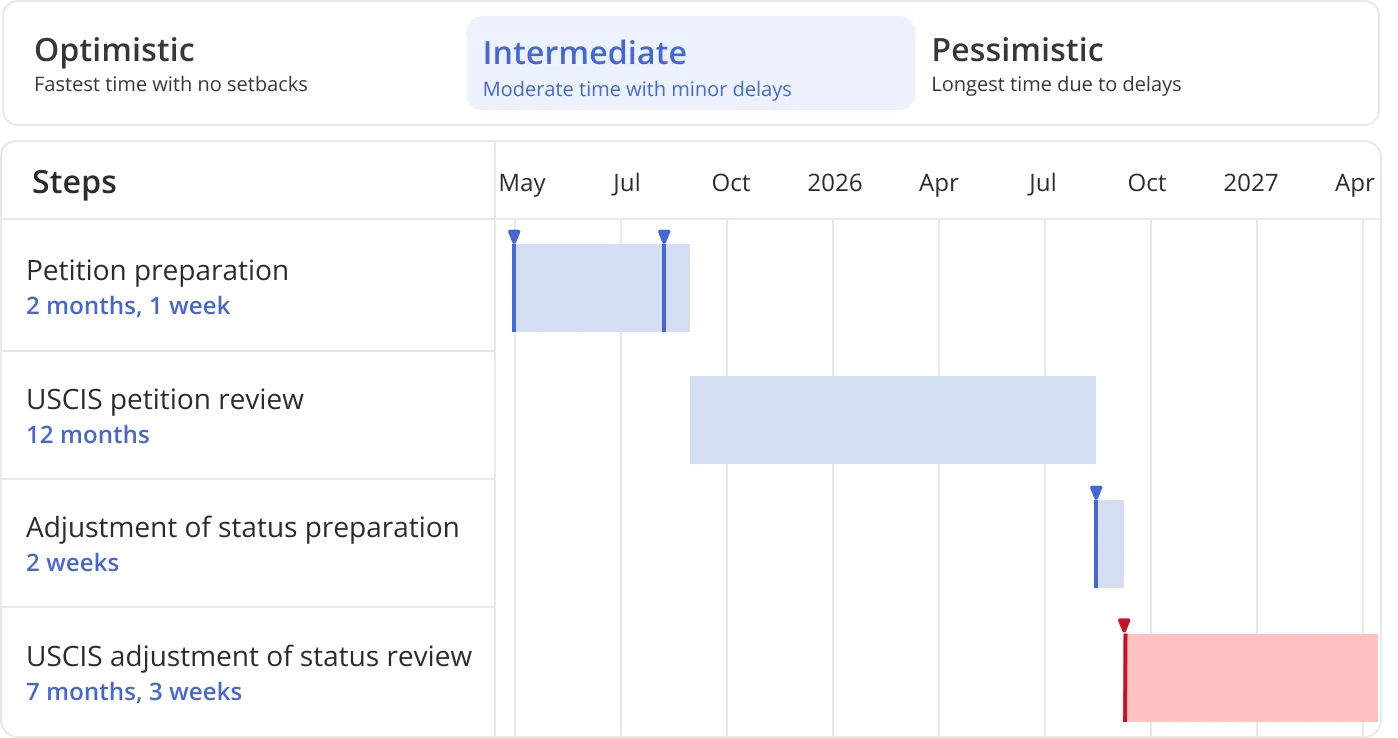
An approved I-140 does not extend your L-1A status beyond the seven-year maximum. This is a very common misconception when planning immigration because applicants tend to confuse the processes of the L-1A with the H-1B, and they are not the same.
For H-1B holders, an approved I-140 (the Form I-140 immigrant petition your employer files to begin the green card visa process) unlocks a powerful benefit under the American Competitiveness in the Twenty-First Century Act (AC21): the ability to get three-year extensions beyond the six-year H-1B cap while waiting for permanent residence. Many foreign nationals assume the same rule applies to the L-1A, but it doesn't. There is no equivalent provision that allows L-1A holders to extend past seven years based on an approved I-140.
I-140 primary value is enabling you to file Form I-485, which is the application for adjustment of status to permanent resident, once your priority date is current.
Your priority date is the date USCIS receives your I-140 petition, and it determines your place in line for a green card. If your priority date becomes current before your L-1A time runs out, you can file I-485 and remain in the United States while your green card application is processed.
The I-140 also provides a safety net for your priority date. After an I-140 has been approved for 180 days, your former employer cannot revoke it in a way that eliminates your priority date. Even if you leave that sponsor, you retain the priority date and can use it with a future green card petition. This protection is significant because it gives the beneficiary long-term flexibility even if the employment situation changes. The USCIS page on AC21 provisions outlines how these protections work.
You have one more option you can try if you've used the full seven years of L-1A time and haven't transitioned to another visa status or obtained a green card: you can reset the clock by residing and being physically present outside the United States for one continuous year. After that year abroad, you become eligible for a new L-1A petition as if you hadn't used any of your previous time.
It may sound easy but this option isn't ideal for everyone.
Spending a full year outside the U.S. means leaving your position, potentially relocating your family, and stepping away from the work you've been doing at the U.S. office. Some multinational companies accommodate this by assigning the employee to a qualifying foreign office during the year abroad, which also satisfies the L-1A requirement of working for the organization in a managerial or executive capacity overseas.
The one-year abroad reset is the last card for most people, but it's worth knowing it exists, especially if your green card processing hits unexpected delays.
The best approach to L-1A extensions is to plan backward from your seven-year limit. This means mapping out when each extension is due, when you'll file your I-140, and when your priority date is likely to become current based on the Visa Bulletin. If the math doesn't work out on the L-1A alone, identify your backup options early, whether that's filing I-485, switching to H-1B, or preparing for the one-year abroad reset.
Don't wait until the last year of your L-1A to start thinking about next steps. By that point, many of the best options may no longer be available to you. For personalized guidance on your L-1A visa extension strategy, explore our L-1A visa guide or check our pricing page to see how Tukki can help.
WE CAN HELP
Need more clarity?
Find quick answers to frequent visa questions from our legal experts
Are USCIS filing fees refundable if my petition is denied?
No. USCIS does not refund filing fees if your petition is denied, withdrawn, or revoked.
This means a denial can be especially costly since you will need to pay the full set of government fees again if you choose to refile.
The only exception is premium processing: if USCIS does not meet the 15 business day deadline, you can request a refund of the I-907 fee.
Is the L-1A always the better choice if the employee qualifies for both?
In most cases, yes.
The L-1A offers two extra years of maximum stay and access to the EB-1C green card pathway, which skips PERM labor certification.
However, the petition must accurately reflect the role.
Filing an L-1A for a role that does not meet the managerial or executive standard risks a denial and delays the transfer.
If the role is genuinely a specialized knowledge position, the L-1B is the correct and stronger filing.
How many employment-based work visa categories are there?
U.S. immigration groups employment-based green cards into five preference categories, EB-1 through EB-5, though most professional hiring runs through EB-1, EB-2, and EB-3. On the temporary side, the main employment-based visa types include the H-1B, L-1A, O-1, TN, and E-2.
So the practical answer is a handful of temporary categories plus three or four green card categories that cover the vast majority of cases.
What is “dual intent” and which visas allow it?
Dual intent means you can hold a temporary visa while also intending to apply for permanent residency (a green card).
The H-1B and L-1 visas are true dual intent visas. Most others, such as B-1/B-2, E-2, and F-1, do not permit dual intent, so pursuing a green card from those visas can create complications.
The O-1 is a special case: it is not a dual intent visa by law, but in practice, both USCIS and the Department of State usually treat it as if it were.
Do L-1A and H-1B time count against each other?
Yes. Time spent in H and L nonimmigrant visa status counts toward the maximum stay for both categories.
If you've used four years on an H-1B and switch to an L-1A, you'll have three years remaining on the L-1A's seven-year maximum, not a fresh seven years.
This combined-time rule makes early green card planning essential for any foreign national on either visa.
Other blogs for every step of your visa journey
Your immigration forms - what each one is for and what to check before you sign
9 mins read | Oct 13, 2026
How to write an RFE response letter and organize the evidence behind it
9 mins read | Oct 12, 2026
Laying off a sponsored employee on H-1B: what the company owes and what the employee has left
8 mins read | Oct 9, 2026