The EB-5 visa is an employment-based, fifth-preference immigrant visa that lets foreign investors and their families obtain a U.S. green card by investing in a new commercial enterprise that creates jobs for U.S. workers. Administered by USCIS as the EB-5 Immigrant Investor Program, it is one of the few routes to permanent residency that does not require an employer to sponsor you, a family relationship, or extraordinary professional achievement. Instead, you qualify through capital and job creation.
Unlike the E-2 treaty investor visa, which is a temporary, renewable status tied to a treaty country, the EB-5 is an immigrant path: it leads directly to a green card and, in time, eligibility for citizenship. It is open to nationals of any country, and the investor's spouse and unmarried children under 21 can be included in the same case.
The program was substantially reshaped by the EB-5 Reform and Integrity Act of 2022, which raised the minimum investment amounts, created reserved visa categories for rural and high-unemployment projects, and added new integrity and oversight requirements. This guide breaks down every EB-5 requirement, the investment and job-creation tests, the difference between direct and regional center investment, costs, processing times, and the full path from a conditional green card to permanent residency.
Who is eligible for the EB-5 visa?
EB-5 eligibility comes down to your capital, the enterprise you invest in, and the jobs it creates. To qualify, you must:
Invest the required amount of lawful capital in a commercial enterprise in the United States. The current minimums are $800,000 for a project in a targeted employment and rural area and $1,050,000 elsewhere.
Show that the capital is genuinely at risk for the purpose of generating a return. Your funds must be committed to the enterprise, not simply parked or guaranteed.
Prove the lawful source of your funds. You must document, with a clear paper trail, that the money came from a legal source such as earnings, business income, a sale of property, a gift, or an inheritance.
Create or preserve at least 10 full-time jobs for qualifying U.S. workers within the required period.
There is no nationality restriction, no minimum education or language requirement, and no need for a sponsoring employer. This makes the EB-5 one of the most flexible green card categories on eligibility, with the trade-off being the size of the capital commitment.
Why choose the EB-5 visa?
The EB-5 is the direct green card route for investors who can meet the capital and job-creation requirements. Here is what works in your favor and what to plan around.
Advantages:
A direct path to a green card, with no employer sponsor or labor certification required
Open to nationals of any country, unlike the treaty-based E-2 visa
Through a USCIS-designated regional center, the EB-5 can be a fully passive investment, so you do not have to manage the business day to day. This is another key difference from the E-2, which requires you to actively direct and develop your enterprise
Reserved categories move faster and stay open. Rural projects qualify for expedited processing, and, unlike the standard category, the reserved rural, high-unemployment, and infrastructure visa set-asides have generally stayed current for nationals of every country, including India and China
Your spouse and unmarried children under 21 are included in the same petition
Green card holders can live, work, study, or retire anywhere in the United States, not only where the investment is located
No minimum education, work experience, or language requirement
Limitations:
A large capital commitment ($800,000 or $1,050,000) that must be placed genuinely at risk
Long processing times in the standard, unreserved category, including green card backlogs for investors born in high-demand countries such as India and China. The reserved categories are the exception and have generally stayed current, even for those countries
Job creation is a condition of the green card: if the enterprise fails to create the required jobs, permanent residency can be denied
Two-stage process, with a conditional green card first and a later petition to remove conditions
EB-5 investment requirements
The heart of the EB-5 is the investment. Four requirements define whether your capital qualifies.
Minimum investment amount
Under the EB-5 Reform and Integrity Act of 2022, the minimum investment amounts for petitions filed on or after March 15, 2022 are:
$800,000 if you invest in a project located in a targeted employment area (TEA) or in a qualifying infrastructure project
$1,050,000 for a standard investment outside a targeted employment area
These amounts are set to be adjusted for inflation every five years, with the first adjustment scheduled for January 1, 2027. Investors planning a case around the current figures should confirm the amounts in effect at the time they file.
Targeted employment area (TEA)
A targeted employment area is what lets you invest at the lower $800,000 threshold. A TEA is either:
A rural area: any area outside a metropolitan statistical area and outside the outer boundary of a city or town with a population of 20,000 or more, or
A high-unemployment area: an area where the unemployment rate is at least 150% of the national average
Rural and high-unemployment projects also benefit from reserved visas, which we cover in the priority-date section below.
Job creation
Your investment must create at least 10 full-time jobs for qualifying U.S. workers. In a standard direct investment, these are typically employees of the new commercial enterprise itself. In a regional center investment, the count can also include qualifying indirect and induced jobs supported by the project, which is one of the reasons regional centers are popular.
At-risk capital and lawful source of funds
The capital must be genuinely at risk, meaning it is committed to the enterprise with no guaranteed return. You also carry the burden of documenting a lawful source of funds: a complete, traceable paper trail showing that the money came from legitimate origins. This source-of-funds documentation is one of the most demanding parts of an EB-5 case and a common reason for requests for evidence.
Direct investment vs. regional center
Most EB-5 investors choose between two routes, and the choice shapes the entire case.
Direct investment
You invest in and actively manage your own new commercial enterprise, and you must create the 10 required jobs as direct W-2 employees of that business. This route gives you the most control but places the day-to-day operational and job-creation risk squarely on you. You file Form I-526, the Immigrant Petition by Standalone Investor.
Regional center investment
You invest through a USCIS-designated regional center, a third-party entity approved to sponsor pooled EB-5 projects. This route lets you count indirect and induced jobs toward the requirement, and it does not require you to run the business yourself, which is why the majority of investors use it. You file Form I-526E, the Immigrant Petition by Regional Center Investor. Regional center investments carry their own risks tied to the project sponsor, so due diligence on the specific project matters.
How much does the EB-5 visa cost?
EB-5 costs fall into two very different buckets: the investment itself, which is by far the largest amount, and the government filing fees, which are comparatively small. The table below covers the USCIS filing fees an individual investor pays across the case.
Fee
Amount
Qualifying investment (TEA or infrastructure project)
$800,000
Qualifying investment (standard, outside a TEA)
$1,050,000
Form I-526 (direct / standalone investor petition)
$3,675
Form I-526E (regional center investor petition)
$3,675 + $1,000 EB-5 Integrity Fund fee
Form I-829 (petition to remove conditions)
$3,750
On top of the investment and filing fees, investors typically pay a regional center administration fee (often in the range of tens of thousands of dollars, set by the individual project), plus immigration attorney fees and, where applicable, the costs of consular processing or adjustment of status.
How to apply for the EB-5 visa
The EB-5 is a multi-stage process that spans from your first petition to a permanent, unconditional green card.
1. Choose your route and project
Decide between a direct investment in your own enterprise and a regional center project, and complete due diligence on the specific investment and its job-creation model.
2. Invest or irrevocably commit the capital
Place the required amount into the new commercial enterprise so that it is genuinely at risk, and assemble your lawful source-of-funds documentation.
3. File the immigrant petition
File Form I-526 for a direct investment, or Form I-526E for a regional center investment, with USCIS.
4. Apply for your green card (concurrent filing possible)
If a visa number is available in your category, which is often the case in the reserved rural, high-unemployment, and infrastructure categories, you can apply for your green card without waiting for the petition to be approved. Investors already in the U.S. can file Form I-485 to adjust status concurrently with the I-526 or I-526E petition. Filing concurrently also lets you request a work permit (EAD) and advance parole (travel authorization), so you can work and travel using those benefits while your case is pending. Investors abroad go through consular processing with the Department of State once a visa is available. For the difference between the two routes, see our guide on consular processing vs adjustment of status.
5. Receive a two-year conditional green card
You and your included family members become conditional permanent residents for a two-year period, during which the enterprise must create and sustain the required jobs.
6. Remove the conditions
In the 90-day window before your conditional green card's second anniversary, file Form I-829, the Petition by Investor to Remove Conditions. Once approved, you receive a permanent, 10-year green card.
EB-5 processing time and timeline
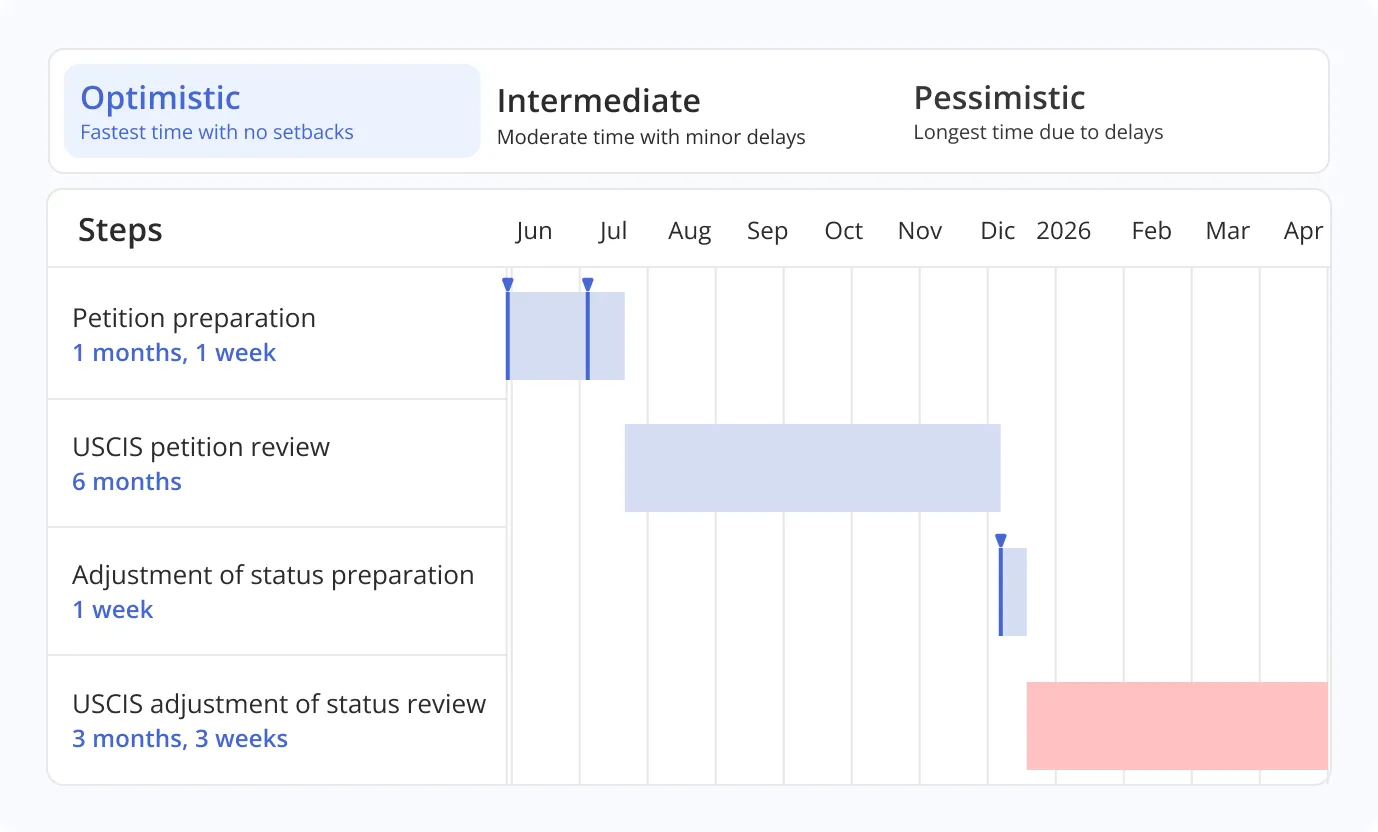
EB-5 processing times vary widely by the category you invest in, and that difference is the most important thing to understand here: a rural, reserved-category project moves far faster than the standard unreserved category. Reading the range as a single number is misleading, so the table below breaks it out by category. These figures reflect USCIS reporting as of mid-2026 and change frequently, so confirm current times on the USCIS processing times tool for your specific form.
Petition
Category
Approximate processing time
I-526E (regional center)
Rural (reserved)
as fast as ~12 months
I-526E (regional center)
High-unemployment (reserved)
~17 to 52 months
I-526 / I-526E
Unreserved (non-TEA)
~30 to 61 months
The takeaway is that category choice drives your timeline. Rural projects benefit from expedited processing and currently clear at the fast end of the range, around a year, which is one of the main reasons investors from backlogged countries choose them. The longest waits fall on the standard, unreserved category. On top of USCIS processing, investors in the unreserved category who are born in backlogged countries may wait additional years for a visa number to become available, which we cover next.
EB-5 priority dates and the India and China backlog
Because the EB-5 is a numerically limited immigrant category, your priority date and country of birth determine when a visa is actually available to you. Investors born in high-demand countries, particularly India and China, can face multi-year waits beyond normal processing, tracked each month in the Department of State Visa Bulletin.
The EB-5 Reform and Integrity Act created reserved visa categories that can significantly shorten the wait for certain projects. Each year, a share of EB-5 visas is set aside for these categories:
20% for investors in rural areas
10% for investors in high-unemployment areas
2% for investors in infrastructure projects
Because these reserved visas are less oversubscribed than the general (unreserved) category, investing in a qualifying rural or high-unemployment project can be a meaningfully faster route for applicants from backlogged countries.
EB-5 vs. E-2: which investor route fits you?
The EB-5 and the E-2 are the two main investor routes to the U.S., and they serve different goals. The E-2 is a nonimmigrant, treaty-based visa: it requires a smaller, flexible investment, is available only to nationals of treaty countries, and can be renewed indefinitely, but it does not lead directly to a green card. The EB-5 requires a much larger investment and is open to any nationality, and its defining advantage is that it is an immigrant path that leads straight to permanent residency. Many entrepreneurs start on an E-2 to build a business, then move to the EB-5 once they can meet the higher investment and job-creation thresholds.
Does the EB-5 visa lead to citizenship?
Yes. The EB-5 is an immigrant category, so it leads to a green card and, in time, eligibility for naturalization. The path runs from a two-year conditional green card, to a permanent green card once you file Form I-829 and remove the conditions, to eligibility to apply for U.S. citizenship after meeting the standard permanent-residence and physical-presence requirements.
For investors weighing other permanent options, the EB-1A and EB-2 National Interest Waiver are green card categories based on achievement rather than capital.
Tukki is a U.S. immigration services provider that helps investors build and file EB-5 cases, document their source of funds, and plan the full path from petition to a permanent green card, with dedicated immigration attorney support and full case visibility from preparation through approval.
Final thoughts
The EB-5 is one of the most direct routes to a U.S. green card for investors who can meet its capital and job-creation requirements. Its strengths are real: no employer, no nationality limit, and a straight line to permanent residency for the whole family. The trade-offs are equally real. The capital is substantial and must be placed genuinely at risk, the source-of-funds documentation is demanding, and processing times and country backlogs can stretch the timeline for years depending on the area of investment. With careful project due diligence, thorough source-of-funds preparation, and a clear view of your priority date, the EB-5 can be a reliable path to permanent residency in the United States.